


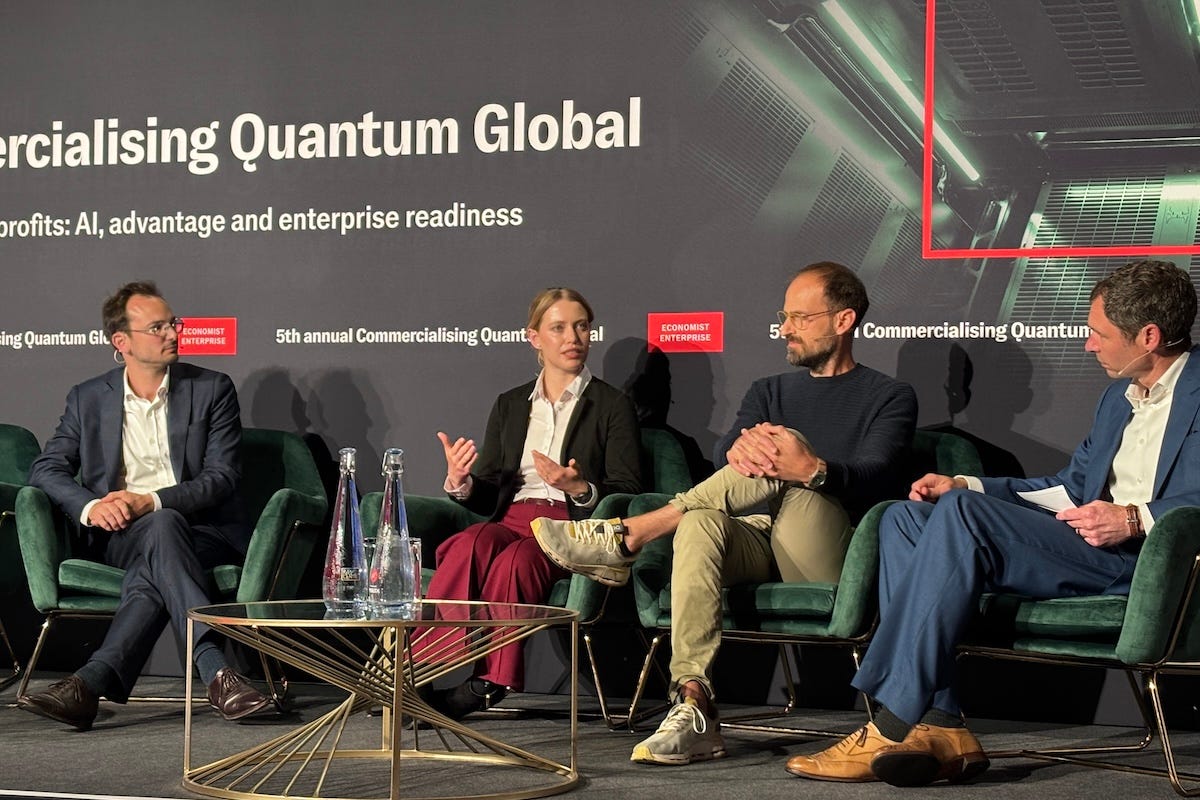
Quantum computing has spent a decade chasing bigger qubit counts. A recent panel of hardware specialists suggested the industry may already be past that.
Three specialists were asked to name the single metric that matters most. All three circled back to the same idea.
“I think it’s the fidelity of the gate between two qubits,” said Pierre Desjardins, co-founder and chief executive of C12. “This is really what you measure, and it integrates a lot of things that need to be right if we want to scale quantum computers.”
Guillermo Albareda, co-chief technology officer of IDEADED, agreed with him.
“Fidelity is definitely something you need to care about,” he said. “It’s not only about average fidelity, but it’s also about worst-case fidelity, because worst-case fidelity tells you about the bad qubits that are going to spoil the entire circuitry.”
“How many physical qubits you’re going to need to get one logical qubit depends a lot on your connectivity,” he said. “Targeting all-to-all connectivity is an important task.”
“Velocity of the operations, how fast you can implement the two-qubit gate or single-qubit gate, is very important,” he said. “Decoherence basically spoils your information very, very quickly.”
Ellen Devereux, quantum computing chief technology officer advisor at Fujitsu, named a different metric.
“I’m interested in the logical qubit number,” she said. “It’s a bit of a cop-out of an answer because it takes into account the fidelity, the error rate and the connectivity of the qubits, as well as their speed.”
Her preferred figure still comes down to fidelity, combined with the other factors Albareda listed.
All three were describing the same underlying quantity, fidelity, whether reported on its own or folded into one composite number.
New yardsticks for scale
The exchange took place at the Commercialising Quantum Global 2026, an event organized by Economist Enterprise in London. The panel on hardware metrics was moderated by Jason Palmer, host of The Economist’s “The Intelligence” podcast.
C12 is a French startup building qubits from carbon nanotubes designed to work without sitting physically close together. Fujitsu’s quantum computing work combines superconducting and diamond spin qubit research. IDEADED, based in Barcelona, focuses on quantum control techniques that speed up qubit operations.
“We are the first hardware provider to publish the watts per physical qubit, how many watts you will use for the whole system, including the cryogenics needed to run the computation,” Desjardins said.
“The second metric is how many qubits you can pack per square meter, which is a very good proxy for the size of your quantum system,” he said.
He said Panopeia would need about 17 square meters, roughly the size of a few server racks.
“I encourage other quantum providers to share these kinds of metrics in their roadmaps,” he said. “The number of qubits, the number of logical qubits and the logical error rates are important, but these two metrics really show whether a technology will be deployable and commercially viable.”
“The megaquop, gigaquop measurement is starting to get thrown around, but we haven’t clearly defined what a quop is,” Devereux said.
She said a “quop” is shorthand for a single quantum operation performed within one coherence cycle.
“It’s made it into the United Kingdom’s quantum road map, but it’s not clear to me whether that includes error correction or just logical operations,” she said.
Fujitsu’s roadmap links many separate machines together.
“It’s a key part of our roadmap,” she said. “Our current machine is 256 qubits, and the next machine will be four of those chandeliers in one fridge, and the machine after that will be 10 of those fridges connected together with photonic links.”
She said Fujitsu is pursuing both superconducting and diamond spin qubit research in parallel.
“I think it’s relatively well understood that we will need new ways of connecting things together to get from physical qubits to logical qubits to useful quantum computing,” she said.
C12 takes the opposite approach, packing more into a single cryostat first.
“Before scaling out by replicating quantum processing units, we need to spend a lot of effort first on scaling in, on miniaturization,” Desjardins said.
He said C12’s roadmap adds qubits while staying inside the same cryostat, avoiding a new cryogenic unit each time.
Both companies agreed on one thing. Connecting hardware efficiently, not raw qubit counts, would decide who reaches useful quantum computing first.
The 10,000 qubit question
“There are very few algorithms that demonstrate a real advantage over classical computing,” Albareda said. “There are four main algorithms that we know of, and all the rest are basically ramifications of those four.”
He said real advantage comes down to controlling physical qubits, and ultimately how many logical qubits a system can encode.
“From the latest literature, we know it’s at least 10,000 logical qubits, and a few hundred thousand operations in terms of gate depth, not circuit depth,” he said. “We still need better fidelity, better physical qubits. That’s the conclusion.”
“The latest Shor’s algorithm is in the range of 2,000 to 5,000 logical qubits, so it’s a little below that benchmark of 10,000, but it’s of a similar order of magnitude,” Devereux said.
“If we manage to have a fault-tolerant computer, the size at this stage is not going to be relevant,” Albareda said. “I think it’s more relevant the energy it consumes. We can fight the hunger of artificial intelligence (AI).”
He said a quantum computer will likely stay roughly 90% classical hardware plus a quantum accelerator.
“It’s obviously a concern, especially when we’re hearing about AI data centers using huge amounts of energy, but it’s not a comparable metric,” Devereux said. “They’re not working on the same scales as AI data centers.”
“If we think about the things we’re expecting quantum computers to do, building new carbon capture materials, improving battery technology for electric vehicles, the net positive outcome of that computation is far exceeding the amount of energy going into it,” she said.
The panel’s sharpest disagreement was over a related figure, the ratio of physical to logical qubits, and what it actually signals about quality.
“Our roadmap includes 40 physical qubits to one logical qubit as a ratio,” Devereux said.
“That still requires a high level of qubit fidelity as a benchmark. If you don’t have that level of fidelity, error correction doesn’t work,” she said.
"It's actually a ratio you can play around with a lot," Desjardins said. "What's important is to ask what this ratio is for the megaquop or gigaquop regime."
He said C12’s own roadmap for Panopeia is working with a ratio close to 100 physical qubits per logical qubit, efficient only because the system is designed to deliver millions of error-free operations.
“We started out with a metric of quantum volume, and that metric has kind of disappeared already, because we recognized as an industry that it wasn’t a good metric for the commercial or technical audience,” Devereux said.
“Finding standards too early might be counterproductive,” Albareda said. “We need to keep calm and allow new paradigms and platforms to arise that aren’t tied to the standards we might define today.”
The panel never settled on one answer. All three agreed the metrics chosen now will shape what gets built next.