


Turning quantum computing into an everyday business tool will hinge less on faster chips than on whether employees trust the people building the systems around them.
That trust has to be earned deep inside a company’s value chain, quantum experts said.
“As a method developer, it doesn’t really matter whether your new shiny method is quantum or classical,” said Christian Gogolin, head of high performance and quantum computing at Covestro. “You need to first convince the practitioners that your method is superior to the methods that have been there previously.”
He said the persuasion chain runs from computational scientists to lab chemists to the application team and finally sales.
“You need to build this culture of trust and of relationships,” he said. “Otherwise you will not be able to profit from any innovations coming in at the bottom of this value chain.”
He said trust takes years to build, because people need to personally experience the advantages of a new way of working before they believe in it, and that organizations building this readiness now, using other technologies as practice, will barely need to change anything once quantum computing matures enough to be useful.
“Ideally, when quantum day (Q-Day) arrives, there shouldn’t be any need for any change in your organization anymore,” Gogolin said. “You should have processes and tooling ready into which you can just plug quantum computing in.”
The stakes of waiting are high.
“The risk we’re trying to mitigate by participating in the technology development of quantum computing is the risk of being left behind and potentially overtaken by the hyperscalers,” Gogolin said. “That would be catastrophic for the industry if we were to be degraded to a pure workbench while someone else does the innovation.”
Other panelists framed the same challenge differently.
Miryem Salah, former director of digital, data and transformation at VodafoneThree, said the same discipline applies to any technology decision, not just quantum. She said organizations need to clarify their strategy and team structure first, before asking whether the right tool is pen and paper or quantum computing.
“Most organizations are set up in a way where technology is split from other areas,” Salah said. “They need to work very hard bringing people on the journey. It shouldn't be an us-and-them [mentality] between technology and everybody else."
That divide, panelists agreed, slows quantum adoption more than the hardware’s immaturity.
Proving value first
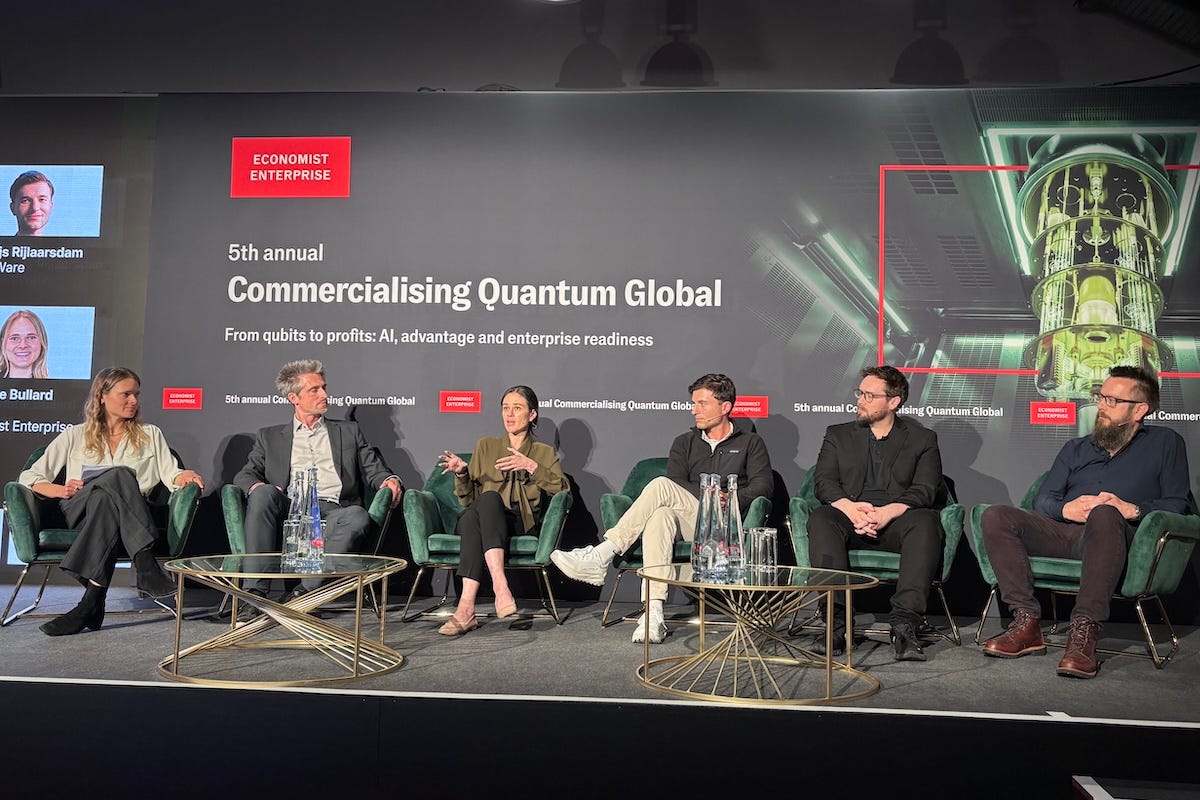
The panel, titled “From Pilots to Platforms,” examined what changes for organizations once they reach quantum advantage. It was held in London at Commercialising Quantum Global 2026, organized by Economist Enterprise and moderated by Charlotte Bullard Davies, senior manager for primary research at Economist Enterprise.
Panelists said winning budget for quantum projects starts with proving the business case rather than the science.
“This is definitely the key priority. You need buy-in on all levels of the stack, from executives to management to the engineers and scientists actually doing the work,” said Corey O’Meara, chief quantum scientist at E.ON.
O’Meara said E.ON ties every use case to a clear business potential.
“We’re all scientists, but we’re trying to drive business value,” O’Meara said. “The end results were patents, federal grants and EU grants, to show that in the competitive landscape of Europe we’re really towards the cutting edge.”
He said quantum computers today are still research machines, so the focus now is algorithm development.
“From a C-suite perspective, fear-of-missing-out (FOMO) is a great catalyst for getting moving,” said Dave Starling, head of future products and technology at NatWest Group. “Even if that doesn’t run the whole conversation, it’s a good catalyst to start it.”
That urgency meets a harder problem at NatWest.
“If quantum advantage hit tomorrow, would any organization be ready? I don’t think so,” Starling said. “They would lack a lot of the structures that traditionally sit in a large enterprise to support AI rollouts.”
He said the questions run deeper than compliance forms.
“What does data mean when it comes to quantum? What is security? Is there such a thing as quantum PII (personally identifiable information)? I don’t think we’ve got those answers yet,” he said.
NatWest applies a framework called model risk to evaluate whether any algorithm, quantum or otherwise, is deterministic, explainable and secure.
Starling said that process became a bottleneck after the arrival of ChatGPT sent a wave of AI projects through the bank’s review pipeline, and he expects quantum to create similar strain.
Because NatWest has no quantum hardware of its own, every job runs on cloud infrastructure.
“We’re sending a transpiled Qiskit circuit with quantum rotations and spins, but that’s really hard to relate to a security team,” he said.
“In order to productionize a quantum system, we have to adapt the existing security and model risk processes we have to the quantum platform,” he said. “It’s not easy, because you’re speaking in terms that people just don’t naturally understand, but that’s going to be a big challenge for us over the next few years.”
The coming compute scramble
As the economics of quantum computing shift, panelists said the real return on investment (ROI) will not be measured in scientific papers.
“Today we don’t have quantum computers big enough to generate real ROI, so the ROI is things like subsidies and patents right now,” said Matthijs Rijlaarsdam, co-founder and chief executive of QuantWare. “Once we get to useful systems, convincing management will be about economics, like how much compute I get for my dollar.”
He said the top metric will be compute-per-dollar, whether on GPUs, QPUs (quantum processing units) or CPUs, followed by the reliability of a company’s compute supply chain, which will become a deeply strategic asset.
“Classical compute and AI improved gradually, from small CPUs to bigger chips, GPUs and clusters,” he said. “Quantum is much more a singular moment. At some point these systems will be big enough to outperform classical computers exponentially, and they will have to provide more compute per watt than GPUs.”
Even before the economics are settled, panelists said the more basic problem is knowing which problems quantum computing should solve.
“Use cases are probably the biggest block right now,” Starling said. “We don’t have an audit of every algorithm the way we do classically, so we don’t know where we’re compute bound or where there are problems we’ve decided not to solve because they’re intractable.”
“There’s so much happening that we just don’t know what to do, so we push down whatever we don’t see as a risk or an issue straight away,” Salah said.
O’Meara said the search for use cases has shifted from a centralized team to business units emailing ideas directly, a sign that internal training and media coverage have raised awareness of quantum computing across E.ON’s subsidiaries throughout Europe over the past year.
“I can count the algorithms on my hands,” he said. “There’s only so many, so it becomes an education topic.”
Rijlaarsdam said hardware production faces a supply crunch of its own too, similar to the chip and transformer shortages already slowing down AI rollouts.
“The amount of fabs and industrial production capacity we will need will not be able to meet demand,” he said. “If you think that moment will be here in three to five years and you’re not building production capacity now. You’re going to be too late.”
Panelists said the organizations that move first will be the ones that treat quantum readiness, from governance to budget cases to supply relationships, as a priority now rather than something to revisit once quantum advantage arrives.