


Quantum computing is starting to reshape aircraft design, not in theory but in early trials already delivering measurably better results.
The clearest gains so far sit in engineering simulation, where new algorithms are already producing answers that classical software cannot match, alongside early work on lighter materials, secure communications and precision navigation, areas engineers say are moving from theory into practice.
“A good example is aerodynamic modeling,” said Jasper Krauser, head of quantum technologies at Airbus. “If you want to design an aircraft, you rely on this capability. We are limited today by the computational power we have. Quantum computing can, in the future, make a difference, so you can design an aircraft that is potentially more fuel efficient and flies in a smarter way.”
“It took five times as long to run and needed five times as much memory, but it gave better answers,” said Leigh Lapworth, a fellow in computational science at Rolls-Royce. “Through most of my career, that’s what has mattered. Not necessarily faster, but better.”
Lapworth, who has spent nearly 40 years working in supercomputing at Rolls-Royce, said the code behind that result is nearly two decades in the making, only now reaching the end of what he calls phase one.
He said the work has been built and tested entirely in emulation, because no suitable quantum hardware existed to run it on. His team has published close to ten papers or preprints and maintains an open GitHub repository of test cases.
The group is now moving toward early trials on real hardware, though he said those machines remain too small to handle full computational fluid dynamics work.
Krauser said quantum’s usefulness at Airbus goes beyond raw computing power.
“We have use cases in quantum communication, for example secure communication infrastructure,” he said. “Quantum sensing is also an important topic for us, in terms of future improvements in navigation.”
He said the company is also pursuing early work on lighter, more resilient materials capable of withstanding harsh flight conditions.
“Quantum computers are particularly strong at simulation on a microscopic scale,” he said. “In future we can use a quantum computer to develop new types of materials, lighter materials, more resilient materials, because an aircraft needs to be ready to fly in very harsh environments.”
Lapworth said the underlying mathematics makes this possible. He said quantum mechanics is matrix mechanics, so any engineer who can do linear algebra can, in principle, write quantum algorithms.
Airbus is trying to widen that pool of use cases. Krauser said the company is running a joint quantum computing challenge with Volkswagen, HSBC, E.ON and Cleveland Clinic, inviting the wider community to propose applications, and is now waiting for submissions to come in.
Hybrid now proof pending
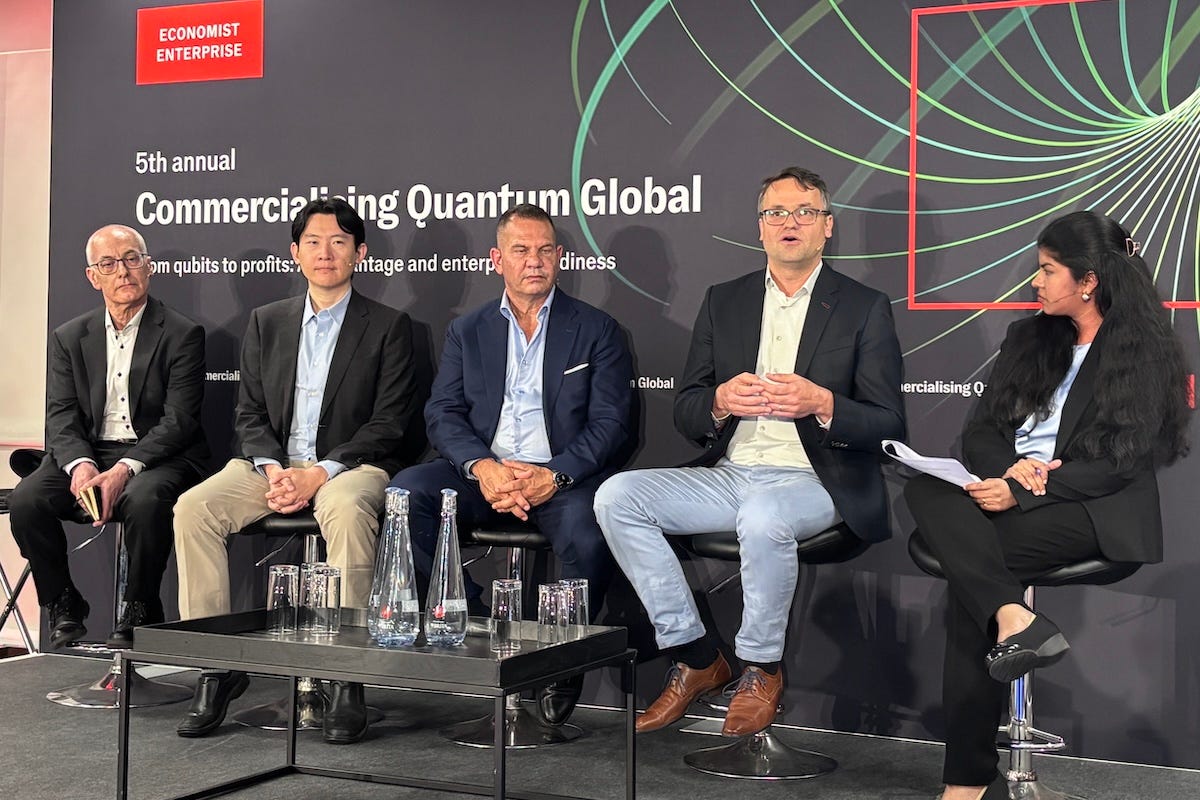
The comments came during a panel titled “What users are learning about use cases and platforms” at Commercialising Quantum Global 2026, organized by Economist Enterprise in London.
The session was moderated by Laveena Iyer, senior analyst for telecoms and technology at the Economist Intelligence Unit, who said that after three years moderating similar panels, conversations have shifted away from vague medium- to long-term timelines toward concrete, near-term deployment plans.
It examined how banks, logistics firms and pharmaceutical companies are testing quantum platforms differently.
Regev Yativ, chief revenue officer at Classiq, said finance and pharmaceutical clients are testing hybrid use cases, benchmarking them directly against classical methods to see where the impact is greatest. He said clients also want to know how the simulation work they are doing today will shape the business decisions they make in the future.
“Leading brands are implementing either a hybrid of classical and quantum, or using quantum as part of the tool set alongside AI and other technologies to create impact,” Yativ said.
Yudong Cao, co-founder and chief technology officer of Zapata Quantum, who has worked in quantum computing for 15 years, said the approaches vary widely. He said near-term heuristic algorithms already outperform classical methods in narrow cases, while fault-tolerant applications require far larger machines and quantum-inspired algorithms run on ordinary GPUs.
“Across the board, especially in finance, we’ve observed concrete cases where you can accelerate workflows with quantum-inspired, near-term quantum and fault-tolerant algorithms,” Cao said.
He said banks are often unwilling to reveal their own quantum work.
“A bank would hesitate to disclose its fraud detection or trading methods,” he said. “What we’re seeing behind closed doors is very different from what’s being published, and that’s worth paying attention to.”
The Rolls-Royce fellow said the bigger challenge is proving quantum systems are as reliable as the classical tools they replace.
“With classical code, you can run the same data hundreds of times and get the same answer,” he said. “With quantum, there’s no separation of data and compute. Every algorithm loads its own data, so different data means a different algorithm.”
Rolls-Royce’s own classical code has run unmodified in production for two years, executing roughly a million calculations a year.
“There are real difficulties in validation, verification and engineering processes,” he said. “We can only start those once we have the codes to run and test.”
Krauser said the same logic applies across the industry. Performance alone matters less than integration into the wider computing pipeline.
“When we talk about benchmarking, it’s not the quantum device itself; it’s always integrated. It’s the end-to-end performance that matters,” he said. “You might have a great advantage on the quantum part of an algorithm, but that gets lost if the hybridization isn’t done well.”
Racing to be ready
Away from the lab, panelists said the same urgency applies to strategy as it does to engineering.
“Quantum is not really a question of if. It’s a question of when,” Krauser said. “If you want to be prepared, it’s a great time to start right now, and there’s a great ecosystem there to help you get started.”
Yativ said the same logic applies to enterprise buyers weighing when to invest in a strategy.
“Hardware readiness could come tomorrow, next year or in two years,” he said. “We don’t know, but it could be tomorrow. If you’re not ready with the strategy, you don’t have the right use cases, the team or the organization. It’s late.”
Lapworth said the same discipline applies to collaboration. He said his four-person Rolls-Royce team has only reached its current position by working with outside partners, funded in part through the UK’s commercializing quantum program.
“There’s plenty of government money to collaborate,” he said. “Go forth and collaborate.”
Yativ said readiness also means confronting where data and code will live. He said the question comes up constantly as Classiq works with clients across different regulatory regimes and geographies, each with its own expectations about control and protection of intellectual property.
“Classiq works globally, and we hear about sovereignty every day,” he said. “People want their data safeguarded somewhere specific, and we have to take that into account, so we’re investing heavily in this.”
Cao said the same tension over control extends to intellectual property. He said the quantum community tends to focus on IP tied to the computational layer, while industry partners care more about domain-specific applications, and dividing IP along that line usually works for both sides.
“IP is a topic that can make or break successful partnerships,” he said. “The quantum community tends to care about IP that’s foundational on the computational layer, while industry domain experts are more concerned about specific vertical capabilities.”
Cao said fields like cryptography should stay within national boundaries, since the right approach depends on the application. He said the quantum community’s own conferences focus heavily on hardware and algorithms, adding that more industry voices are needed to define which problems actually matter and how to reformulate them for quantum systems.
Airbus and Rolls-Royce say the next test is turning today’s narrow gains into standard practice. Both expect quantum hardware to reach usable maturity within the next few years, leaving little time for competitors still deciding whether to start.