


The quantum computers being built today still make roughly one error in every 1,000 operations. A computer trusted the way today’s ordinary machines are would need an error rate closer to one in a trillion trillion.
That gap is why executives want one checkable metric, real operations completed before failure, not loose terms like “logical qubits.”
“The metric I prefer can be immediately related to fault tolerance: the number of operations you’re running,” said David Rivas, chief technology officer of Rigetti.
He said that four years ago, people used the term to mean matching a classical computer’s reliability, an error rate of about one in a trillion trillion.
“The numbers we’re talking about now are more like one in 1,000, and that’s not a fault-tolerant computer,” he said.
He added that the term “logical qubits” has become loosely used over the past 18 months, following Google’s “Willow” error-correction paper, which drew a wave of investment into the sector and, he said, more noise than signal.
“Hype matters, and it’s on every vendor to make sure we don’t fall foul of it,” said Richard Murray, co-founder and chief executive of ORCA Computing. “If the public are skeptical, our customers are even more skeptical. We need to convince people with applications and benchmarking.”
Murray cited ORCA’s 25,000-variable optimization as evidence, and called the wider industry largely hype free.
Gillian Bussey, deputy chief science officer of the US Space Force, said senior leaders often overestimate quantum’s current abilities.
“I was in a war game once where a general said, ‘I just want quantum.’ We had to have a long conversation about what for, and the cost benefit,” Bussey said.
Yong Meng Sua, chief technology officer of Quantum Computing Inc (QCI), said benchmarking must translate into figures customers can act on.
“Benchmarking is ultimately the standard customers look to,” Sua said. “Beyond that, we have to translate benchmarking into business metrics that matter, so customers can put it into their budgeting and proposals.”
That shift matters increasingly for his own customers, he said, including NASA, one of the company’s clients.
The price of qubits
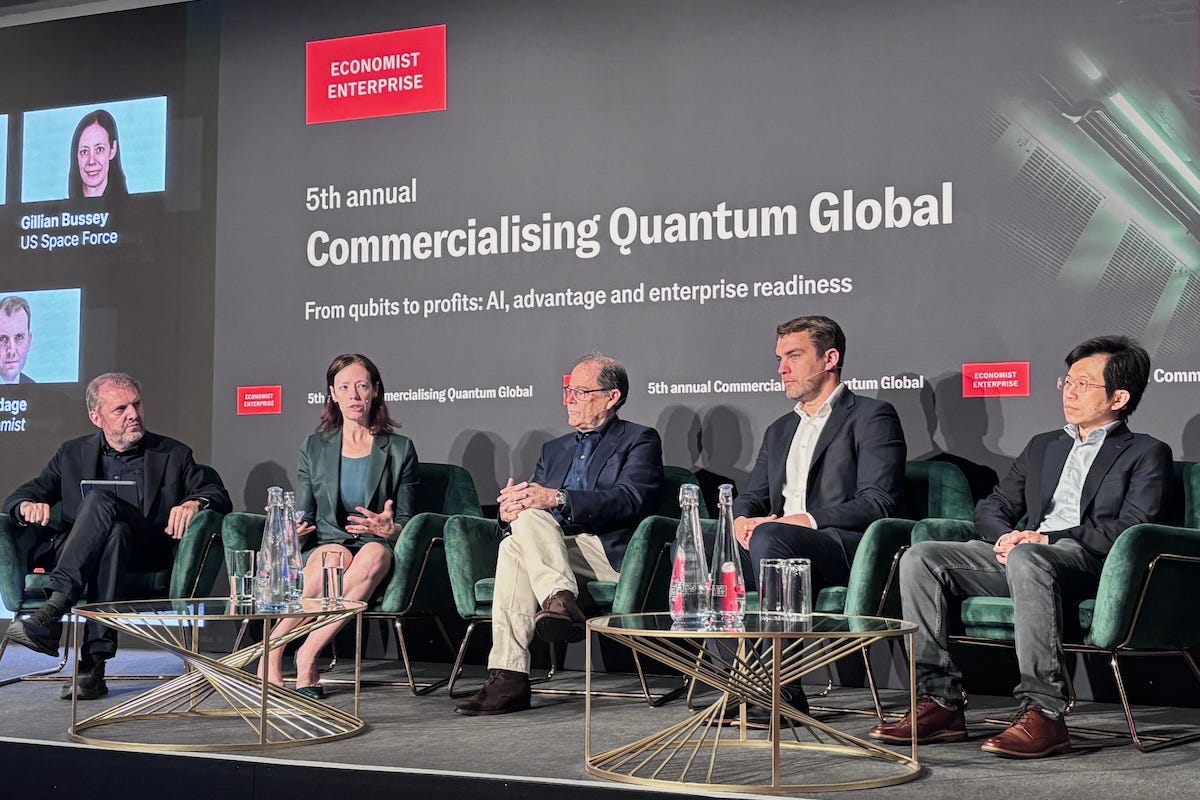
The discussion took place at Commercialising Quantum Global 2026, held in London and organized by Economist Enterprise. Tom Standage, deputy editor of The Economist, moderated the panel, which examined how far quantum computing has advanced over the past year and where the obstacles remain.
“The original business model for the company was to leverage the cloud,” Rivas said. “It boils down to how much of the quantum computer you’re actually using, and it’s not that expensive compared to supercomputers.”
“I suspect that in three to five years we’ll see predominant use of these machines over the cloud,” Rivas said.
He said the shift toward in-house hardware is driven partly by security concerns, and partly because the industry is still new enough that buyers want to experiment directly with the underlying technology themselves.
“One question we get often is: I’m already spending all the money I can on GPUs, why would I buy a quantum computer?” said Murray, noting that the economics have shifted since vendors could argue their systems were worth any price.
“We’re trying to make quantum relevant to commercial organizations by bringing the cost down to a few million dollars, so it makes sense alongside an investment in GPUs and other infrastructure,” he said.
He said the comparison increasingly comes down to a straightforward calculation: how much a given problem would cost to solve on an equivalent supercomputer, versus a quantum system, factoring in the cost of the hardware itself even when it is accessed over the cloud.
The panel also compared how competing hardware designs fare in a data center.
“We build hardware based on photonics that is data-center ready,” Murray said. “These systems are rack-mounted, mostly room temperature, and can be installed in a matter of hours, not days, weeks or years.”
He said Orca installed one such system for a Japanese customer that same week, taking six hours door-to-door.
“It’s neither complicated nor expensive technology that we’re dealing with,” Rivas said. “The data center we have in Fremont has a dilution refrigerator capable of cooling on the order of 100,000 physical qubits, and it costs less to run and takes up less space than a similarly sized rack of high-end AI chips.”
“People who’ve never worked with a cryo unit are afraid of them,” he added. “We’re not afraid of them.”
Dilution refrigeration is a well-established, 45-year-old technology supplied by multiple vendors, Rivas said. Rigetti builds most of its own technology from the ground up, not because it wants to be a full-stack company, but because it has to be.
The target price echoes the Pentagon’s own Quantum Benchmarking Initiative, which favors commercially relevant systems, Murray said. He said ORCA tries to leverage existing telecom infrastructure as much as possible to help hit that target.
Institutions such as the UK’s National Quantum Computing Centre are still swapping components to see what matters most, Rivas said.
Racing toward real applications
Quantum systems do not need to wait for full error correction to be useful, Murray said.
“We have the clear view that quantum can be useful before error correction,” he said. “We look at two general areas: accelerating generative AI, and optimization.”
“The mission of QCI is to put quantum into the hands of a billion people,” Sua said. “Beyond computing, we also offer secure communication, imaging and remote sensing.”
QCI has spent over a decade developing photonic chips built on thin-film lithium niobate (TFLN).
The platform lets the company build on two decades of existing silicon photonics manufacturing rather than reinvent the wheel, Sua said.
He cited a recent demonstration with networking company Ciena at the OFC optical networking conference as an example of fitting the technology into existing infrastructure rather than replacing it.
“We believe quantum communication will not replace existing communication,” he said. “We need to fit into the existing architecture, with a device similar to the form factor of the transceivers used today.”
Bussey said the CHIPS Act’s roughly $2 billion investment spans seven quantum computing companies, including Rigetti and Infleqtion.
“We’ve recently announced $100 million in investment in expanding our operations here,” Rivas said. “We’re also a recipient of some of the redeployed CHIPS Act money, about $100 million, to further our technical roadmap.”
“Retail and institutional investors jumped into the stock market. Government investment has exponentially increased,” Rivas said. “We have a billion dollars here, a billion dollars there.”
Bussey said the Space Force wants to be a smart consumer of quantum, not a builder. The Air Force Research Lab is also investing in nitrogen-vacancy (NV) diamond materials and supply chains, and already has access to Qiskit, the quantum software toolkit.
The first phase is algorithm work already underway at the Air Force Research Lab. The second brings optimization tasks to combatant commands within a few years. The third, a much longer push toward battlefield hardware, is constrained by weight and power.
She said her own preferences have shifted, starting with superconducting, which seemed the fastest path to a large-scale computer.
“Now I like neutral atoms, because you can do computing and sensing, which matters for the Space Force. I’m also interested in silicon spin, because the chips can be very small,” she said.
“It’s unlikely that the large data centers required to do AI are going to stick on a ship or show up in space,” Rivas said. “So you’re not going to stop using them, right?”
“Many modalities are going to be leveraged regardless of where they fit,” he said. “Deploying superconducting in space is utterly out of the question, but I think the data-center-in-space thing is going to happen. It’s not as crazy as people think.”
Asked what large organizations should do next, the panelists agreed that waiting is the bigger risk.
Bussey said companies should get onto the cloud now to build algorithms and use cases. Rivas said near-term machines are already useful enough to justify hiring staff who understand the technology.
Murray said the priority is mapping quantum’s first and widest applications, while Sua said the technology is moving faster than most procurement cycles can keep up with.