Discovering a new crystalline material has traditionally meant years of trial and error in the lab. Researchers are now treating the search itself as a giant optimization problem, one that a quantum computer is built to solve.
Every crystal’s properties come down to how its atoms are arranged, and finding the lowest energy configuration among countless possibilities is what makes that search so difficult. That arrangement determines whether a material ends up useful in a battery, a solar panel or a catalyst.
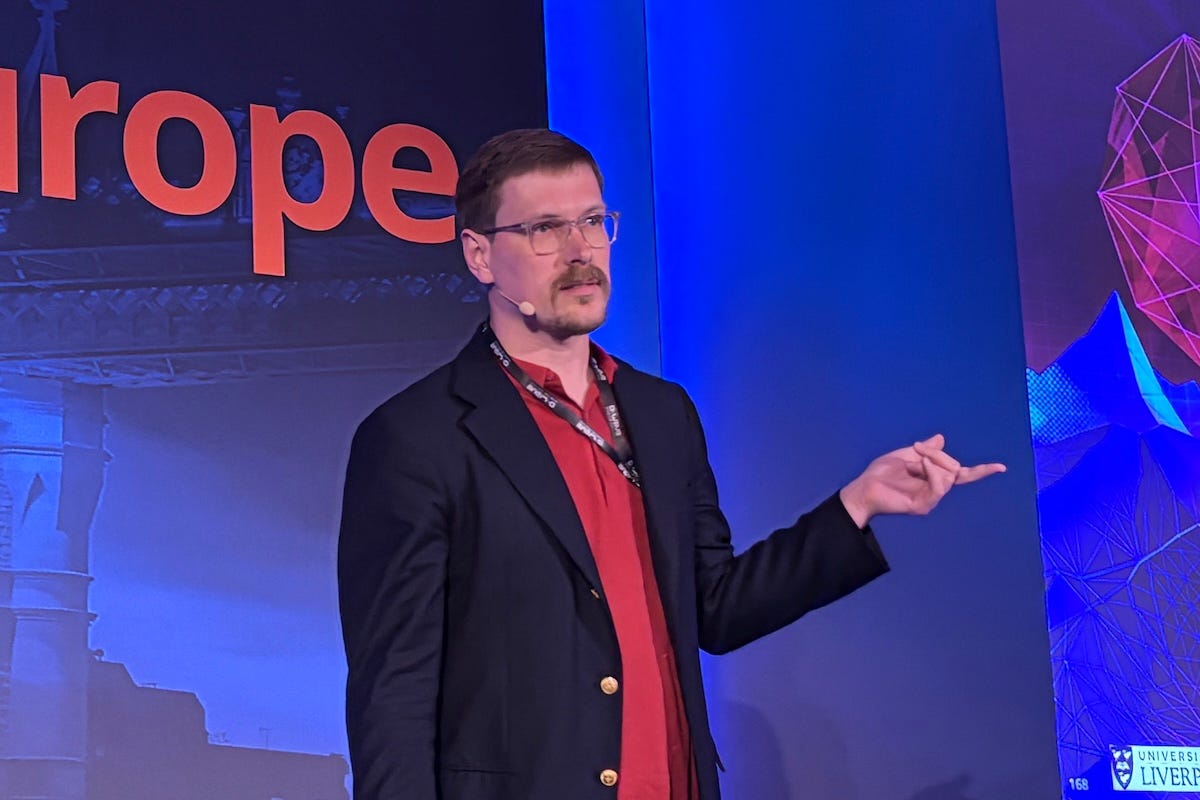
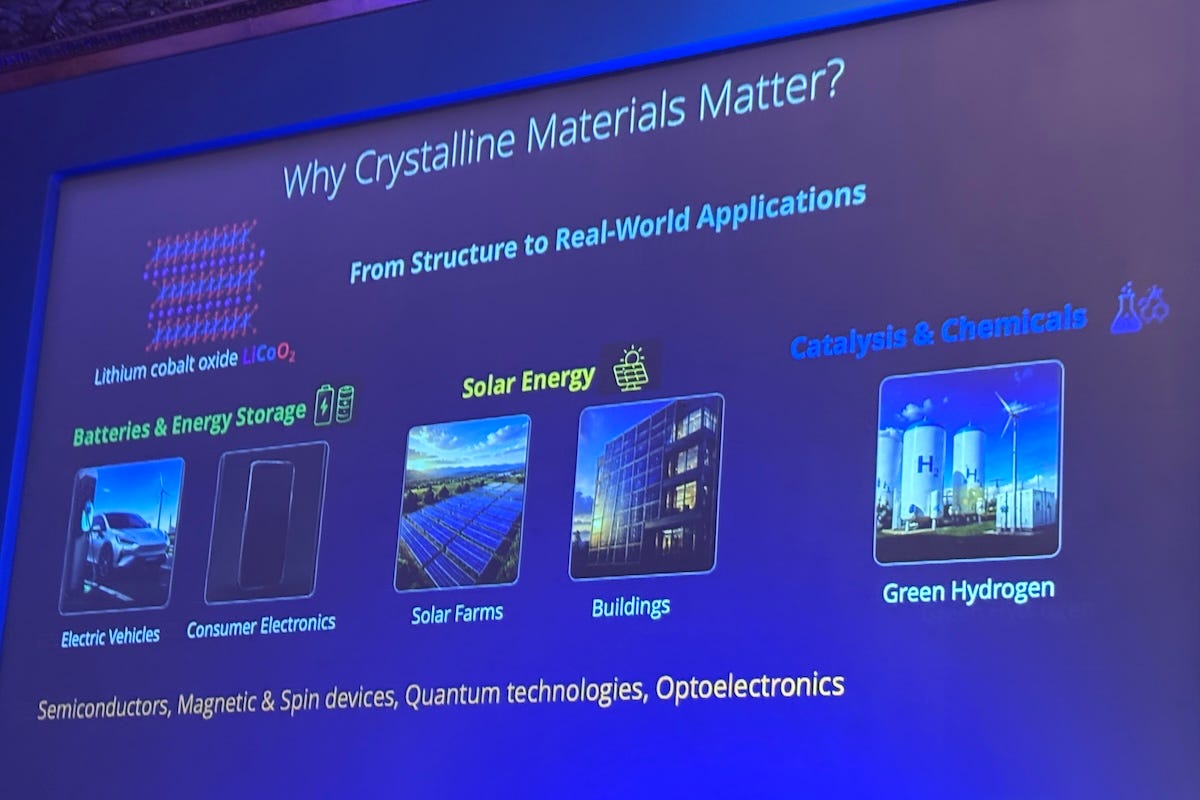
“This is a material known as lithium cobalt oxide, and I carry it with me every day. That’s my phone,” said Vladimir Gusev, a lecturer in computer science at the University of Liverpool.
Crystalline materials are defined by long-range atomic order, and lithium cobalt oxide is a textbook example.
Discovery normally follows a loop, according to Gusev’s presentation. A chemistry is selected, a possible structure is predicted, a sample is synthesized in the lab, and its properties are assessed before the results feed back into the next round of predictions.
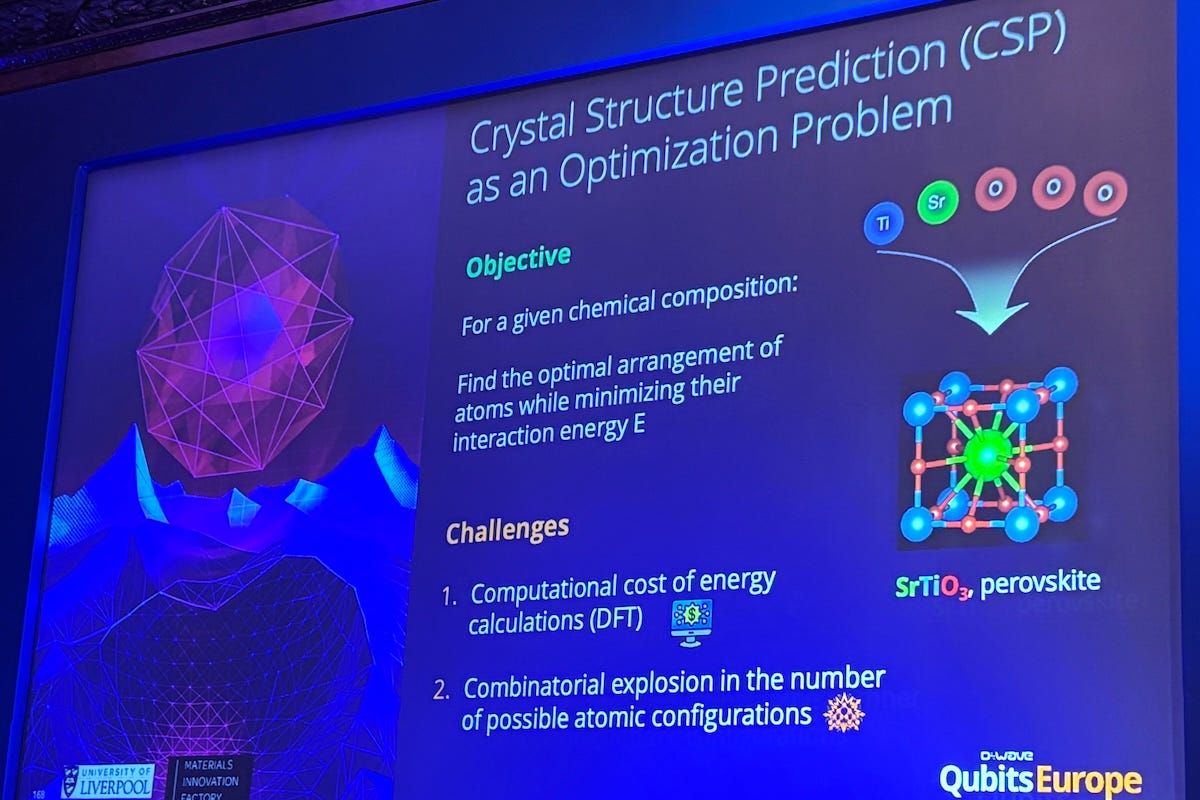
Gusev said the idea traces back to a study his team published in Nature in 2023, which framed crystal structure prediction (CSP) as an integer programming problem.
Given a chemical composition, the goal is to find the atomic arrangement that minimizes interaction energy.
He said the challenge comes in two parts:
Calculating that energy from quantum mechanics, through a method called density functional theory (DFT), is computationally expensive; and
the number of possible atomic arrangements explodes combinatorially as a structure grows.
“Maybe we can use quantum computers to solve these kinds of problems in materials,” he said.
By encoding each possible atom position as a binary variable, the integer program becomes a quadratic expression, known as a quadratic unconstrained binary optimization (QUBO) problem, which is well suited to D-Wave’s quantum annealers. In strontium titanate, for example, the model must also satisfy exclusivity constraints that stop two atoms sharing a site.
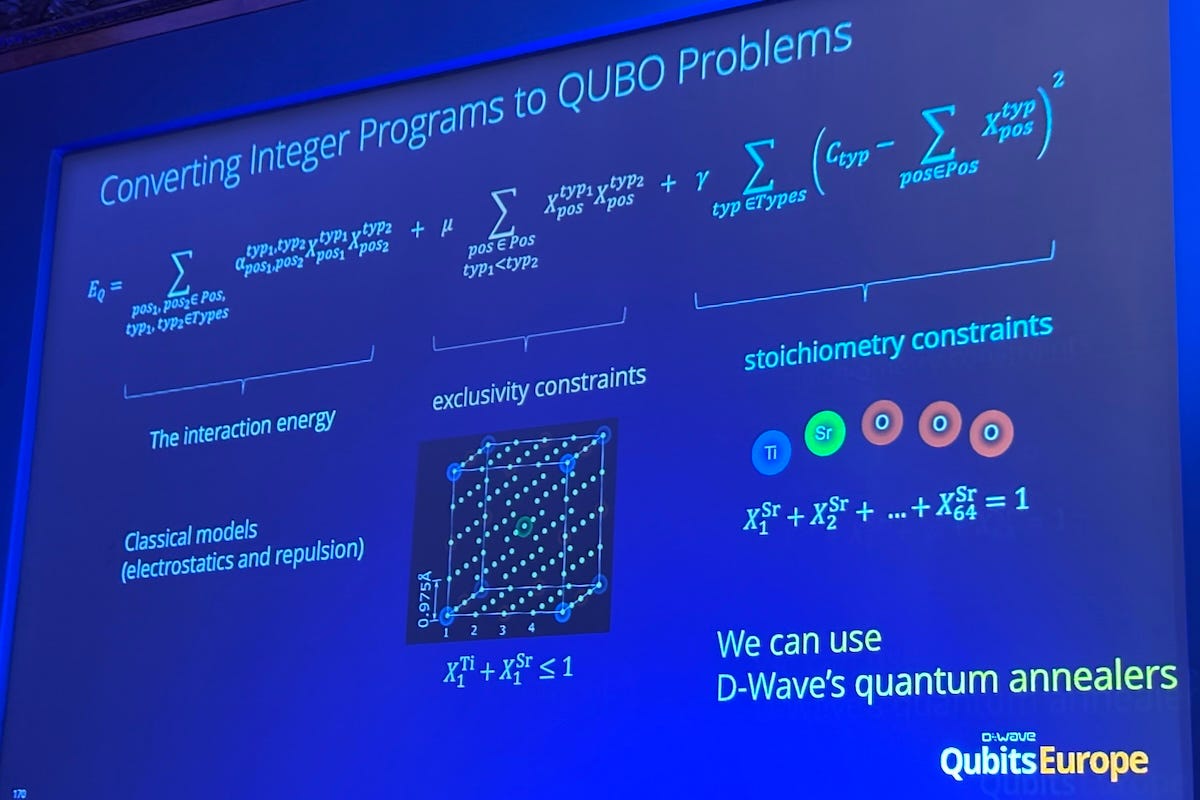
Checking every possible arrangement by brute force becomes impractical once a structure grows beyond a handful of atoms. That combination of optimization and quantum hardware is what Gusev’s team has spent the past two years refining, moving from the original 2023 study to the quantum experiments described in his talk.
Learning from known crystals
Gusev presented the research at Qubits Europe, a quantum computing conference held in London. The event was organized by D-Wave and focused on real-world applications of annealing and gate-model quantum computing across industries including materials science.
He works on CSP at the University of Liverpool, applying computational and machine-learning methods to discover new materials.
The original 2023 method relied on classical force fields, treating atomic interactions as a combination of electrostatic attraction and repulsion. Gusev said that approach only works for a limited set of well-studied chemistries, which has limited the method's practical use more broadly.
To fix that, he said a colleague compiled structural data from nearly all previously cataloged crystalline materials and measured how often specific pairs of elements occur at particular distances, building a distance profile for each pair.
A simple mathematical transform then converts that statistical pattern into an energy-like potential.
The result is a data-driven potential that can model interactions between virtually any two elements without requiring bespoke force-field data for each chemistry. That is what lets the quantum annealing approach extend beyond the handful of materials covered in the 2023 study.
Gusev compared the technique to a radial distribution function, a concept familiar from physics. He said the concept describes how likely atoms are to be found at a given distance from one another, and that the team evaluated the new potential the same way it evaluates any other CSP method, rather than using simple test cases.
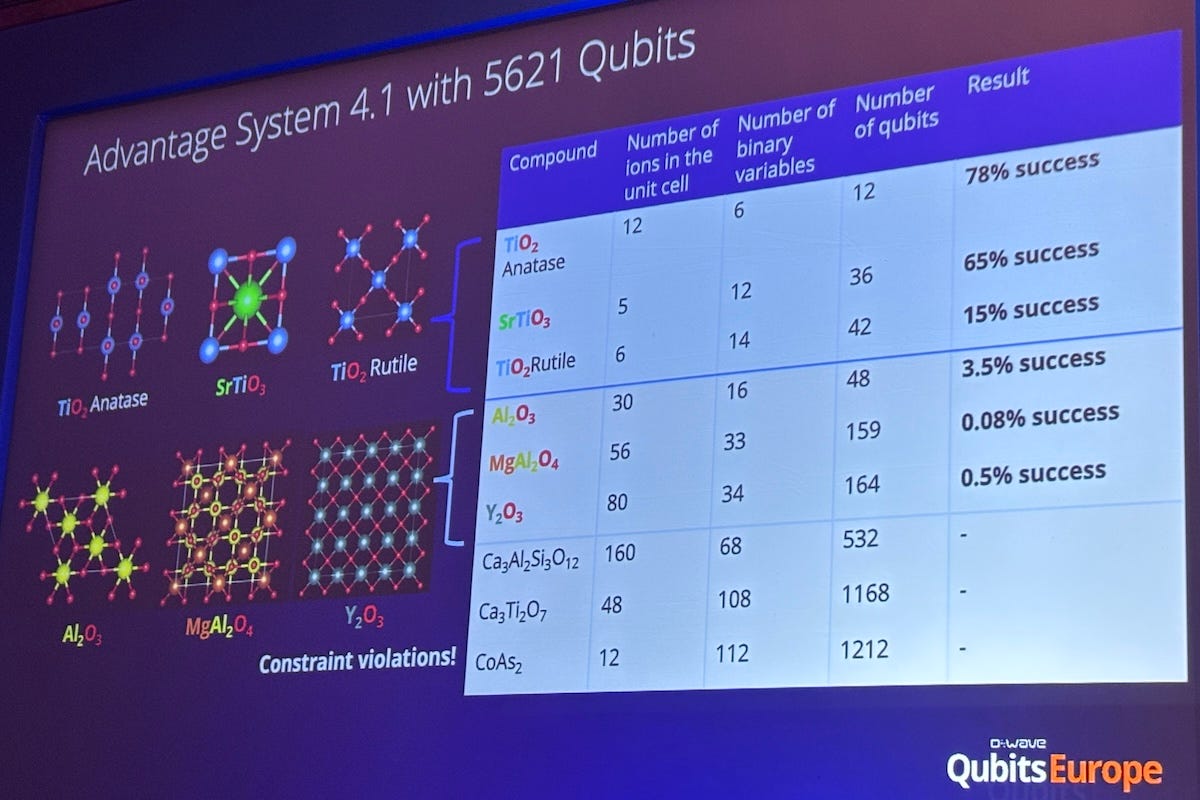
Running on D-Wave’s Advantage System 4.1, which has 5,621 qubits, the team tested crystal structures of increasing size and complexity. Small, simple structures succeeded at high rates. Titanium dioxide in its anatase form, encoded with just 6 binary variables, achieved a 78% success rate, while strontium titanate achieved 65%.
Success fell sharply as structures grew larger and required more qubits to encode. Rutile titanium dioxide dropped to 15%, aluminum oxide to 3.5%, magnesium aluminate to 0.08% and yttrium oxide to 0.5%.
Three of the largest structures tested, including a calcium aluminosilicate garnet and a cobalt arsenide, returned no successful results.
“Computer scientists like me are all about efficiency. If it cannot run on your laptop, that is a bad algorithm and you need to make a new one. People in chemistry tell me something different. [For them], it is only a problem if it cannot run on a supercomputer in a few days,” Gusev said.
Toward a virtual lab
Not every part of the problem maps neatly onto the hardware. Gusev said the energy function in the team’s model is fully connected, meaning every atomic position variable interacts with every other variable, which does not naturally fit within D-Wave’s native qubit layout.
That mismatch is why D-Wave has been developing hybrid solvers that combine classical and quantum processing, letting the team keep running the same models without redesigning them specifically for the hardware.
“We haven’t optimized it for D-Wave specifically. We’re just taking our modeling and applying it here,” he said.
He described the current implementation as a work in progress rather than a finished product, noting that the team built its models around the science first and is only now adapting them to fit D-Wave’s specific chip.
The stakes extend well beyond any single chemistry. Crystalline materials sit inside lithium-ion batteries for electric vehicles and consumer electronics, solar farms and solar-integrated buildings, and the catalysts and chemicals used to produce green hydrogen, according to Gusev’s presentation.
He also pointed to semiconductors and other quantum technologies as further beneficiaries.
He said the field is moving away from trial and error toward a computational, database-driven pipeline, one built around machine learning methods his group described in a 2021 study in Nature Communications, used to select which chemistry to explore next.
From there, the pipeline predicts the structure that the chemistry forms and experimentally tests the most promising candidates.
He said better catalysts and materials also support resilience against oil supply shocks by strengthening the technologies that reduce dependence on oil, from batteries and solar power to green hydrogen production.
He added that much of modern manufacturing still relies on catalysts that researchers in crystalline materials aim to improve.
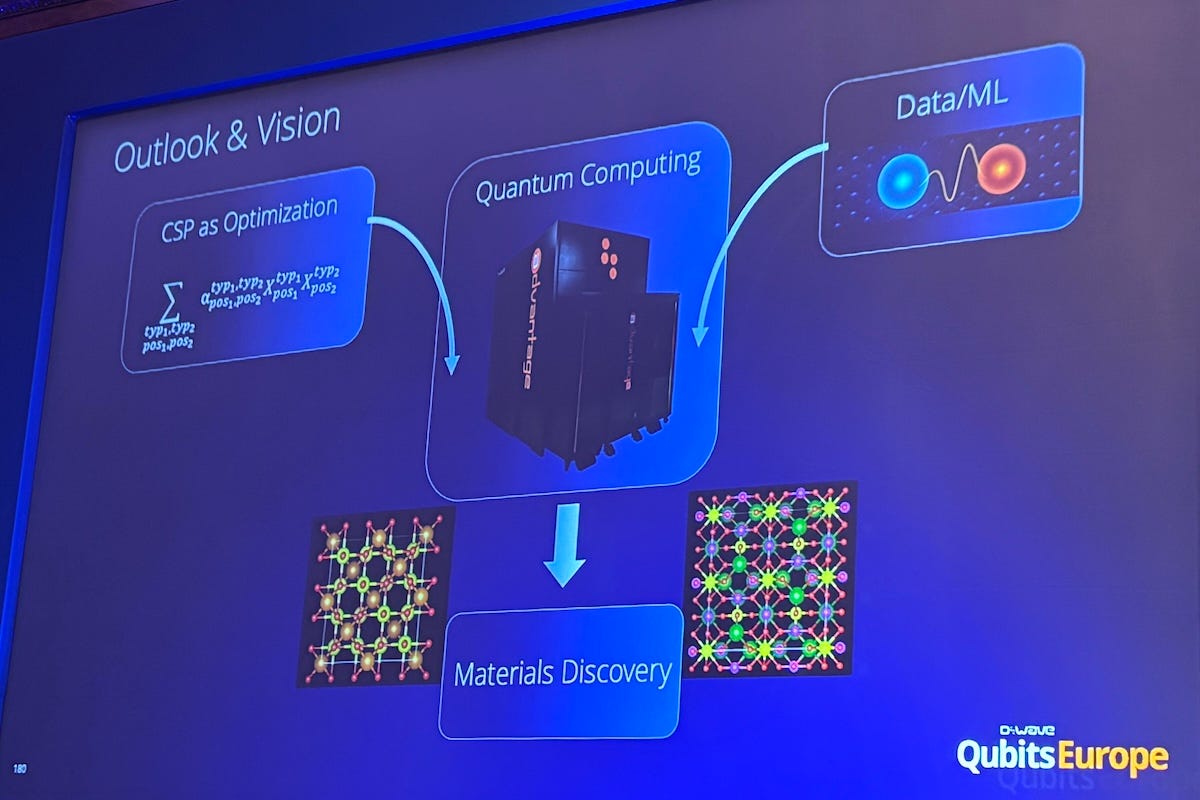
Gusev sketched where the work could lead, combining the optimization framing of CSP, the data-driven potential built from known materials, and D-Wave’s quantum annealer into a single discovery pipeline that also draws on machine learning.
He said all three elements feed into the same goal of materials discovery. The goal is to treat the quantum annealer as a reusable virtual chemistry lab, one capable of taking in any chemistry, proposing candidate structures for almost any composition and pointing researchers toward which materials are worth attempting to synthesize next in the real laboratory.