


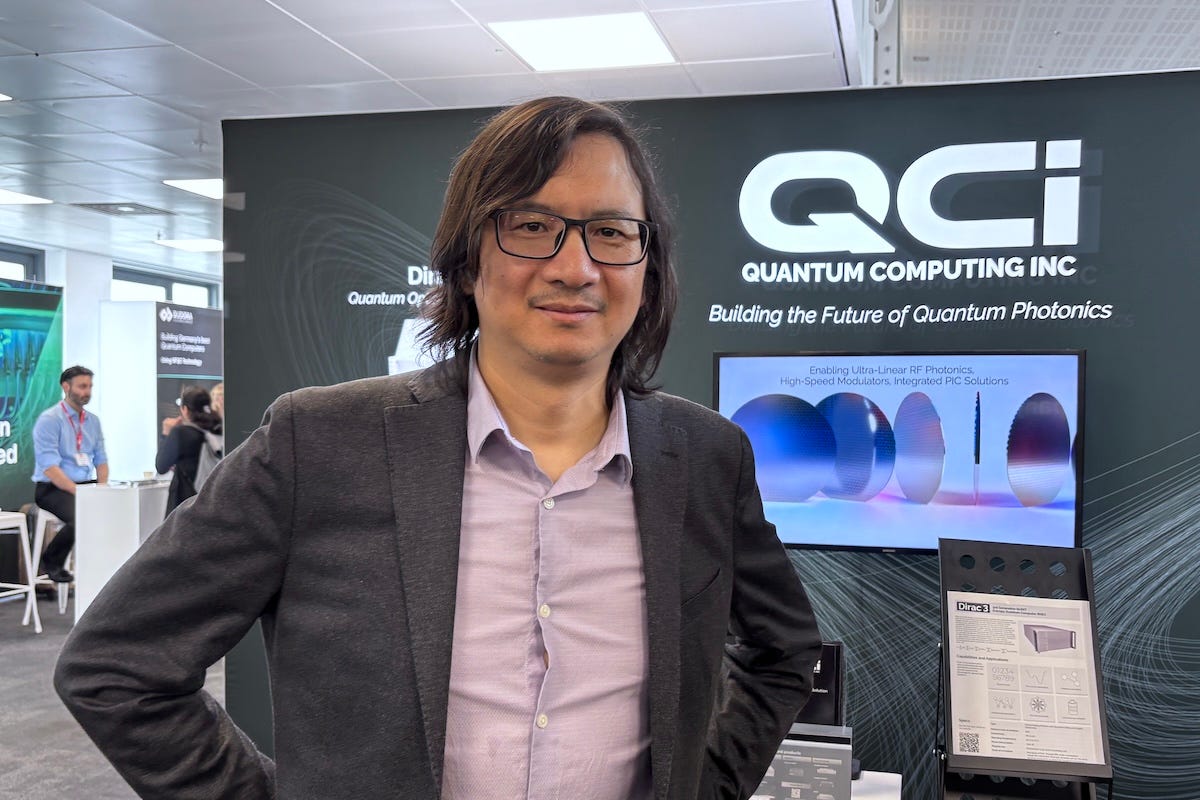
Quantum Computing Inc (QCI), a New Jersey-based quantum photonics company, is racing to bring its entire supply chain onshore, concerned that access to foreign-sourced components could one day be restricted as geopolitical conditions deteriorate.
The strategy took concrete shape last week with the acquisition of NHanced Semiconductors, Inc., a US-based advanced packaging foundry specializing in hybrid bonding, chiplet architectures and photonics device integration. The deal formally launches Fab 2, QCI's second production facility in Tempe, Arizona, years ahead of schedule.
“As a US company, we have to obey any US rules. Right now, we are not subject to export control restrictions, but that could change,” Yuping Huang, chairman and chief executive of QCI, told TechJournal.uk in an interview. “In order to mitigate the risk imposed by geopolitics, we have been working on establishing our manufacturing capabilities in the US.”
The NHanced transaction, valued at $73.1 million in cash and stock with up to $72 million in additional performance-based earnouts, establishes Fab 2 alongside the existing Fab 1, which produces thin-film lithium niobate (TFLN) photonic chips, the core material in QCI’s quantum hardware.
The NHanced deal follows QCI’s earlier acquisition of Luminar Semiconductor Inc., which brought laser fabrication, photodetection and photonic packaging capabilities into the group. Together, the two acquisitions give QCI a vertically integrated domestic manufacturing stack from chip design through to full-system assembly.
“Today, we are delivering on our commitment to launch Fab 2 and expand our manufacturing capabilities and capacity years ahead of our original timeline,” Huang said in a statement accompanying the acquisition.
The rationale runs deeper than supply chain insurance.
Huang has long argued that quantum technology will only fulfill its promise if it can be manufactured at the scale of the semiconductor industry, and that photonic integrated circuits offer a proven path to get there, one that the industry has already spent 20 to 30 years refining.
“We are not talking about having 100 engineers spend two years to build a big machine. We are talking about making millions of products on a production line. This is the manufacturability that quantum has to take on,” he said.
Room-temperature operation is central to that case. Unlike most quantum computing approaches, which rely on superconducting qubits that must be cooled to near absolute zero, QCI’s photonic systems operate at ambient conditions. That makes them far more compatible with standard semiconductor fabrication processes and far more practical for deployment in commercial and defense environments.
On June 22, US President Donald Trump signed an Executive Order directing federal agencies to develop adequate domestic supply chains and manufacturing capabilities for quantum technologies, a policy direction that aligns directly with QCI’s strategy. The Hoboken, New Jersey-based company is listed on the Nasdaq and employs 205 people.
The domestic manufacturing push coincides with QCI’s first foray into European defense. On June 18, the company announced a framework agreement with Planck Dynamics, a Netherlands-based defense technology firm backed by NUNC Capital BV, to deploy its NeuraWave photonic reservoir computer for next-generation artificial intelligence (AI) edge applications.
The initial order covers five systems, with delivery expected during 2026, and the agreement establishes a pathway to deploy up to 100 units, representing a potential program value in excess of $10 million.
From the lab to the market
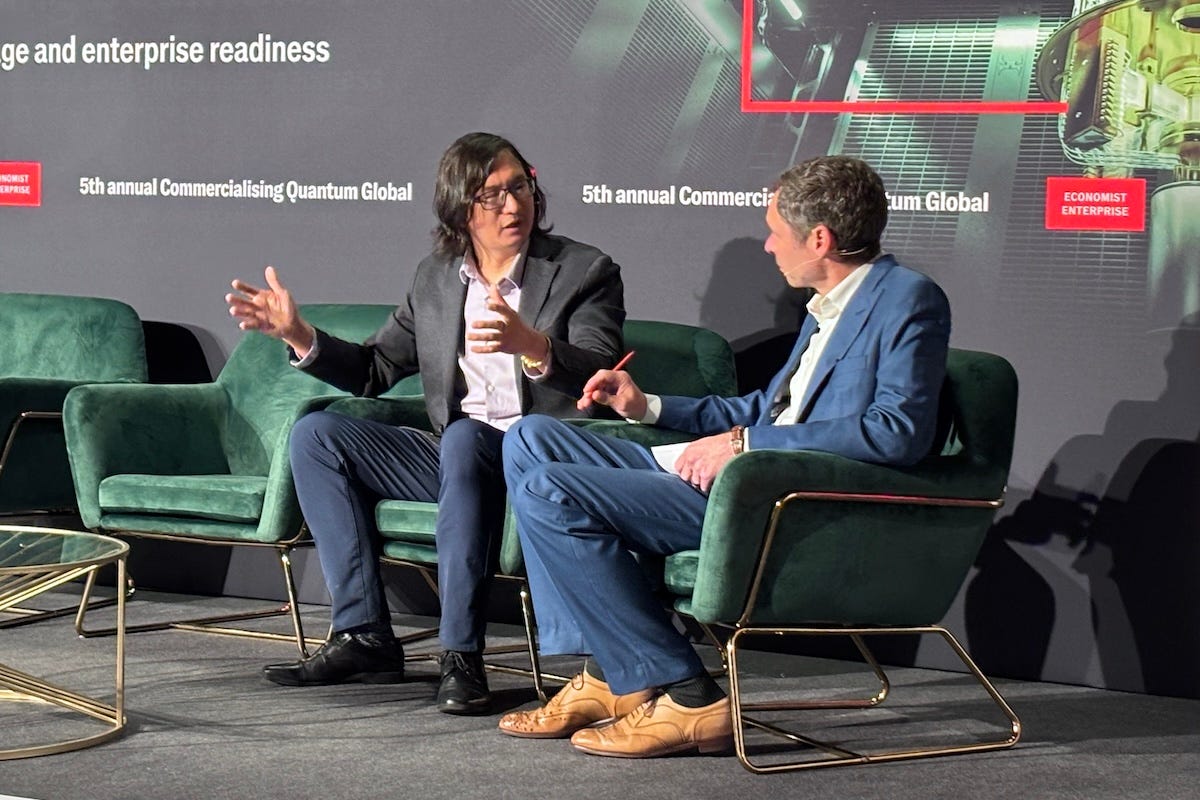
Huang was interviewed on the sidelines of Commercialising Quantum Global 2026, held on June 17 in London and organized by Economist Enterprise. He was also a fireside chat guest at the event, moderated by Jason Palmer, host of The Economist's The Intelligence podcast.
He spoke at the fireside chat about the long road from laboratory physics to commercial quantum hardware. The following draws on both conversations.
Huang graduated from the University of Science and Technology of China (USTC) in 2004 and received his PhD in quantum physics from Michigan State University. He went on to hold faculty and research leadership roles at Northwestern University and Stevens Institute of Technology. He is now a US citizen.
During that period, he led a portfolio of quantum research projects totaling approximately $40 million in funding from US government agencies, including DARPA, the National Science Foundation (NSF), the Department of Defense, and NASA, establishing himself as one of the leading researchers in quantum photonics.
He founded QPhoton, a quantum photonics innovation firm, in 2020, driven by a conviction that the inventors of a technology are always best placed to take it to market.
“We wrote quite a few patents because of the huge commercialization potential of the technologies that we developed in the lab,” he said. “We realized that the best way to commercialize a technology is by the inventors themselves. This is why we started.”
QPhoton merged with QCI in June 2022, in what Huang described as a half-and-half transaction undertaken primarily to access the resources available to a publicly listed company.
He was appointed interim chief executive in April 2025 and confirmed in the permanent role in January 2026. He holds the largest individual shareholding in QCI but does not hold a controlling stake.
Through his years of academic research, Huang said he had come to understand the precise technical barriers standing between photonic quantum physics and a commercially deployable product. At the fireside chat, he walked through those barriers one by one, explaining what had been solved and what remained.
Beyond the qubit
The technical problem Huang has spent his career solving is specific. Photonic quantum computing was widely discussed in the early 2000s, but the field stalled when researchers found that photons in a linear optical system simply do not interact with one another.
“If you shoot two laser beams against each other, they pass each other as if nothing happened,” he said. “Without interaction, there can be no logic gates, and without logic gates, there can be no computation.”
QCI spent over a decade working on the problem, ultimately identifying five technical conditions that must be met for photonic quantum computing to be viable. Four and a half of those conditions have now been satisfied. The remaining challenge is one of materials and precision manufacturing.
“The last condition outstanding is that we have to make very high-quality factor micro-resonators that can keep photons in the ring for a long time. As they circulate along the ring, they can interact with each other,” he said. “Our calculation, which has been verified by many experiments, is that we need to achieve about 10 million Q. Right now we are at 2 million Q.”
The Q-factor measures how long photons can be kept circulating inside a micro-resonator before they are lost. The higher the Q-factor, the longer photons remain in the ring and the more computation becomes possible.
Closing the gap from 2 million to 10 million Q is the central engineering challenge QCI is now racing to solve, and it is fundamentally a manufacturing problem, the same domain in which QCI has been investing most heavily.
Huang said the end goal is not a quantum computer for enterprises or governments alone.
“Quantum will change the world, but quantum will not change the world until and unless the majority of the population in the world can have easy access to it,” he said.
He drew a direct parallel with the rise of AI and social media. He said that just as those technologies only transformed society when placed in the hands of billions of ordinary people, quantum will only fulfill its potential when it escapes the laboratory and becomes accessible to anyone with curiosity.
“Our job is to manufacture millions of quantum devices per day, so that even middle schoolers can buy a quantum device and figure out what to do with it.”
On the question of competition between quantum modalities, Huang said the framing was wrong. Photonics, superconducting and trapped-ion approaches will each find the problems they are best suited to solve.
The industry should share components and capabilities rather than compete, he said.
QCI already provides its best lasers and photon detectors to collaborators working on other quantum platforms, on the basis that no single organization can build everything alone.
“Let’s cook a very big cake, and the cake can grow by itself as we really start to put quantum into the hands of people,” he said.
QCI has no plans for further fundraising. With two US fabrication facilities now operational, a European defense contract secured and Washington formally aligned behind domestic quantum manufacturing, Huang said the company is finally moving at the pace its technology has long demanded.