


Financial institutions are quietly racing against a deadline they cannot see coming. When quantum computers eventually become powerful enough to break today’s encryption standards, sensitive data stolen right now could be unlocked in an instant.
Quantum machines capable of that kind of decryption remain years away, but the risk from data collected today is already immediate. Records intercepted now can simply be stored until a machine capable of unlocking them exists, a strategy the industry calls “harvest now, hack later.”
The threat, in other words, comes in two distinct layers: the still-distant question of when a quantum machine will be powerful enough to break codes, and the immediate question of what to do about data that is vulnerable right now.
Banks handle vast volumes of financial data built up over decades, all of it a target long before any quantum computer is switched on. The scale of that exposure is forcing a rethink of how quickly cryptography needs to change.
“If we prepare ourselves for Q day, we are already late,” said Yulia Shamsudinova, head of AI transformation and process intelligence at BNP Paribas. “We need to start right now on this point.”
“We have this term: ‘harvest now and hack later,’ and we do understand that this data might be very vulnerable,” she said. “The cryptography is a total must. It’s maturing very fast, and the funding is there.”
No bank can overhaul everything at once. Shamsudinova said the priority list starts with client-facing platforms and portals, then extends to digital-asset applications and other critical systems used across the group.
That urgency is starting to register beyond the technology team.
“The moment you mention security to our executives, that is when you get their attention,” said Asteris Apostolidis, senior technical innovation lead at KLM Royal Dutch Airlines.
He said it is the first time in eight years of raising the topic internally that executives have shown this kind of traction.
The same anxiety over who controls sensitive data runs through a bigger question hanging over the wider quantum industry. Who ultimately controls the computing power and energy behind it?
Compute turns political
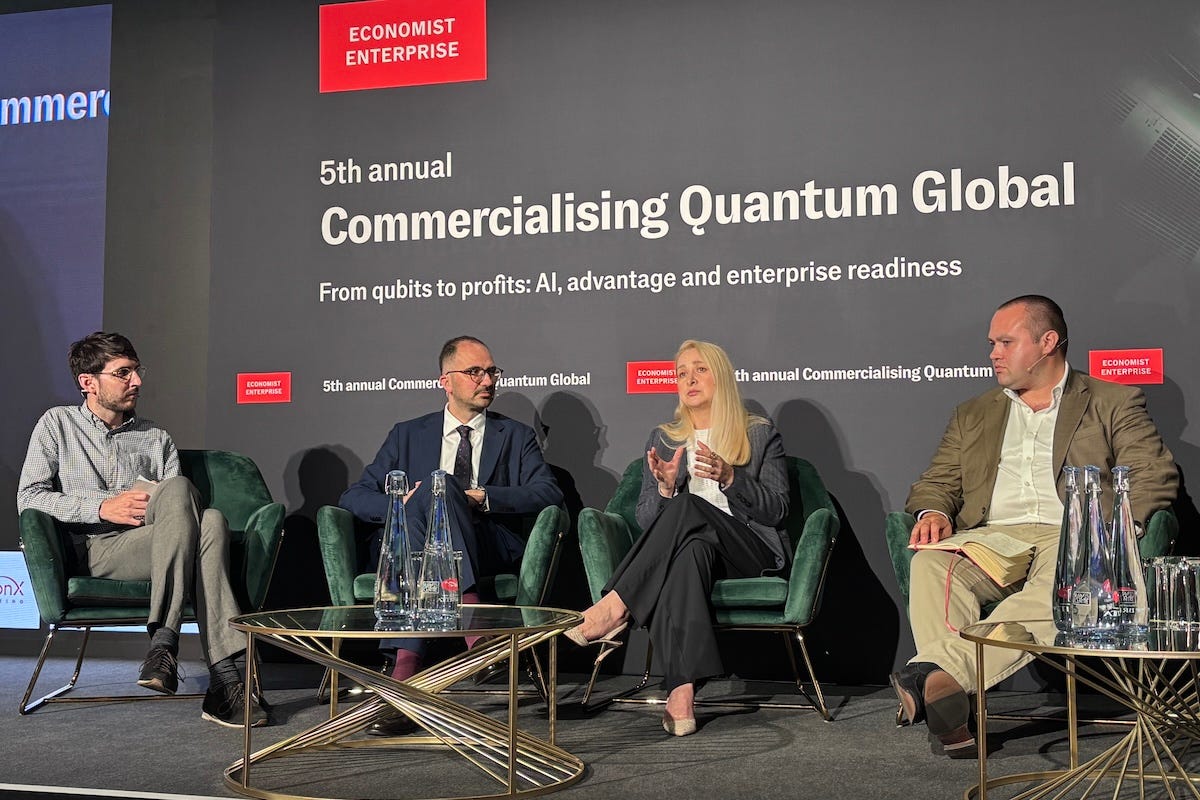
The discussion took place at Commercialising Quantum Global 2026 in London, an event organized by Economist Enterprise exploring how new computing architectures are reshaping the relationship between data, software and computing power. Alex Hern, an AI writer at The Economist, moderated the panel.
“How much energy we can generate to power our systems, how much compute we can build, who can access that compute and where that data lives are increasingly politicized questions,” said Harry Stovin-Bradford, senior director and head of government affairs for Europe at the quantum computing firm IonQ.
The European Union’s Quantum Act, expected by the end of the year, is an early attempt to answer some of these questions, though governments still have significant work to do at a national level.
“What does sovereignty look like from a quantum perspective? Is it the ownership of a system? Is it the ability to direct that system? Is it where the system was built?” he said.
He said compute and the energy that powers it are becoming inherently more national than international, particularly for countries such as Britain and the Netherlands that face constraints on their power grids.
IonQ’s own hardware may have an advantage there.
“Our systems, in particular the trapped ion modality, are significantly less energy intensive than a lot of classical supercomputing, and perhaps less energy intensive than some other quantum modalities like superconducting,” he said.
The same instinct for caution is reshaping how banks think about the data they collect in the first place. For years, the industry default was to gather everything and worry about its use later; executives now say that approach carries its own risk.
“As a large bank in Europe, we take it really seriously. Data protection and data security are among the biggest topics for us,” Shamsudinova said.
She said most of BNP Paribas’s systems are built internally or with partners who work inside the organization rather than on external platforms, reflecting the bank’s caution around cybersecurity.
“Technology is going to apply to organizations, but it’s not going to fix them. If your data is broken or incomplete, you are just going to propagate the fragmentation,” she said.
Only once that foundation, meaning governance and a clear operating model, is solid does it make sense to scale new technology such as artificial intelligence (AI) or quantum computing, she said.
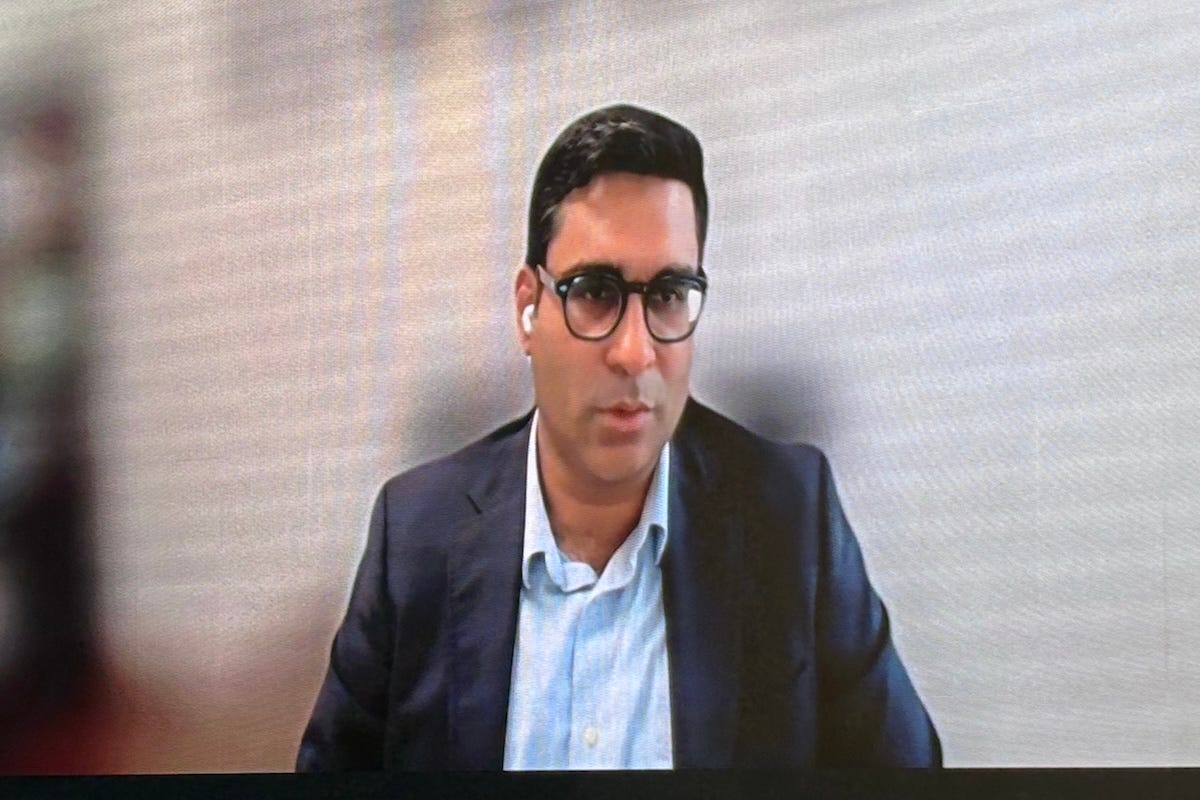
Akshay Pore, managing director for data modernization, AI automation and strategic architecture at Bank of America, joined the discussion via video link.
He described a similar discipline at Bank of America, where data is organized into what he calls data products.
“The data itself is a product that is transacted between different lines of business. We create data contracts around it, treat it as a product, govern that product well, and expose it to AI workloads,” he said.
Solving the scheduling puzzle
Few problems illustrate the promise of quantum computing as vividly as the daily puzzle of running an airline.
“If you strip an airline down to its core, it’s a huge optimization and scheduling problem. You need to combine a pretty extensive network with certain aircraft and crews, under operational, labor and technical constraints, and maintenance,” Apostolidis said.
The goal is for quantum computing to eventually search far more combinations than any classical system can manage today, to find the schedules that actually work.
“That’s a problem no one has managed to solve in its entirety. So what we do is break it down into smaller problems and try to solve them, sometimes successfully, sometimes not,” he said.
“Keep in mind that KLM is the oldest operating airline in the world. We’re 170 years old right now, so that’s a huge benefit, but it comes with lots of legacy as well,” he said.
The airline has run early proof-of-concept projects on crew rostering and, separately, digital marketing, partnering with outside companies, government bodies, research institutes and academia to find where quantum computing actually helps before committing more resources.
That cautious, one-step-at-a-time approach reflects a broader theme among the panelists. Readiness, not raw processing power, is the real bottleneck.
“It’s not about the computational power. It’s more about how ready we are, and which areas we need to be more ready in than others,” Shamsudinova said.
She said she does not believe the future belongs to quantum, AI or classical computing alone, but to a hybrid of all three over the next couple of years.
Pore set a concrete bar for that hybrid future.
“Right now we need to get quantum to a fidelity of at least four nines, essentially 99.99%, before we can integrate it with traditional workloads,” he said.
He said the goal is a layer of abstraction so users never have to know which technology is doing the work.
Even before that threshold is reached, quantum computing is already producing results elsewhere in the business.
“You can use quantum in both pre- and post-training of AI to substantially increase the performance of a large language model against standard benchmarks. That’s promising,” Stovin-Bradford said.
He pointed to a project with an automotive client designing steel alloys, where the models performed far better than earlier attempts.
“The models we found were 70% more useful at the point of delivery than in standard classical large language model (LLM) use,” he said.
Asked whether quantum has become unavoidable rather than a wait-and-see bet, Stovin-Bradford said yes without hesitation.
Apostolidis said executives are showing more interest than at any point in his eight years pitching the technology internally.
Shamsudinova said industry attention still leans toward AI for now, even as cryptography funding accelerates. Pore said the clearest near-term payoff sits in fraud detection, data processing, image processing, key distribution and cryptography, all of which he expects to mature within four to five years.
Each panelist pointed to a different timeline. All the same, quantum computing is moving from a research curiosity toward something banks, airlines and hardware makers alike are actively building around.