


GPS jamming is no longer a rare battlefield tactic. It now threatens airlines and militaries alike.
The disruption costs an estimated one billion dollars a day in the United States alone, and a new generation of navigation technology built on quantum sensors is racing to close the gap.
“GPS jamming is an increasing threat that faces both militaries and commercial aviation,” said Niall Moroney, lead solutions engineer at Q-CTRL. “We developed a sensor and a navigation system that allows pilots to know where they are, even when they’re facing this threat to GPS.”
He said the company’s chief executive had already proven the approach worked outside the lab a year earlier.
“Militaries will necessarily be operating in areas of GPS denial,” he said. “That means those operators find it difficult to know where they are, so there is a strong incentive for them to adopt alternative navigation systems, such as our own.”
That earlier demonstration paired a quantum sensor with Q-CTRL’s own navigation software to solve a real-world problem better than the best available classical alternative.
Q-CTRL is a Sydney-based quantum control company that builds software to make quantum hardware and sensors perform reliably in real-world conditions.
Its navigation product, Ironstone Opal, was unveiled in February as the first commercially available quantum navigation system validated for defense and aerospace use, following extensive trials across air, land and maritime settings that improved inertial positioning accuracy by more than a hundredfold.
The system was later named to TIME magazine’s list of the best inventions of 2025.
Moroney said the company has since made its first commercial sale of the system, though public materials describe the offering as a presale evaluation kit previewed at the Singapore Airshow, allowing customers to test its performance before committing to a full purchase.
It is now working with manufacturers to move Ironstone Opal toward full production at scale.
“We have a strategic partnership with Airbus, where we’re looking to integrate our quantum navigation systems for commercial aviation,” he said.
Airbus Ventures first backed Q-CTRL with a $25 million investment in 2021.
The two companies have since deepened that relationship through dedicated navigation trials, with field tests showing the joint system outperforming high-end inertial navigation systems by up to fifty times under real-world flight conditions across both commercial and defense aviation settings today.
Quantum joins the battlefield
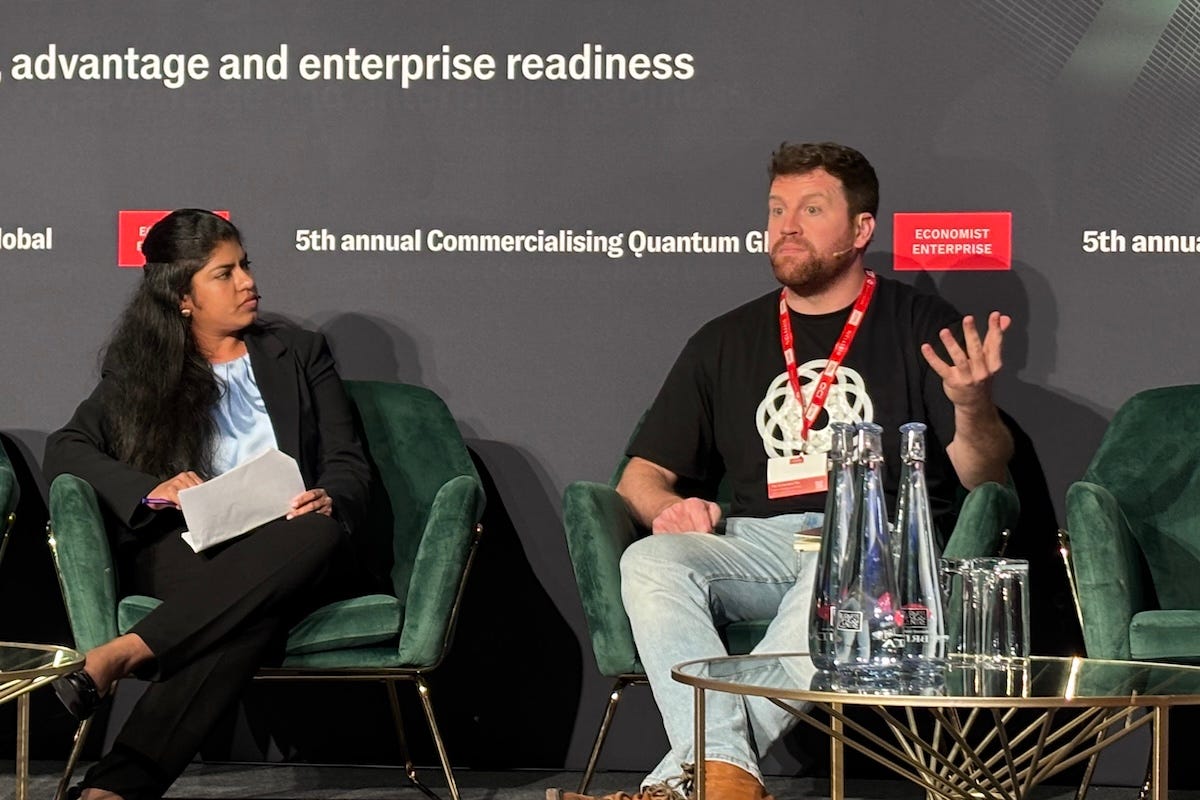
Moroney’s comments came during a fireside chat titled “From clean fuels to safer flights: where is quantum advantage delivering real-world impact?” at Commercialising Quantum Global 2026, held in London and organized by Economist Enterprise.
The session was hosted by Laveena Iyer, senior analyst for telecoms and technology at the Economist Intelligence Unit. It explored how quantum computing and sensing are moving from laboratory promise toward deployed technology, a shift now visible across energy, defense and transport.
Q-CTRL’s ambitions extend well beyond navigation.
In May, the company said it achieved a 3,000-times speedup on a materials science problem using IBM’s quantum computers, cutting a simulation that once took more than a hundred hours down to about two minutes.
“Just three or four weeks ago we did it again, this time in the area of quantum computing,” Moroney said. “Using IBM’s computers, along with performance optimized using our software, we were able to solve a real-world problem faster than the best classical alternative.”
Q-CTRL followed that milestone with a white paper on quantum computing for defense, published in late May.
Titled “Quantum Computing for Battlefield Information Dominance,” it outlines four military case studies, including convoy routing, strategic airlift, defense manufacturing and missile defense, and the company said it used the approach to solve a simulated deployment of five thousand vehicles for the Australian Army during the military exercise Talisman Sabre.
The initiative also aligns with broader government efforts, including the United States’ National Quantum Initiative and the trilateral security partnership between the United States, Britain and Australia known as AUKUS, according to Q-CTRL.
Moroney pointed to poorly managed supply chains as a recurring problem in past conflicts, saying businesses and militaries alike have suffered when logistics were not planned with enough precision, and that better tools could help prevent similar delays and losses in the future.
He said quantum computers could join defense logistics workflows as soon as 2027 to optimize convoy routes and resource allocation.
“We were showing how quantum computing can solve exactly those types of problems to maximize the safety of all teams involved,” he said.
Beyond defense, Moroney named three areas where he expects quantum computing to deliver value soonest:
Chemistry, including battery design and drug discovery
Financial services, such as pricing assets against an uncertain future
Optimization problems like supply chain management and scheduling for large organizations
“That demonstration we did a few weeks ago, of practical quantum advantage in computing, was on a problem that’s related to chemistry,” Moroney said. “We would be working with people who want to design new battery technology or drug discovery.”
On finance, he said quantum computing could help banks price assets whose value depends on an uncertain future.
“There are lots of enterprises who face very similar problems,” he said. “We work with a whole host of typically large organizations who have complex supply chains that they would like to manage or complex workflows that they would like to run optimally.”
The risk of waiting
Not every organization needs to act immediately, according to Moroney.
Moroney was asked what he would tell a board weighing an early investment in quantum technology against priorities such as cybersecurity and artificial intelligence.
“Frankly, it quite possibly is early to adopt quantum computing, because in the near term, quantum computers are going to be good at solving specific types of problems,” he said. “What I would then ask is: are you sure that’s not you?”
He said companies fall into three groups:
dedicated teams already chasing quantum’s edge;
fast followers trying to catch up;
a large remaining group that has shown interest but not yet started exploring.
“We can’t say for certain that in the next three to five years you would be facing those benefits,” he said. “But if you’re not going through that exploration piece, then we know that you won’t be leveraging those benefits. It’s quite possible that your competitors will, and they will have the competitive advantage that goes with it.”
Moroney distinguished a proof of concept, which shows a computer can solve a problem, from proof of value.
“Quantum is hard,” he said. “It’s not that large of a word in letters, but I think it’s a very big word in impact, because it sounds so abstract and so difficult to grapple with.”
That complexity shows up in Q-CTRL’s work with Mazda, one of its enterprise clients.
“One of the things that Mazda has to do is run very complicated design software to understand how strong one of their beams is,” he said. “They don’t want to put too much material and make it very heavy and expensive, but nor do they want to sacrifice safety.”
Q-CTRL used a quantum computer to learn from a handful of data points as a cheap surrogate for costly runs. The team started with several candidate use cases before narrowing to the one judged most worth pursuing, rather than spreading its effort evenly across all of them.
Much of that work ultimately depends on internal literacy across the client’s own teams.
“We call it like Duolingo for quantum computing,” he said. “It’s an app-based educational software that allows interactive learning, and allows teams to get up to speed with this otherwise quite intimidating technology.”
Commercially, however, Q-CTRL is leaning on its sensing business first for near-term revenue.
“Our strategy is to use quantum sensing for revenue in the near term, and that will give us the buffer for the unknown timeframes to commercial adoption for quantum computing,” Moroney said.
With Ironstone Opal advancing and its defense white paper fresh, Q-CTRL’s next test is turning early demonstrations into lasting contracts, and Moroney said the company is now focused on finding those partners rather than chasing every possible use case at once.