


Many successful physical artificial intelligence (AI) pilots fail at scale because the networks and data behind the robots cannot keep up.
Factories are adding sensors, control systems, and video analytics to networks built for an earlier era, while cloud-trained models must run at the edge, where delays and security gaps carry real costs. Without clean, contextualized and time-stamped data, these systems cannot correlate what is happening on the production line.
“The main question is not if AI technology is scalable. We know it is. The basic question is if the companies have the operational infrastructure required to scale it up,” said Germán Fernández, vice president of global strategy and ecosystems at Belden.
“The first assumption we need to break down is that the network that you built 10 years ago is going to support the new traffic that is required for physical AI or agentic AI,” he said.
Fernández said many pilots fail at scale for three reasons:
There is no solid, resilient and secure network
Companies lack real-time, clean and contextualized data
No governance model integrates different technology providers with clear accountability
He said companies typically underestimate the complexity, and the biggest mistake is to treat each deployment as a separate project, creating fragmented architectures that are hard to maintain and manage.
“We are moving from systems of insights that were connected to ERPs (enterprise resource planning systems), MES (manufacturing execution systems), etc. to systems of action, and here the role of the network changes completely. This will be a foundational layer of the autonomous decision-making process,” Fernández said.
Aaron Boasman-Patel, vice president of innovation at TM Forum, a global telecoms standards body, said most deployment plans overlook the networks that power robots.
“Get your security right, get your network right. If you get those two wrong, you get carried away with the fancy robotics, you’re on a pathway to failure,” he said.
He said companies must first decide which data is processed in the cloud and which on a core server, as latency becomes critical and compute grows expensive. He added that hacking has become one of the biggest forms of terrorism, with attackers able to switch off hospital systems.
Ahmet Hasanbeseoglu, chief value partner for digital transformation in supply chain at Arla Foods, said a fleet of robots can orchestrate well and still miss its expected throughput without a strong data platform behind it.
“The challenge is not about orchestrating the physical robot, but building this data knowledge around that, so we can program the factory. That’s our biggest challenge,” he said.
He said companies should treat “soft AI” and “hard AI” together, linked by a “digital thread,” so a maintenance agent reading the next service cycle from SAP can trigger maintenance robots or workers on the shop floor.
Traceability over dashboards
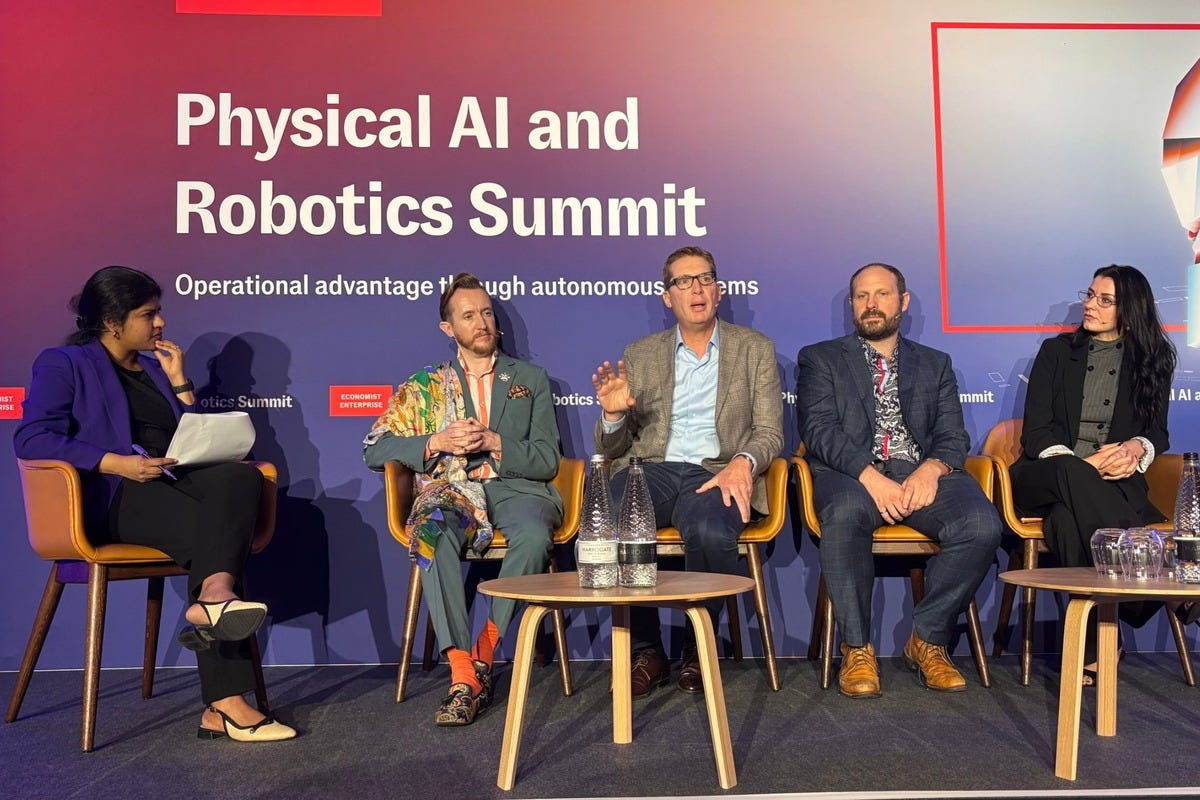
The panel, titled “Increasing autonomy without losing control,” took place at the Physical AI and Robotics Summit, organized by Economist Enterprise in London on October 13. Laveena Iyer, a senior analyst at the Economist Intelligence Unit, moderated the session on how companies can let AI systems adapt while keeping safeguards and human oversight.
Tom Hummel, robotics technical director at Ford Motor Company, said leading indicators are hard to track in autonomous systems, and quality problems usually surface only in a failed downline test.
“The most important thing that we look for at Ford is traceability, and that’s something that we are keenly aware of when we think about our physical AI deployments,” he said.
“If we’re building an engine, say the bearings were improperly installed, that engine is going to blow up on the test stand when we do its first spin, and all of a sudden that’s a rather large amount of value and time that’s wasted.”
More insidious faults show up later as warranty claims. He said real-time monitoring is valuable but very difficult, so Ford needs traceability from autonomous systems.
Boasman-Patel said the same applies to AI agents. Through agent-to-agent (A2A) communication, companies must be able to see which agent made each decision and when, with trust and safety guardrails built into every step. He had just returned from a TM Forum hackathon in Dallas with about 250 telecoms developers.
The panel also turned to who answers for a robot’s mistake.
Sara Filipčić, executive director and founder of the Institute for Humane Robotics, said more than 600 industry conversations across Japan, China, Korea, the US, and Europe revealed a reactive mindset.
“A lot of robotics companies are almost like waiting for a problem to emerge before they start creating the solution for that,” she said.
She urged companies to settle three questions in advance:
Who decides what happens with the robot
Who has the agency to stop its actions during a malfunction
How to learn from the incident
“Who is responsible if something goes wrong? Is it the person who sourced the data? Is it the person who built the bot or the AI algorithm?” Boasman-Patel said. “That governance isn’t some kind of ethereal thing that sits on paper. It sits with people because people will go to jail over this.”
He said the industry is not taking enough accountability for who is responsible and what happens to those people when something goes wrong.
Every 15 seconds
Ford builds an F-150 truck every 15 seconds in North America, so even minutes of downtime are costly, Hummel said, adding that robots must be easy to service, with constant teleoperation or a support worker on call. Ford’s own teams act first, followed by external service support.
“Ford takes an approach where we want our skill teams at the plants to know how to fix and repair the robot as fast as possible,” he said.
Task design is another concern. Many physical AI systems target brownfield tasks that already exist, and he questioned whether those lines could still hit the correct takt time if the robot were removed. He said companies should judge each use case by its total value over the deployment's life.
“In many cases, in what I’ve seen in real-world deployments, a lot of times the task is modified for the robot at the expense of the human,” Hummel said.
“It’s very easy with physical AI, especially with humanoids or mobile manipulation, to say, ‘Hey, we can do it.’ There are very few times we really ask, even at a large organization like Ford, should we do it?”
At Arla Foods, robots are rolled out with safety as the top priority. Hasanbeseoglu said the dairy cooperative runs safety design tests during proof-of-concept and pilot phases because staff work alongside collaborative robots (cobots).

“The human is always there checking if the robot is acting correctly. Ideally, when we go to the future, these systems should be more and more human in the loop,” he said.
In that model, systems would alert a maintenance or site manager only when something unusual happens. He said governance must cover a mixed workforce of humans, “augmented” humans and robots, and that staff affected by automation should be reskilled into roles such as observers and supervisors.
“We have fewer and fewer people who want to work in a factory. We are somehow going into this dark factory mode,” Hasanbeseoglu said.
Filipčić said robotics companies must also understand their customers’ customers. In a hospital, staff and patients interact with robots most, so they should help co-design the technology.
Boasman-Patel said common interfaces, such as open application programming interfaces (APIs), are needed so every device shares the same data. He cited the fanfare around Waymo’s driverless cars in London, which depend on surrounding sensors and traffic lights sharing the same data.
“All of those devices must have the same data, and if they don’t, what happens? The car just stops and everybody else drives into it,” he said.
He said standards must also cover a common “expression of intent,” the way users now tell tools such as ChatGPT what they want instead of writing lines of code. When intent is expressed differently, things start to go awry.
Hasanbeseoglu said accountability, safety and cybersecurity are fundamentals that must be in place before Arla takes automation further.