


Photonic Inc, a Vancouver-based quantum computing company, is positioning its distributed quantum computing architecture around a single benchmark increasingly shaping the sector: commercial usefulness.
The company is aligning its strategy with government programs and international validation frameworks designed to test whether quantum machines can deliver real economic value rather than laboratory demonstrations.
The focus reflects a broader shift across the quantum ecosystem toward measurable outcomes. Public funding and industrial partnerships increasingly hinge on technical milestones and credible commercialization pathways, including benchmarking initiatives led by DARPA (Defense Advanced Research Projects Agency).
“DARPA’s quantum benchmarking initiative defines utility-scale quantum computing not as just what can develop a quantum computer that can do something,” Nick Morris, Managing Director, UK, and Vice President of Strategic Partnerships at Photonic, told TechJournal.uk in an interview.
“They’re looking to understand how we find companies capable of building a quantum computer that can do something commercially viable. We appreciate the way DARPA structured that. They’re not interested in form — they’re interested in technologies that can deliver commercially impactful use cases ahead of 2033.”
The company’s strategy centers on proving that distributed quantum systems can meet the practical and economic thresholds required for real-world deployment. This emphasis has become increasingly important as governments and investors seek clearer signals that the industry is progressing beyond proof-of-concept systems.
The Canadian Quantum Champions Program (CQCP) represents one such signal. The initiative is designed to support approaches capable of scaling toward industrially relevant quantum computing while anchoring talent, intellectual property and supply chains domestically.
Commercial horizon
Despite the momentum, timelines for commercial deployment remain closely guarded across the sector. The company has not publicly disclosed detailed commercialization roadmaps.
However, participation in benchmarking programs and continued validation from government and industry partners provide signals about progress.
“If a quantum computer could build an interesting new battery technology — worth $500 million — but you can only do that on a computer that cost $5 billion to build and takes two years to run the algorithm, you haven’t built anything commercially useful there,” Morris said.
The example illustrates the industry’s growing focus on cost, speed and practical application as defining measures of success.
“By virtue of our participation in that program and ongoing selection, that gives you some indication of the track that we’re on,” he said, referring to DARPA’s quantum benchmarking initiative.
Quantum computing is entering a phase defined by validation and commercialization. The ability to demonstrate real-world utility is becoming the central metric shaping funding, partnerships and long-term strategy across the industry.
Scaling strategy
Morris explained how government funding programs and milestone-driven technical validation are steering the next phase of competition across the quantum industry.
“The CQCP is a new initiative from the Government of Canada to support Canadian approaches to quantum computing that could be scaled up to build an industrially relevant quantum computer,” he said.
“The government aims to support scalable, fault-tolerant computing, anchor firms like Photonic in Canada, and signal confidence in Canadian approaches to quantum computing to the wider world.”
Phase one of the program provides up to C$23 million (US$17 million) in funding over approximately 12 months. Future funding is tied to performance against technical milestones.
“They are looking to ensure any future taxpayer funds go to companies which have shown, not told, that they are on the right track,” Morris said.
Technical assessments are conducted throughout the funding period, with progression determined by performance rather than fixed timelines.
“The team is looking to understand whether we can do what we say we can do,” he said. “We will be working with technical teams to educate them on our system, capabilities, and roadmap, and they will decide progression based on performance against milestones.”
The program forms part of a broader global effort to benchmark quantum progress. It also channels investment toward technologies with credible scaling paths.
Scaling architecture
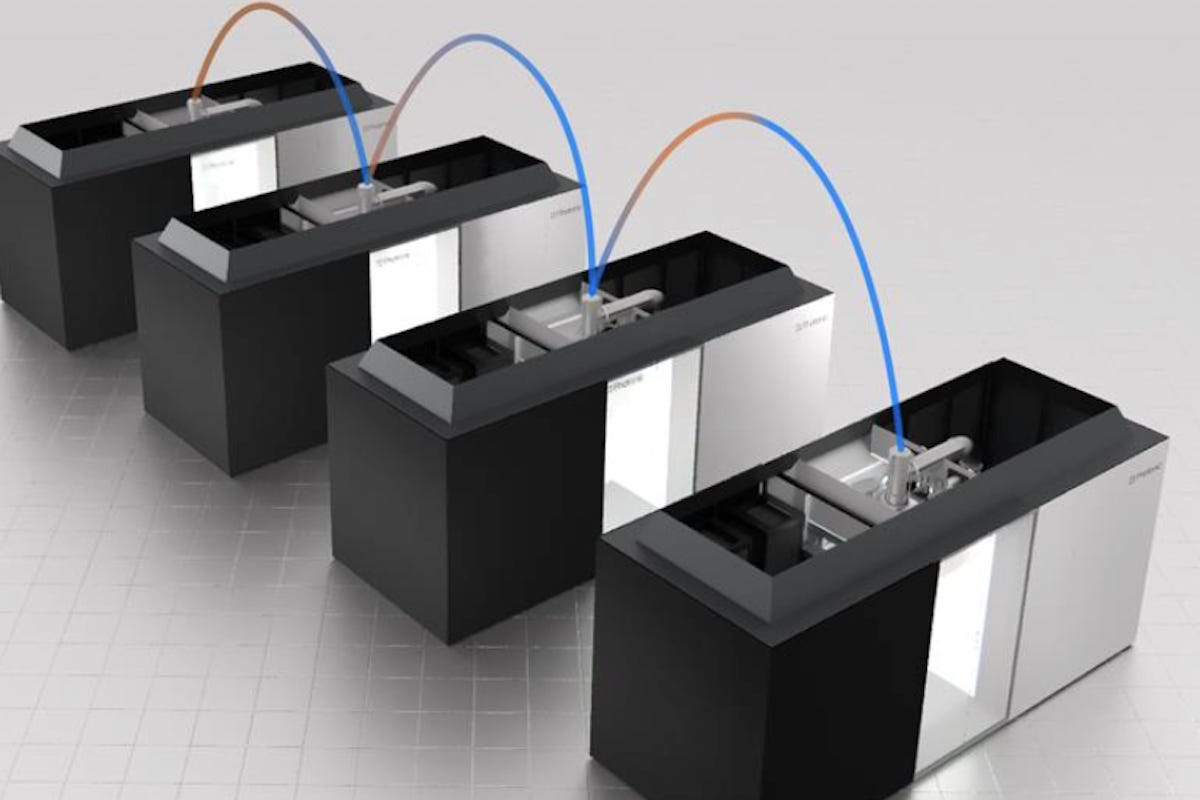
Photonic’s technical differentiation centers on its use of optically linked silicon spin qubits and distributed architectures designed to scale both vertically and horizontally. Conventional quantum computing architectures typically refer to superconducting and trapped-ion qubit approaches that currently dominate the field.
“Conventional competing architectures are not going to be able to scale to sufficient commercial utility, either scaling up sufficiently or scaling out sufficiently,” Morris said. “That’s why Dr Stephanie Simmons founded Photonic, in order to provide an alternative approach and answer to that.”
“Our silicon manufacturing enables vertical scaling, while our native telecom interconnect by light enables horizontal scaling — more nodes talking to each other than in competing approaches.”
The approach combines dense integration, distributed networking and error correction to create a modular pathway toward large-scale systems.
“We scale up via dense integration in one module, scale out through distributed quantum computing across telecom network modules, and scale performance with efficient error correction across thousands of stable qubits,” he said.

This distributed model reflects a growing industry consensus. Networking multiple quantum nodes may offer a more practical route to scale than relying solely on single monolithic machines.
Error correction remains a central challenge for all quantum architectures, as practical systems must operate reliably despite the fragile nature of quantum states.
“Our qubits support the integration of memory, compute and communication,” Morris said. “A qubit in our system doesn’t have to be next to another one to communicate. It can be at any point in the system.”
“That allows us to implement highly efficient error correction codes called quantum low-density parity check (QLDPC) codes.”
Ecosystem partnerships
Alongside government funding, strategic partnerships are increasingly central to accelerating development and validation.
“The most important partnership we have is with Microsoft,” Morris said. “We’re co-developing QRE (Quantum Resource Estimation) and working together on a roadmap towards fault-tolerant, networked quantum systems.”
The collaboration has already produced publicly announced milestones focused on distributed quantum networking.
“We have delivered public milestones around distributed entanglement and teleported gate demonstrations,” he said.
Academic collaboration remains an important part of the company’s ecosystem. Photonic originated at Simon Fraser University and maintains close ties with the institution.
These partnerships highlight how quantum computing development increasingly spans industry, academia and government. They also reflect the scale of the technical and financial challenges involved.