


A federal energy research agency in the United States is betting that quantum algorithms, not just quantum hardware, can help cut the cost of producing hydrogen fuel. The wager centers on catalysts, the materials that make industrial chemistry possible, and whether better ones can be found by simulating them on today’s imperfect quantum machines.
The project targets catalysts used in low-cost hydrogen production, with insights expected to extend to refining and metallurgy. Researchers say the difference between success and failure lies not in bigger quantum computers but in cleverer algorithms that extract useful answers from existing hardware.
Phasecraft, a quantum algorithms company with offices in the UK and the US, announced on June 15 that it had agreed to work with the Advanced Research Projects Agency for Energy (ARPA-E), alongside Johnson Matthey, Harvard and QuEra, on quantum algorithms for catalyst development aimed at reducing reliance on critical minerals for hydrogen fuel, among other things.
“This project, and others like it, are targeting something that is genuinely useful within the time frame of the project, rather than outputting a PDF with some numbers about what you might do one day,” said Ashley Montanaro, co-founder and chief executive of Phasecraft.
“The way that we think about algorithms at Phasecraft is that you can get gigantic reductions in computational costs by thinking abstractly across different hardware platforms,” Montanaro said. “We came up with a brilliant idea that can reduce the complexity of some problem by a factor of a million, for materials modeling, for example.”
Phasecraft designs software for today's imperfect hardware rather than future large-scale machines. It says its published work in materials simulation has delivered efficiency gains of up to 43 million times over earlier quantum methods.
Montanaro said this shift extends beyond the ARPA-E project, with end users increasingly approaching Phasecraft for outcomes rather than exploratory research. Projects now target results within about two years rather than open-ended timelines.
“End users are starting to realize that the sorts of collaborations they can set up with us are heading towards an actual useful outcome, something that’s going to make a difference to them,” Montanaro said. “The projects we’re thinking about now are ones which are targeting delivering something useful in the time frame of two years, and that’s a real difference in mindset.”
He said the sorts of collaborations he and others had some years ago would have been much more fact-finding missions, with end users trying to work out whether it would be 10 or 15 years before quantum computing affected their businesses.
Betting on noisy qubits
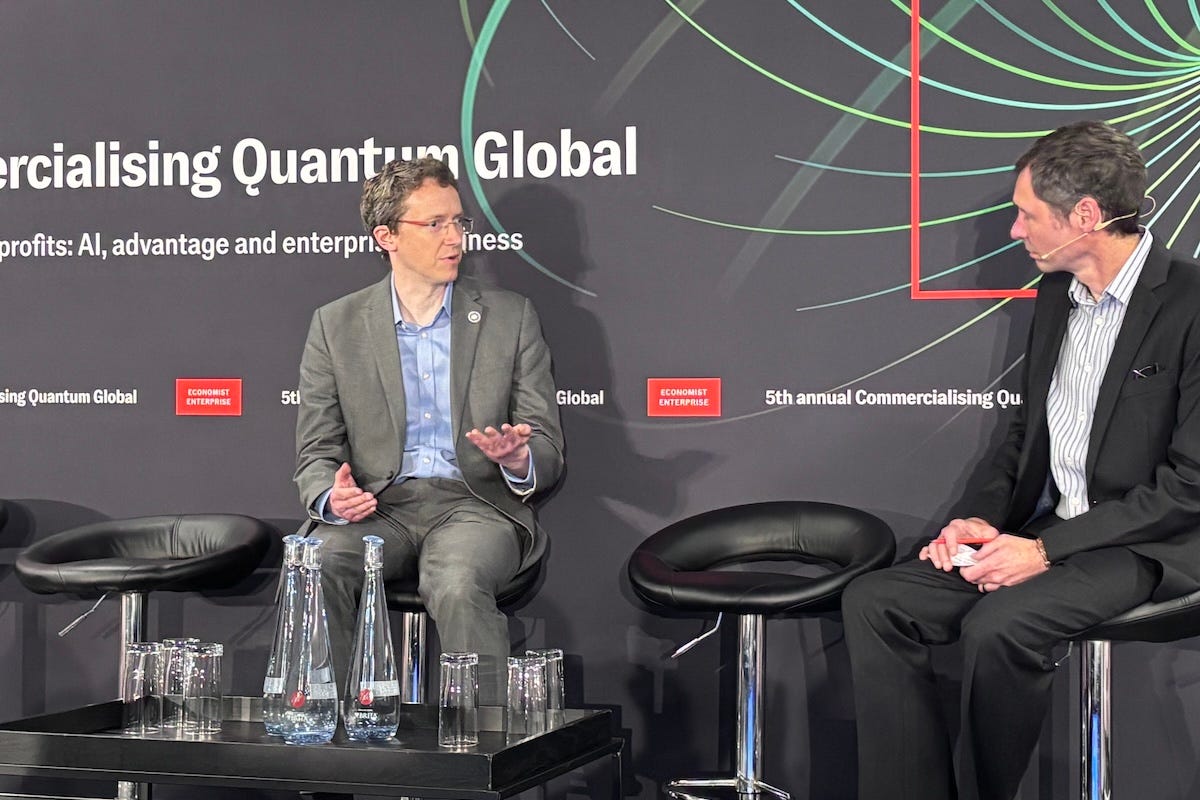
Montanaro’s comments came during a fireside chat titled “When the algorithms arrive: what really determines quantum advantage?” at Commercialising Quantum Global 2026, an event organized by Economist Enterprise in London.
Jason Palmer, host of The Economist’s “The Intelligence” podcast, moderated the discussion, which examined whether hardware progress or algorithm development is the bigger constraint on commercial quantum computing.
Montanaro co-founded Phasecraft and serves as its chief executive, leading a team that builds algorithms for chemistry, materials science and optimization problems designed to run on current quantum hardware.
He said the industry now has a broader set of hardware to build on, noting that the UK plans to procure 10 quantum hardware platforms in its first procurement phase.
He said Phasecraft was working with more and more quantum hardware companies, including Atom Computing, where it was developing and running algorithms on the company’s hardware platform.
Phasecraft and Atom Computing announced their own memorandum of understanding the same day, June 15, focused on adapting Phasecraft’s algorithms to Atom Computing’s neutral-atom hardware to accelerate the development of materials for batteries and solar cells.
Atom Computing has separately announced a $100 million letter of intent with the US Department of Commerce and is taking part in the Defense Advanced Research Projects Agency’s (DARPA) Quantum Benchmarking Initiative.
He said hardware companies increasingly see the benefit of working alongside software and algorithms specialists.
“There’s also more and more of a recognition from the hardware companies that they will benefit from working with the software and algorithms experts to get the most out of those hardware platforms,” he said.
Montanaro also returned to an assertion he made at the same event a year earlier, that near-term commercial value would come from running algorithms on today’s flawed hardware rather than waiting for fault-tolerant machines.
“I still absolutely believe that assertion,” he said. “We’re in this amazing time at the moment, where we’re at the dawn of the error-corrected and fault-tolerant era.”
“If you want to run the most high-performance experiments you possibly can and solve the biggest and hardest problems you possibly can, you’re better off using the noisy and imperfect qubits directly,” he said. “These machines are already showing their value for problems of scientific interest.”
He said problems of genuine commercial value remain on the horizon, with a two-year timeframe still realistic.
There is nothing inherently near-term or long-term about an algorithm, he added. The goal is simply to make it efficient enough, with few enough operations, to run on hardware available today or within the next year or two.
Selling algorithms, not promises
Montanaro said the industry increasingly recognizes the importance of algorithms, but investment has lagged behind that recognition.
“There is this very widespread recognition of the crucial role and importance of algorithms,” he said. “What needs to come now is people putting their money where their mouth is.”
“We’re beyond the stage of just having algorithms funded via research grants or very long-term things,” he said. “There are algorithms and software solutions that we have developed which can deliver scientific utility today. These are things that can now meaningfully be sold, where they couldn’t have been some years ago.”
The lag partly reflects assumptions about how quantum computing should develop. It is easy to assume hardware comes first and software follows, when algorithms can in fact be designed abstractly, ahead of any particular machine, and can achieve quantum advantage across multiple hardware platforms.
“If you’re a user and you have a particular problem you care about, the off-the-shelf quantum algorithms you see in textbooks probably are not going to be good enough,” Montanaro said. “If you want to get decent performance and do something genuinely useful, you’re going to need to work hard to tailor the algorithm to that particular problem.”
Hardware choice still matters. Superconducting qubit platforms tend to run fast but are more prone to errors, while ion trap platforms are slower but more reliable, meaning some problems suit one platform better than another.
“We’re not at a stage now where there is useful and meaningful quantum middleware that takes a problem and says it doesn’t matter what the underlying substrate is,” he said. “You should have an algorithm which really understands the hardware you’re working with and gets the most out of that hardware platform.”
He said most of quantum computing’s advantage comes from it being a fundamentally different computational model, which is where the sort of million-fold reductions Phasecraft has achieved originate. Applying that advantage usefully still means choosing carefully between platforms such as an ion trap or a neutral-atom device.
Looking five years ahead, Montanaro said the picture shifts again.
“In five years’ time it will be much more like a computational chemist will just use a quantum algorithm rather than a classical algorithm to solve their problems, because it’s just one of the standard techniques that happens to be the best one for a particular problem,” he said.
“The sorts of applications we expect to see in a couple of years’ time will be quite specific, quite targeted at particular problems which are really good fits for quantum computing,” he said. “In five years’ time, these domains will have expanded out of all proportion compared with where they are now.”
He added that cryptography is also likely to become an important application on that longer horizon, alongside the materials and chemistry problems Phasecraft is targeting today with ARPA-E and Atom Computing.
The concept of the Quantum Node Economy proposes a future in which quantum computers are interconnected using secure quantum networks, similar to how the cloud currently allows disparate systems to communicate. Individual quantum nodes will not exist in silos, but rather will interoperate with artificial intelligence, high-performance computing, and the cloud in order to facilitate solutions for challenges across the health sciences, financial services, cybersecurity, logistics, energy, and the physical sciences.
Creating this type of ecosystem will necessitate three pillars. Infrastructure will be characterized by quantum processors, quantum networking and communication, cloud integration, and data security and transfer. Work force will require expertise in quantum computing, AI, cybersecurity, software development, photonics and systems engineering supported by institutions of higher education and industrial partnerships. Policy and governance will need to include standards and specifications for quantum technology, cyber security standards for quantum-safe communications, data protection, research and development incentives, international cooperation and ethical considerations for all of the aforementioned to spur development and protect national infrastructure.
The Quantum Node Economy is not meant to substitute classical computing, but to build upon it, uniting quantum computing, AI, and HPC as an intelligent, secure and an interconnected network to fuel future technological and economic advances.