


Perplexity’s flagship artificial intelligence (AI) system can now decide for itself when a task is too sensitive for the cloud, keeping it on the user’s own Mac instead of sending it to a server.
The feature, called Hybrid Compute, shipped on September 1. It adds a privacy gate that scans for sensitive details such as names, addresses, government ID numbers, login credentials and payment card numbers before they leave the Mac. Sensitive material stays local, is masked or requires approval, while other tasks run in the cloud.
Hybrid Compute offers a choice of three local models:
Google’s Gemma 4 E4B
Alibaba’s Qwen3.6 35B-A3B
A proprietary Perplexity model
It requires an Apple silicon Mac with 24GB of unified memory, available to Pro, Max and Enterprise subscribers.
Hybrid Compute is the clearest expression yet of what Aravind Srinivas, Perplexity’s co-founder and chief executive, calls the biggest shift in computing in decades: machines built to pursue outcomes instead of follow instructions.
“For most of computing history, you had to tell the machine exactly what to do. With AI, that’s finally changing. You tell the computer what outcome you want, and it reasons, searches and executes whatever it needs to satisfy that outcome,” he said.
“With AI, the computer is a Ferrari for the mind, and Perplexity is the engine for the Ferrari. The word ‘computer’ has been around for 400 years, but its definition changes every time the technology does. Right now, the definition is changing again.”
Jobs made a similar comparison in a 1990 interview for the documentary The Machine That Changed the World, describing the computer as “a bicycle for the mind.” In the same interview, he predicted a far bigger shift in computing was coming, one that took 36 years to arrive.
Srinivas said the shift itself rests on three changes:
AI can finally read the internet with the fidelity of a computer reading its own storage, treating the web as a single disk of knowledge
Processing is giving way to reasoning, turning raw information into judgment and decisions
Operating systems are moving from taking instructions to pursuing objectives
Perplexity was founded in 2022, positioning itself as an “answer engine” rather than a search engine: instead of links, it provides direct answers. Search has stayed largely link-based since Google’s PageRank reshaped it in the late 1990s, even as AI transformed software.
“It’s strange that the tech industry settled there and stopped innovating search for 28 years,” he said. “Google turned the paper card catalog of the library into a $300 billion advertising business, and everyone else stopped innovating.”
The company later expanded into Perplexity Computer, unveiled in February 2026 to run projects end-to-end. The agentic AI platform spins up teams of agents across 19 models, including Claude, GPT and Gemini.
In April, Perplexity extended Computer to the desktop, announcing Personal Computer, a Mac-based version that works across local files, native apps and the web at once, organizing folders, comparing local data against the internet and carrying out to-do lists on its own.
Perplexity described it as hybridizing local and server processing, with local files kept in a secure sandbox and every action auditable and reversible. Left running on a Mac, it can also work around the clock without needing a fresh prompt each time.
The orchestration problem
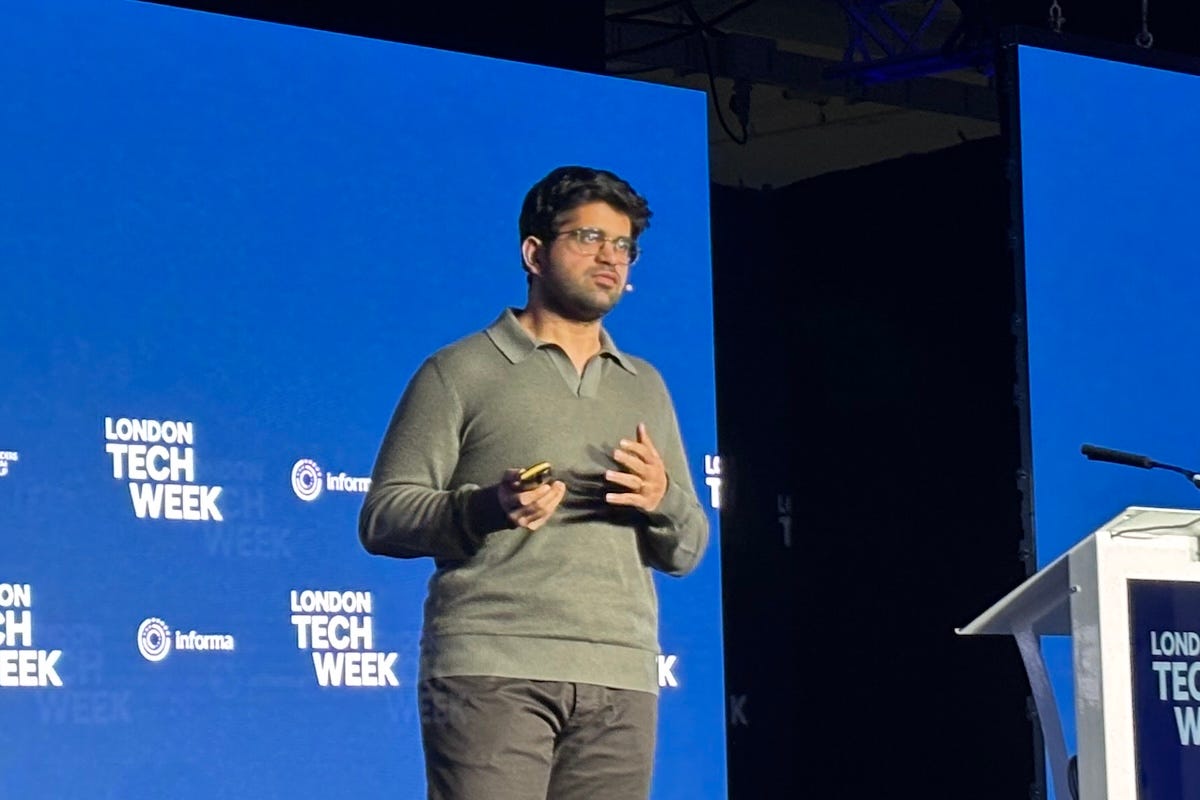
Srinivas delivered the keynote, titled “AI is the Computer,” in June as London Tech Week 2026 got underway. The event was co-organized by Founders Forum Group and Informa Festivals, and founded by London & Partners and Tech London Advocates.
“Think of the orchestra. The agents that Computer creates are all the individual musicians, the instruments they play are the different models, and Computer is the conductor,” he said.
Srinivas described an on-device classifier that decides when a task should stay local, running a compact model for sensitive work while heavier tasks go to frontier models in the cloud.
“Every time I come to the UK, somebody asks me about data sovereignty. It doesn’t get much more sovereign than sitting right on your lap,” he said. “We are in the earliest days of this. It’s only going to get better as local models get more powerful.”
“A cloud-based computer is incomplete. An AI operating system should not be tied to your device. Perfectly balancing intelligence, accuracy, privacy and cost, that is the orchestration problem, and Perplexity is the right company to solve it.”
He said every desk in every office exists to hold a computer because computing has always been personal, but that the shift toward objectives means people no longer need to stay tied to a screen to get that benefit.
The same idea extends to the wider ecosystem: the system is designed to keep improving on its own as any part of it advances, whether through a new frontier model or a more capable chip that enables local inference.
A million-pound bet
“What bothers me about talking of the future of AI is that the future of AI will be whatever it is. The future that matters is what people can do with it,” he said.
In the US, Perplexity has run a competition called the Billion Dollar Build, challenging one- to two-person teams to build a company with a credible path to a billion-dollar valuation using Computer as their primary tool.
Around 1,500 people registered for the U.S. competition, and some shipped revenue-generating businesses in under two months, with Computer handling much of the building and operating. Several went on to win other pitch competitions and raise funding from angel investors before the program had even concluded, Srinivas said.
“It’s based on the idea that AI will lead us to the first one-person, one-billion-dollar company,” he said.
Perplexity also launched a UK version: the Billion Pound Build.
“This is the first time we’re taking this program outside the US, and I’m really proud to start here in the UK,” he said. “You have to build something real.”
The prize is a share of £1 million in Computer credits, for one- to two-person teams, over eight weeks.
He tied the launch to Britain’s tech credentials, saying the country is home to four of the world’s top 10 universities, the birthplace of modern peer review, and a natural fit for Perplexity’s own commitment to trustworthy knowledge sharing. He framed the wider stakes with a warning from computing history.
“Every time the concept of a computer has changed, the technology landscape has shifted in favor of whoever understood the new meaning first,” he said. “IBM owned the mainframe and missed the PC [personal computer]. Microsoft owned the PC and missed mobile. Nokia owned mobile but missed the smartphone.”
This history is why Perplexity calls its product Computer, not a conventional product name.
“Computers are personal. A computer needs your personal context, your files, your tools and the way you actually do your work,” he said.
Srinivas closed with a nod to Jobs’s bicycle metaphor, recalling that some people ride bikes around the park, others race them or build their own, and one man once rode his bike to Mount Everest, climbed it without oxygen, and rode home to Sweden. He ended by telling the audience that tools only define what is possible, not what anyone chooses to do with them, urging the crowd to decide for themselves and go for it.