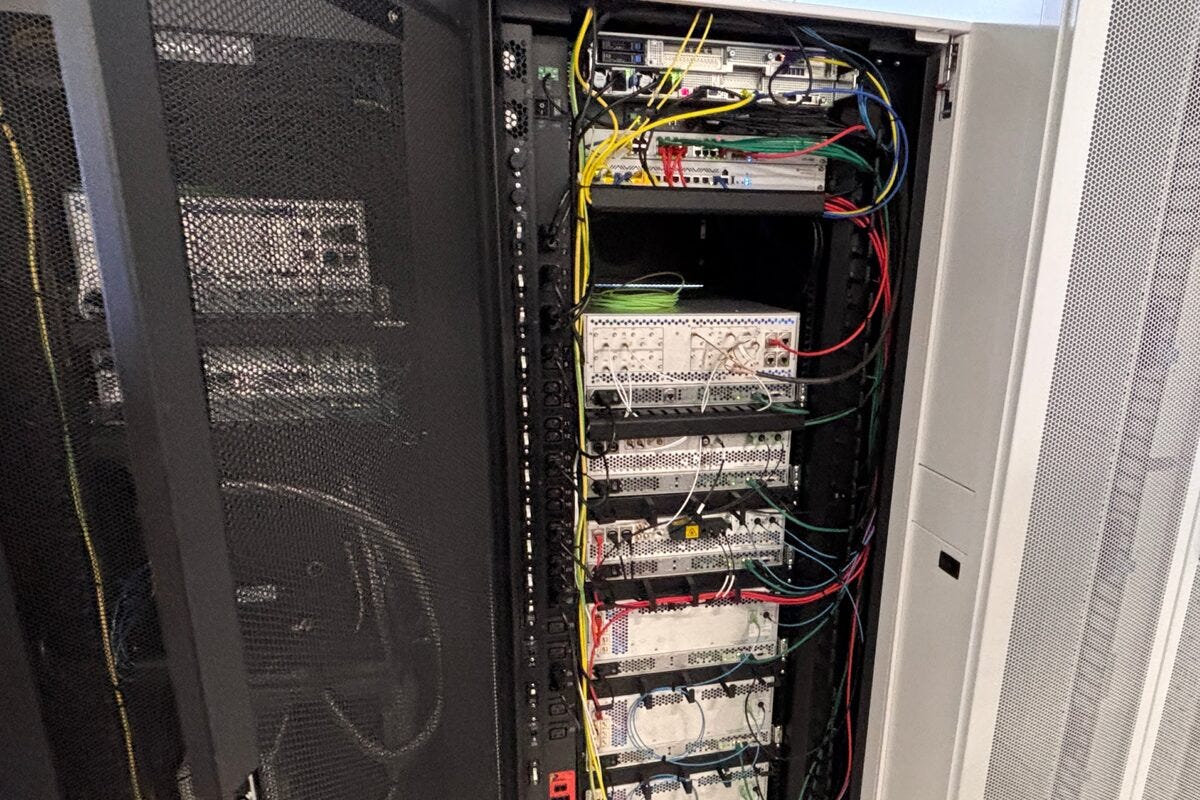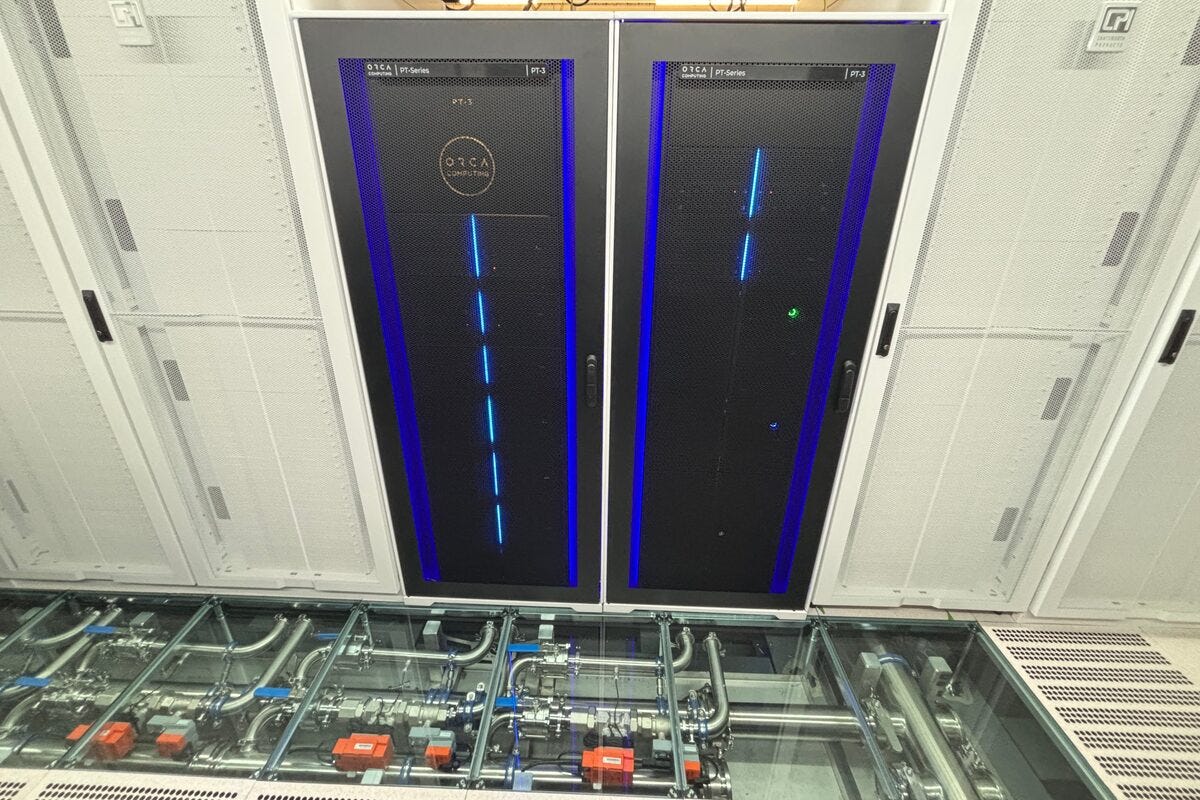
ORCA Computing, a London-based photonic quantum computing company, has launched the PT-3, which it says is the first quantum computer built for commercial quantum advantage.
The first system is now live at Digital Realty’s innovation lab in London, where it runs alongside NVIDIA graphics processing units (GPUs) on artificial intelligence (AI) for science and optimization workloads. It operates at room temperature, draws 6kW across two standard racks, and can run within hours of installation.
“By integrating our photonic quantum computer with NVIDIA-accelerated computing, we have taken a critical first step in the future of hybrid quantum supercomputing,” said Richard Murray, co-founder and chief executive of ORCA Computing, in a press release. “The PT-3 is built to scale. It upgrades in the field, so customers who start today keep building on the same system.”
Murray said customers are already testing use cases in life sciences, defense, energy and logistics.
ORCA added the PT-3 to Proteína, NVIDIA’s generative model for protein design. Trained on 32 NVIDIA Hopper GPUs alongside the PT-3, the hybrid model improved the ratio of useful proteins by 20% over the classical version.
The PT-3 also tackles energy scheduling. Earlier this year, ORCA, Japanese quantum software firm JIJ, bp and the UK’s National Quantum Computing Centre (NQCC) published a white paper benchmarking hybrid methods on the “unit commitment” problem. The PT-3 now runs the 25,755-variable benchmark in about an hour, more than 12 times faster than its predecessor.
In the white paper’s tests, the hybrid solver matched the industry-standard commercial solver in solution quality.
“Take any airline, any defense organization, any large logistics company. They’ll all be struggling to solve very large optimization problems: routing delivery drivers and making sure their workforce, tools and resources are in the right place,” Murray said.
Clem O’Rourke, principal data scientist at Origami Labs, a research and development (R&D) consultancy focused on AI, optimization and autonomy largely in defense and government, has worked with ORCA for about four years.
“We found it quite useful when you can evaluate your cost function quickly, but the solution space you’re trying to explore is big and complicated to move around,” O’Rourke said. “There are some problems which work very well, and other problems which don’t, just like there are classically.”
“We’ve been extremely impressed here by how quickly it was installed and integrated when it arrived,” said Séamus Dunne, senior vice-president and managing director for the UK and Ireland at Digital Realty. “There’s an attractive point about the speed of deployment and how it can integrate into IT infrastructure and systems right now.”
ORCA was spun out of the University of Oxford in 2019. It put a quantum computer into a data center in 2022 and has since installed 11 PT Series systems in customer data centers worldwide, working with more than 35 customers and partners.
Filling the data gap
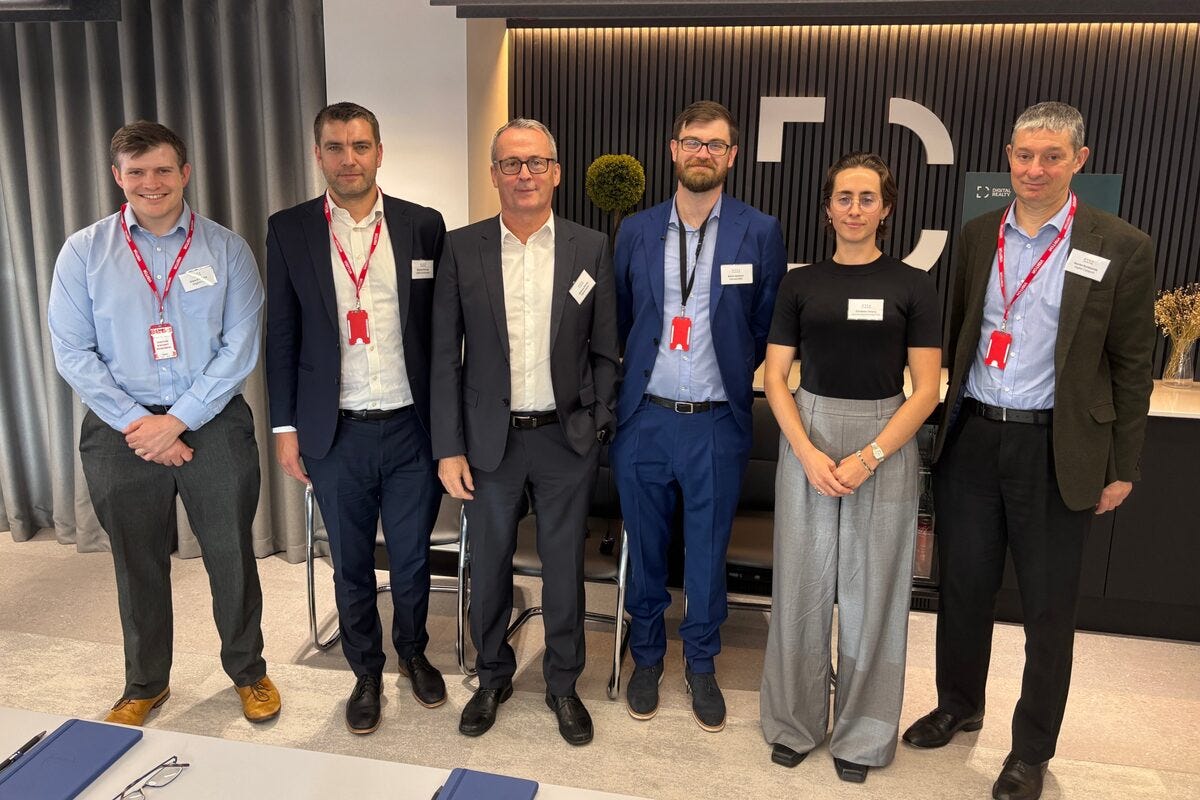
On October 14, a day before the launch, ORCA hosted a roundtable in London on how close quantum computing is to delivering commercial value. Kevin Jackson of market research firm Intersect360 moderated the discussion.
Murray said the PT-3 is ready for quantum advantage, though ORCA is not yet claiming to have achieved it.
He said AI for science, which applies AI to predicting molecules, industrial processes and other physical things, often lacks the abundant training data available to language models. If a model is meant to design therapies no one has thought of before, there is almost no data to train it on, he said.
“Lots of people talk about the intersection of quantum and AI. The reality is they’re two quite different types of computers, so it’s not a natural marriage,” he said. “The quantum system we’re building is itself scientific and incorporates all the laws of quantum mechanics that these AI models would otherwise have to learn.”
ORCA inserted the PT-3 into Proteína as a “prior layer,” one of the model’s first layers, and trained the quantum and classical parts together. The quantum output is abstract and feeds the rest of the model, which turns it into real molecular data.
For the experiment, the PT-3 used 64 photons spread across 128 “qumodes,” or optical quantum modes.
“Quantum systems have struggled because they haven’t been able to be trained. Gradient descent methods haven’t been possible in quantum systems. We’ve got a method to do that,” Murray said.
He said the hybrid model improved both “designability,” the likelihood of producing a real molecule, and the diversity of molecules generated. ORCA is running extensive benchmarks across several models, the largest with 200 million parameters.
“I don’t want to get too carried away here. A lot of this is the first indication of many things to come,” he said. “As with all quantum advantage claims, we’re getting ready for a lot of counter-claims.”
He said the PT-3’s most important feature is its speed. The model switches between quantum and classical hardware so quickly during training that it works far worse over a remote link.
When asked by TechJournal.uk how much time the PT-3 could cut from protein design compared with a supercomputer, Murray said he wasn't sure whether ORCA had measured time savings, as it has focused on result quality, such as designability and molecular diversity. He said the company would share data comparing it with classical computing.
Panelists also highlighted energy savings as a less discussed advantage.
“Some of our potential customers are too busy just buying GPUs. But slowly there is a realization that that’s not sustainable,” Murray said. “When you wake up and realize that even Texans are starting to complain about data centers, you know there’s something going on.”
He said ORCA’s quantum computers run on 6kW, so moving workloads from GPUs to quantum shifts them from energy-intensive processes to ones with negligible energy use, letting more AI run on less power. He said quantum could keep AI’s growth sustainable.
Dunne said the PT-3 draws little power compared with the high-density GPUs behind AI training and inference.
Daniel Goldsmith, senior quantum computing technologist at Digital Catapult, said classical computers lose time and energy moving data between processors and memory and through heat and interconnects, problems quantum machines don’t necessarily share.
Proof before production
Dunne said most IT executives at banks, governments and pharmaceutical companies are experimenting with quantum, almost always in lab environments.
“No IT executive running a business implements something in production until it’s proven. You’re not going to prove quantum computing in the labs,” he said. “Proving the science seems to be the obsession, but proving real-world application use cases is being neglected.”
He said the chief information officer (CIO) of a large UK bank recently visited to discuss AI. The bank plans to shut its own data centers. Its team spotted ORCA’s machine in the racks and asked about it.
Clem O’Rourke, principal data scientist at Origami Labs, a consultancy that works largely in defense and government, said hype has pushed some potential customers away from quantum altogether. A contact at the Ministry of Defence (MOD) told him the word “quantum” was no longer allowed in their future planning.
“We need to start delivering tangible, provable benefits now to get people back on board,” he said. “If we start to say, ‘This is a benefit we have seen, and it’s standalone, ready to go, integrated,’ that’s going to cut through.”
Murray said the quantum industry bears the burden of proof.
Cordelia Tahany, investment associate at Unicorn Asset Management, a UK small-cap investor that backs ORCA, said Britain is good at funding such companies early but struggles to raise the large sums needed to scale them.
“Valuation will follow revenue more and more. With those 100-times sales multiples we’re currently seeing in the market, people are going to want to see real commercial delivery,” she said.
She expects fewer and bigger deals, noting that about 60% of the 12.6 billion raised in the sector in 2025 went into 10 deals. She said a shift in customer spending from research budgets to operating budgets would show quantum has become a core tool.
ORCA’s systems sell for $2 million. Murray said that makes them a similar investment proposition to GPUs.
“If a company is investing in quantum off its balance sheet, it means it is treating it as an asset that will pay back with a return on investment,” he said, borrowing a phrase from another chief executive.
Murray said learning how to apply a quantum computer is the industry’s biggest skills gap. As the technology moves out of the laboratory and becomes a scalable, robust product, it needs product, deployment and applications specialists to work alongside scientists.
Goldsmith said organizations that did best in Digital Catapult’s Quantum Technology Access Programme (QTAP), which gives users time on ORCA’s machine, brought people who knew their business problems, the classical solutions and where quantum might fill the gaps.
“They were data scientists but had no experience of quantum at all. They were running things on the simulator within about a month,” O’Rourke said of colleagues who joined QTAP. “It all sits in Python, so it’s quite an easy process to go through.”
Digital Catapult is running a third QTAP cohort with ORCA and the NQCC, using better hardware and algorithms, to move participants’ work from trials into live production.