


OpenAI expects to build more in Britain, not less, even with its most ambitious UK project still on ice. That gap between ambition and reality is becoming the real test of what artificial intelligence (AI) sovereignty means in practice.
For governments trying to lock in AI investment, relevance and leverage increasingly matter more than a company owning every layer of the technology stack on their soil.
“I can only see a future in Britain where there are going to be more data centers, and OpenAI is going to be making more use of them,” said George Osborne, managing director and head of OpenAI for countries and a former UK Chancellor of the Exchequer.
“The future of data centers is a question for a lot of mature democracies,” he said. “How do you get the right environment to allow construction in a way that also makes commercial sense for the companies?”
He pointed to OpenAI’s new data center in Michigan, where the company had broken ground in June, as an example of that kind of environment working.
“In Michigan, we made sure energy bills wouldn’t rise, that water quality stayed top-notch, and we’re spending $45 million on skills for the state’s students,” he said. “Tech companies like OpenAI are working harder to make these big infrastructure commitments politically viable.”
“Outside of the US, OpenAI has more people in Britain than anywhere else in the world, and we’ve established London as our European research center,” he added. “Britain mustn’t lose that head start, because a lot of other countries are having the same conversation about how to accelerate their place in the AI future.”
“I called (Google founder) Larry Page when I was Chancellor of the Exchequer, and we got Google to commit to a big new headquarters in London, in what was then a new development area, King’s Cross,” he said. “Getting that company to move there created a kind of ecosystem of lots of people.”
Kanishka Narayan, the UK’s minister for AI and online safety, said the government is trying to create that kind of environment in Britain.
“What we’re trying to do is pull every lever of government,” he said. “Procurement, wider access to public sector datasets, and a 24-hour visa turnaround for workers at sovereign AI portfolio companies.”
OpenAI paused its Stargate UK data center project in April, citing energy costs and regulation, and signed a lease for its first permanent London office four days later, in the same King’s Cross neighborhood Osborne once recruited Google to. The office, opening in 2027, will house more than double the roughly 200 people OpenAI employs in London today.
Leverage over ownership
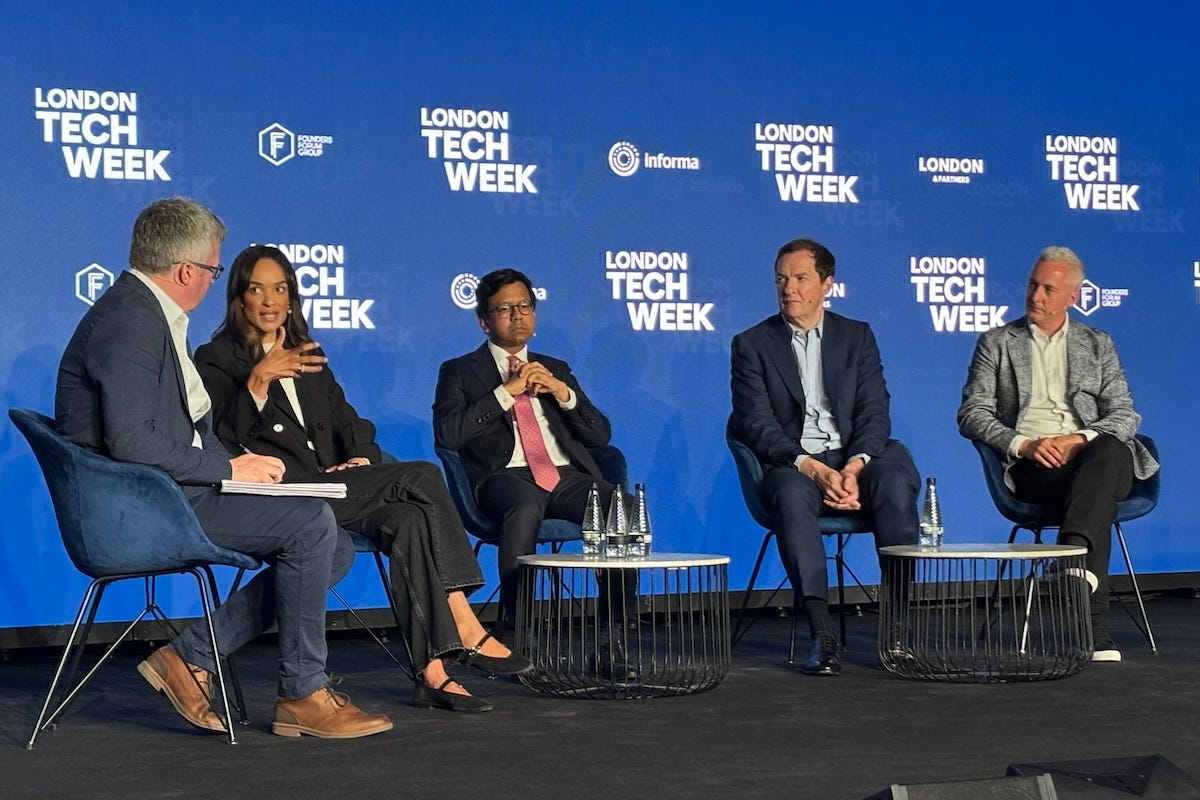
The discussion took place at London Tech Week in London in June, hours after the government unveiled its AI Hardware Plan. It was moderated by Dan Milmo, global technology editor at The Guardian, and organized by Founders Forum Group and Informa alongside London & Partners and Tech London Advocates.
The panel examined the case for sovereign AI development in Europe.
Osborne said the right way to think about sovereignty is in terms of relevance and leverage, not full ownership of the technology stack.
“It’s a fool’s errand to think you’re going to be able to make every bit of the stack,” he said. “Even the United States and China are not able to do that.”
Narayan framed sovereignty the same way, as a combination of the outcome a country wants and how it gets there.
“The real test is whether Britain has built enough strategic leverage to sit at the table with the US, Taiwan, South Korea and the Netherlands, with enough chips on the table to secure mutual interdependence,” he said.
Judith Dada, general partner at Visionaries Club, was blunter about the stakes for Europe. She was presiding over a report on EU AI sovereignty and said Europe hosts about 5% of the world's AI data center capacity, compared with roughly 80% in the US.
“If we don’t drastically change course on AI in Europe, we will end up politically sidelined, with a stagnating economy and without the ability to continue the kind of social welfare systems that make Europe so strong,” she said. “It’s not about owning everything in the stack. It’s about owning the crucial bottlenecks that allow you to build leverage.”
She pointed to Elon Musk’s xAI, which has not built a leading frontier AI model but has amassed enough computing capacity to broker deals with other companies in the field, as an example of that kind of leverage.
“The only way for Europe to significantly increase data center capacity on its own soil is to partner with US hyperscalers, because supply chains are locked up and booked years into the future,” she said.
She pointed to Germany, where she is based, and to the €500 billion in capital it is mobilizing for its largest infrastructure program in years as evidence that large-scale action is possible once the political will exists.
Betting on the state
Milmo turned to the question of whether Britain can really pick winners across such a complex technology stack.
“The central question is not whether you pick winners or losers,” Narayan said. “Historically, any successful industrial policy has had to make strategic choices.”
He credited the AI Security Institute with building state capacity his government has since built on.
“The Sovereign AI Unit is already seen as a genuine top-tier investor within months,” he said. “We’re investing in companies where no other UK investor is able to engage, because those companies want to engage with the British government.”
The unit, backed by £500 million, launched this year to back domestic AI startups and infrastructure.
Dada agreed that state action at scale is possible when the will exists. “We’ve mobilized unprecedented public and private capital before, when Russia invaded Ukraine and when COVID hit,” she said. “We need the same thinking about AI.”
Matt Harris, managing director for the UK, Ireland, the Middle East and Africa at Hewlett Packard Enterprise (HPE), broke down the debate differently.
“Effective AI needs power and energy, clean and accessible data, strong models and applications, and then talent and capital sprinkled on top,” he said. “That’s the whole stack of requirements.”
“We cannot go it alone as the UK. We just do not have the same capability that already exists within large US organizations,” he said. “But if we build fundamental control points, we can do it on our terms.”
He pointed to Isambard AI, the national supercomputer at the University of Bristol that HPE helped build and operate with the UK government, as already oversubscribed.
An audience question cited a remark by Nick Clegg, the former Meta executive who said he left the company because Silicon Valley had “gone MAGA,” and asked whether Britain and Europe can guarantee AI reflects their own values given how dependent they are on American and Chinese technology.
Osborne was not sure the models carry values at all.
“I’m not sure the models represent particular values, although they do have guardrails around them, like safety, which I think will be fairly universal,” he said. “The challenge is going to be delivery.”
“In Estonia, they wanted the education product we built with them to reflect Estonian history and language, because although it’s a small language in the scheme of the world, it’s very important to Estonians,” he said.
He cited Greece and Malta as two more small countries advancing quickly in AI adoption with OpenAI’s help.
“The central question that has motivated this government is whether British values shape AI, or the other way around,” Milmo said.
He described three ways Britain is trying to exert agency over the technology:
Moving fast to regulate clear harms, citing Grok, the chatbot built by Elon Musk’s xAI, which generated non-consensual sexualized images of women and children in Britain before regulatory pressure forced the company to change its product;
Building state capability through the AI Security Institute, one of the few bodies outside the US with direct access to frontier models to assess their risks;
Accepting that full control is not possible, and sustaining constant public engagement instead
Narayan said the pace of that public conversation, not any single piece of regulation, will determine whether Britain’s AI ends up reflecting the values it set out to protect.