


OpenAI has vowed to boost its presence in enterprise markets after industry data showed its grip on key sectors has weakened amid intensifying competition from other large language models (LLMs).
Benchmarking data from Evident, an artificial intelligence (AI) benchmarking and intelligence platform focused on financial services, shows that OpenAI’s share of underlying AI use cases in major global banks has fallen from roughly half 18 months ago to about one-third by the end of last year, as financial institutions diversify their AI providers.
The loss of share has sharpened OpenAI’s focus on large organisations, particularly in regulated industries where trust, governance, and deployment speed determine whether AI systems ever reach production.
A central element of that response is OpenAI’s deepening partnership with Snowflake, announced on February 2 as a US$200 million, multi-year agreement designed to embed AI capabilities directly within enterprise data environments.
“When it comes to agents and generative AI, it’s all about context, and that deep context starts with enterprise data,” said Ashley Kramer, vice president of Enterprise at OpenAI. “This partnership allows customers to work with real-time data rather than stale extracts, while observing the security and compliance controls that already exist with Snowflake.”
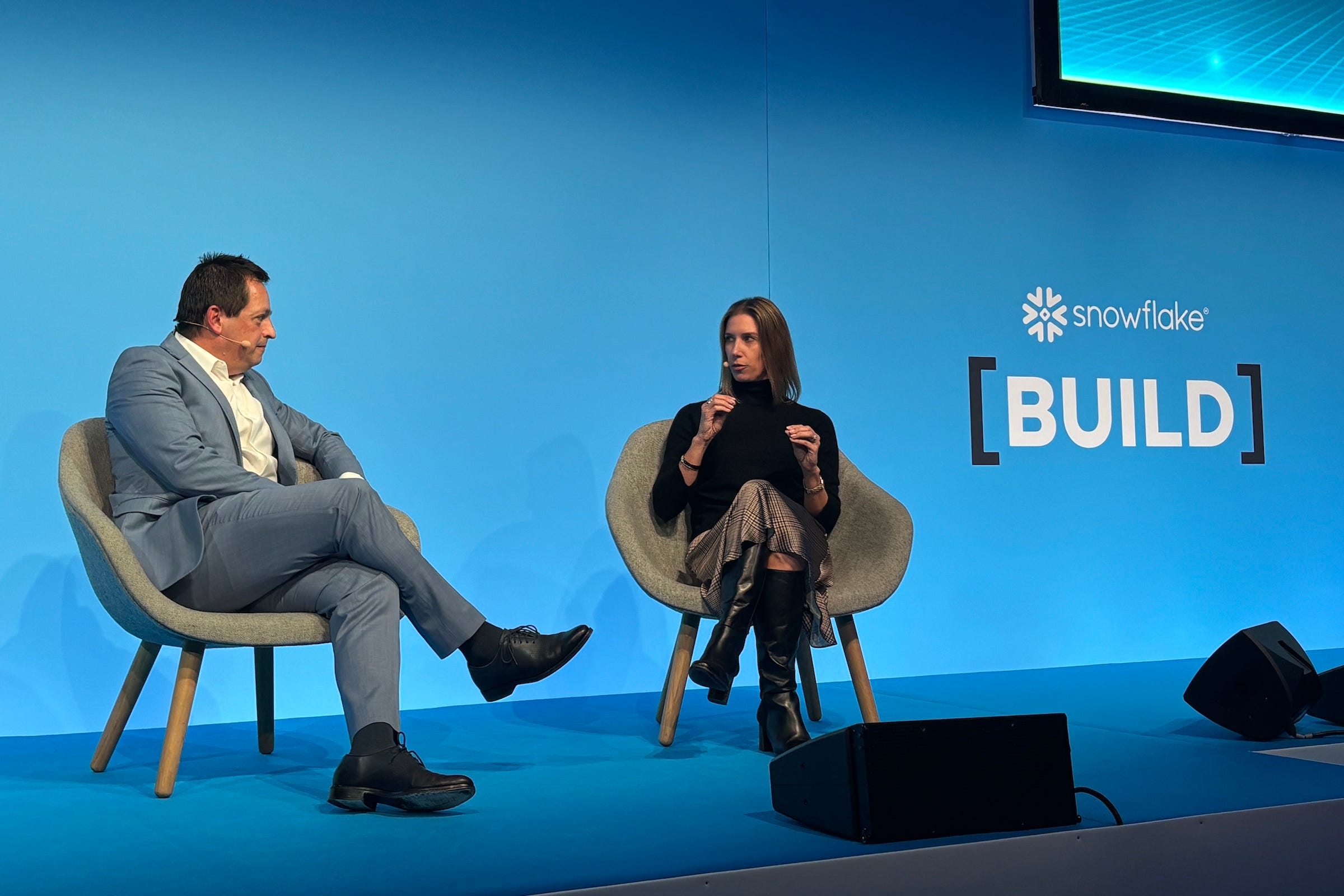
Kramer made her comments at the “BUILD London: The Dev Conference for AI & Apps” event, held in London on February 3.
She spoke with Christian Kleinerman, executive vice president of product management at Snowflake, during a session focused on enterprise artificial intelligence adoption, governance, and the rise of agent-based systems.
According to a press release, the partnership makes OpenAI models natively available to Snowflake’s 12,600 global customers through Snowflake Cortex AI across all three major cloud platforms.
The two companies said customers, including Canva and WHOOP, plan to use the setup to deploy AI applications and agents on top of their governed enterprise data, while OpenAI models such as GPT‑5.2 will also be accessible within Snowflake Intelligence, Snowflake’s enterprise intelligence agent for querying and acting on organisational knowledge using natural language.
Europe’s AI governance
Kramer said OpenAI’s approach to Europe reflects an effort to meet enterprises where they already operate, rather than requiring them to compromise on compliance or control.
“From an OpenAI perspective, we always keep security, governance, and privacy top of mind,” she said. “We will never train on enterprise data, and we comply with the EU AI Act. We have data residency, not just for the EU, but for the United Kingdom as well.”
Those compliance commitments, she said, are not simply defensive measures but shape how enterprises design and deploy AI systems from the outset.
In her view, Europe’s regulatory environment is influencing corporate behaviour in ways that can shorten the path from experimentation to large-scale deployment.
“From my perspective, Europe is by no means slower or behind. They just go about the process differently. In Europe, a lot of the governance and compliance work is done upfront,” she said. “You bring security, legal, IT, and engineering together at the beginning. It might take a little bit longer, but then you can go from pilot to mission-critical production much faster.”
She said this regulation-first mindset is shaping OpenAI’s enterprise strategy in Europe, particularly in the UK, Germany, and France, which she described as among the company’s strongest enterprise markets outside the United States.
“In Europe, you’re bringing security, legal, IT, and engineering together upfront. It might take a little bit longer, but then you can move from pilot to mission-critical production much faster,” she said. “That’s actually not a bad thing.”
She contrasted that approach with the US, where organisations are often quicker to launch pilots than to align internal stakeholders.
“In the US, they are much more likely to jump into a pilot first. Then what happens is the organisation gets messy,” she said. “In one case, a bank in New York had to go through 17 committees to get a pilot into production, and it took over six months.”
“In America, people tend to go into the approvals and the regulation at the end of the process, which can actually be highly frustrating, because everybody gets excited about AI being introduced, and then they have to wait,” she said.
Europe’s slower start, she said, often results in faster and more confident deployment once systems reach production. She added that both the US and the EU can learn something from each other.
From chatbots to agents
Beyond regional differences lies a broader challenge facing enterprises globally: a widening gap between what frontier AI models can do and the value organisations can extract from them.
“We’re at a critical moment right now where model capabilities are not the issue,” she said. “They are moving so fast that enterprises can’t keep up. There’s a huge value gap between what models can provide and the value that enterprises are actually extracting.”
That need for discipline becomes more acute as enterprises move beyond chatbots toward agentic AI systems capable of executing tasks autonomously.
“We’re seeing agents go from answers to true action,” she said. “It’s no longer just about retrieving information. It’s about making decisions and taking actions for you.”
She illustrated the shift with a consumer example, describing how future agents could plan and book an entire trip based on a high-level request. Inside enterprises, she said, the same principle applies, but with far higher operational and regulatory stakes.
“In the enterprise, we’re at a moment where it is about trust, not the technology,” she said. “The technology is there. And there’s responsibility on OpenAI’s part, Snowflake’s part, and, of course, the customer’s part.”
To make that trust possible, she said observability and auditability are essential.
“When it comes to enterprise agents, every step will be logged so you can audit it, review it, understand the metrics, and iterate,” she said. “There are powerful ways to bring this to life in enterprises, and you have to be thoughtful about it.”
Kramer cautioned against automating entire workflows in a single step.
“Don’t start big. Don’t introduce an agent that’s going to take care of a huge action,” she said. “Start with humans doing the actions, then humans approving the actions, and only later move to humans just reviewing the outcome.”
Crucially, she said agentic AI should not be treated as a shortcut for existing processes. The real opportunity lies in redesigning workflows altogether, questioning whether long-standing processes still make sense once advanced AI capabilities are introduced.
As European enterprises accelerate adoption, she said OpenAI sees momentum building rather than slowing. The UK, France, and Germany are already among the company’s strongest enterprise markets outside the United States, reflecting what she described as a pragmatic appetite for AI that is both powerful and governed.
Her message to organisations weighing their next steps was blunt. She said AI is already reshaping competitive dynamics, and organisations that fail to engage risk falling behind.
Kramer joined OpenAI in May 2025 and oversees global go-to-market efforts to help organisations adopt artificial intelligence responsibly and at scale. Her role spans sales, marketing, product, and technology, giving her a cross-functional view of enterprise adoption.
Before OpenAI, she held senior leadership roles at GitLab, including chief revenue, strategy, and marketing officer and chief technology officer, and previously worked at companies such as Alteryx, Tableau, and Amazon.