


Artificial intelligence (AI) is advancing at a pace few organizations can match, exposing a widening gap between what the technology can deliver and what businesses can extract from it. The constraint is no longer whether AI works, but whether companies can absorb, deploy, and scale it effectively across their operations.
That gap is becoming a defining challenge as enterprises invest heavily in AI but struggle to translate capability into measurable outcomes. The issue is a structural misalignment between fast-moving technology and slower organizational systems.
“We’re actually seeing the gap widen. We’re seeing the technological innovation and what the technology can actually do is accelerating, but the value that businesses are extracting is somewhat remaining flat. Our goal is working every single day with companies and customers to narrow that gap,” said Nicolai Skabo, EMEA enterprise lead at OpenAI.
“The ones who are truly approaching this from a true business transformation are the ones that are having success,” he said. “They’re rethinking this from the ground up. They’re thinking about their organizations at the capability layer, not just at the technology layer. They are building the skill set, the operating rhythm and the system. The technology can’t do that on its own.”
Enterprise drag
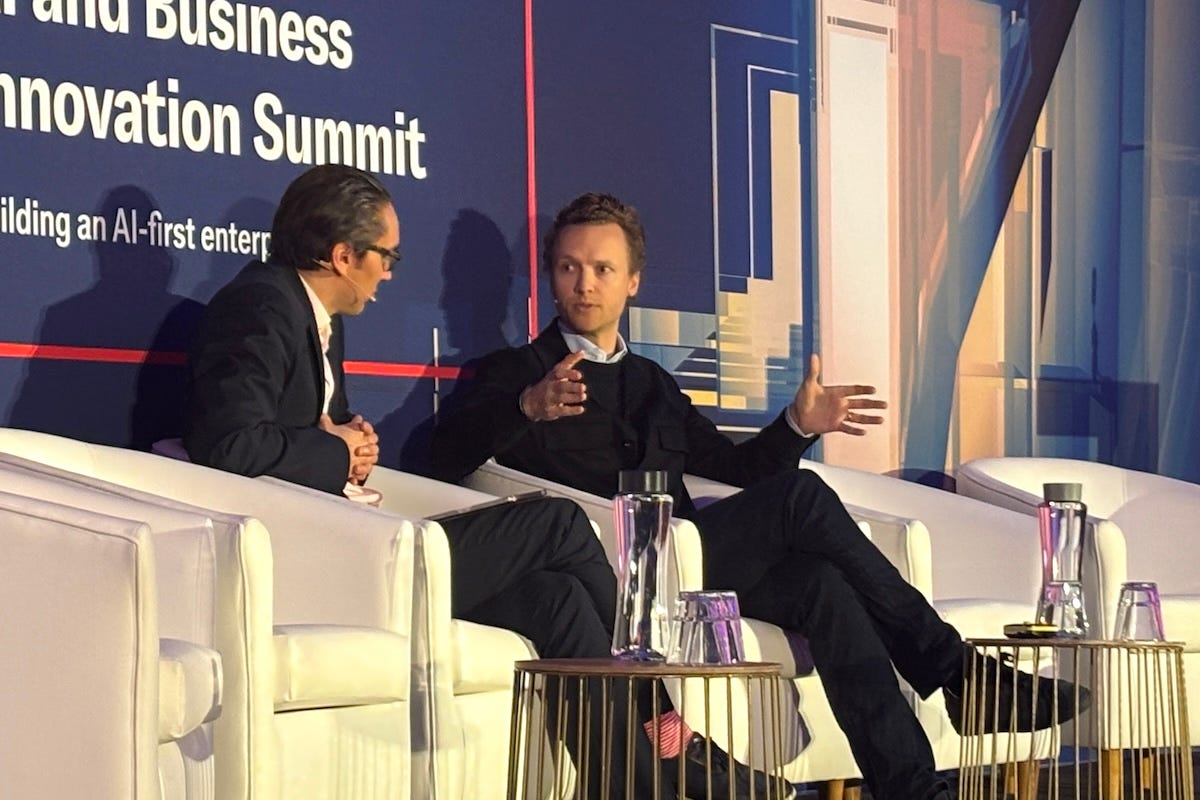
The discussion took place at the AI and Business Innovation Summit, organized by Economist Impact on March 25, in London. Skabo was speaking in a session, moderated by Dexter Thillien, lead analyst for technology and telecoms at the Economist Intelligence Unit, that focused on how organizations adapt to rapidly evolving AI capabilities.
Across financial services, manufacturing, life sciences, and telecommunications, companies are deploying AI at scale, but benefits remain uneven, reflecting a disconnect between technological progress and enterprise readiness.
This disconnect is rooted in what he described as enterprise inertia or drag, in which legacy processes, governance structures, and operating models slow adoption. Many organizations continue to layer AI onto existing workflows rather than redesigning them, thereby limiting the technology’s impact.
“It’s kind of that enterprise inertia or drag. The companies that have the most success are the ones willing to rethink how their business operates at a fundamental level. If you’re not testing and learning quickly, you’re very quickly behind,” he said.
The comparison, he noted, is similar to earlier industrial transformations. Just as factories had to be redesigned to take full advantage of electricity or steam power, businesses today must rethink how work is organized to fully benefit from AI.
Operating model shift
A key barrier lies in how organizations are structured for evaluating and deploying new technologies. Traditional processes for procurement, compliance, and risk management are often too slow to keep pace with AI’s rapid evolution.
“Most companies have not been structured or set up to handle the pace of innovation that has come from AI. You have to change your process for how you evaluate and adopt this. It goes around security, compliance and governance,” Skabo said.
Some organizations are beginning to address this by creating parallel pathways for AI adoption. These accelerated tracks sit outside traditional processes, allowing companies to experiment and deploy new capabilities more quickly while longer-term operating models are updated.
This dual approach enables firms to capture near-term value while modernizing legacy systems that are not fit for AI’s pace.
Leadership plays a critical role in overcoming these structural barriers, but not in isolation. Rather than a generic top-down mandate, Skabo framed executive involvement as a necessary condition for signaling strategic priority and mobilizing resources across the organization.
“It has to be CEO led. It has to be board-led. They need to show up and put their money where their mouth is if this is a true core part of the strategy. If CEOs and boards are treating this as optional, so will the rest of the organization,” he said.
Effective adoption also depends on distributing capability across the organization, with business units identifying practical use cases and refining workflows.
Companies that share knowledge across teams scale successful initiatives more quickly and avoid duplication, combining centralized direction with distributed execution.
Proof of value
Early adopters are beginning to demonstrate tangible gains from AI, particularly in areas such as software development, process automation, and customer-facing operations.
One example cited during the discussion was NatWest, where AI has been integrated across multiple business lines. Nearly a third of the bank’s code was AI-assisted or AI-generated in the past year, contributing to significant productivity improvements.
The bank also reported saving approximately 70,000 hours by automating business processes, reducing operational costs and improving efficiency. In its wealth management division, time spent on administrative tasks has been cut by 30% to 40%, allowing staff to focus more on client engagement.
These results show AI can deliver measurable returns at scale, but only when aligned with broader organizational change.
Beyond individual use cases, organizations are also confronting a more immediate challenge: defining meaningful milestones for AI adoption.
“So I think firstly, it’s about how the organization is adopting and leveraging AI day to day, and in an integrated environment? When we then look at milestones, I don’t have a single metric. These businesses are so different, they have different goals,” Skabo said.
“Whether it is increasing customer satisfaction, doing more with less, or AI coding, the measures of success will be different by company.”
Rather than relying on universal benchmarks, companies are tracking how deeply AI is embedded in day-to-day operations and whether usage has moved beyond pilots into organization-wide workflows.
AI adoption is not a one-off deployment but an ongoing process. What was advanced six months ago may already be outdated, forcing continuous reassessment.
Skabo framed this as a forward-looking readiness challenge for enterprises.
He said a key question for organizations is whether they are ready to adopt the technology coming in six months, including whether they have the team, structure, processes, and clearly defined business problems in place.
“If we’re ready for that, then we’re in a good position to take advantage of this in a great way looking forward,” he said.
Readiness gap
Looking ahead, enterprises must not only implement current AI capabilities but also prepare for what comes next, as today’s tools may be superseded within months.
Skabo said this raises a fundamental question: whether organizations can absorb the next generation of AI tools. Readiness depends on skills, processes, and strategic clarity, not just infrastructure.
He said companies that continuously test and adapt are more likely to close the gap between capability and value, while others risk falling further behind. In practical terms, organizations must speed up evaluation and deployment. Traditional multi-year planning cycles are incompatible with AI’s pace, pushing firms toward shorter cycles and faster deployment.
He also said clearly defined business problems are critical, enabling organizations to adopt new capabilities proactively rather than reactively. These changes reflect a broader shift in how organizations learn and adapt, with continuous testing enabling firms to keep pace with change.
This reinforces Skabo’s central point: the challenge is not access to AI, but the ability to evolve alongside it. In this environment, the competitive advantage lies not in access to technology, but in the ability to transform alongside it.