


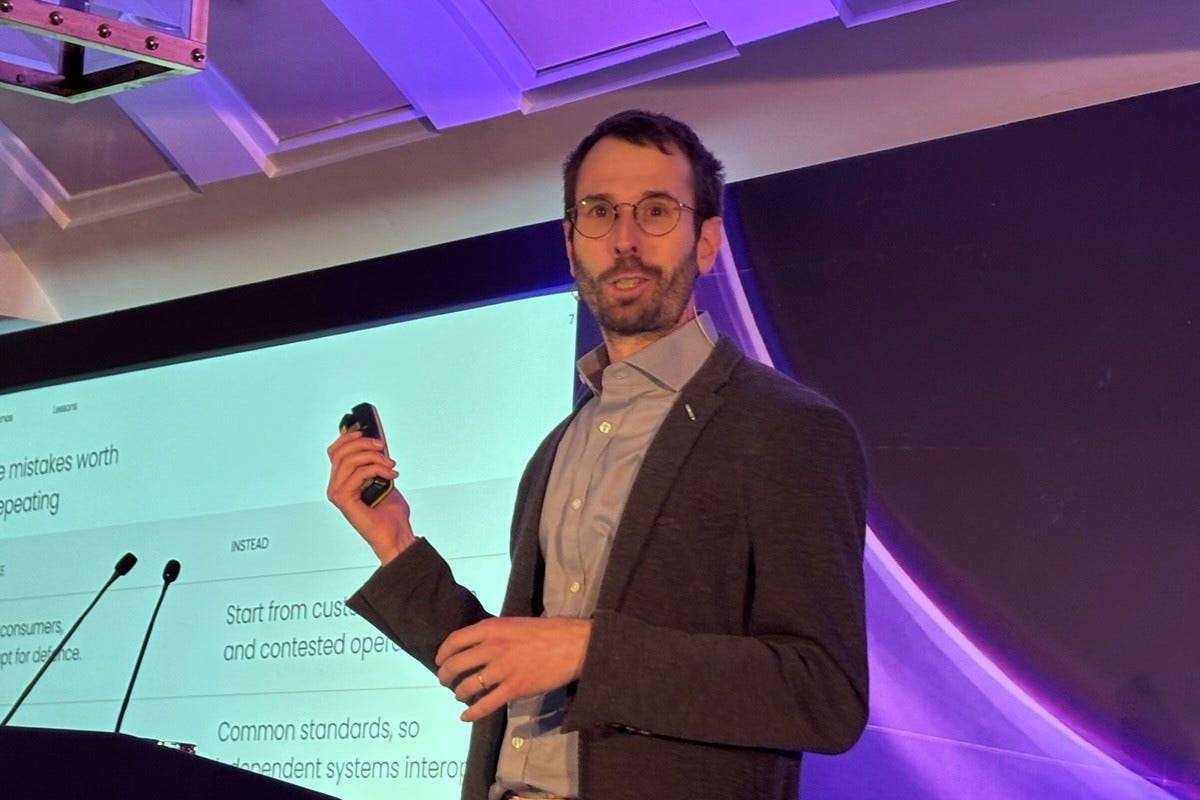
Open Cosmos, a UK-based satellite maker, is building a communications network that passes data between users in orbit, bypassing ground gateways defense forces cannot control.
Commercial low Earth orbit (LEO) networks have given forward units plenty of bandwidth, but their traffic lands at provider gateways and points of presence, sometimes in another country, where a third party can throttle, deprioritize or switch it off. Subsea cables can be cut, while satellite navigation signals can be jammed or spoofed.
“Connectivity that we don’t control is a vulnerability. Many of the systems nowadays depend on ground stations or other systems that defense customers do not have control over,” said Jordi Barrera Ars, chief technology officer and co-founder of Open Cosmos.
“Our system is gatewayless. You go from user terminal to user terminal. You have your secure private network,” he said. “A few weeks ago, we mysteriously saw gateways catch fire and cables get cut, so the system doesn’t rely on that.”
Data travels across optical links between the satellites, carrying broadband to user terminals and lower-throughput Internet of Things (IoT) traffic from devices and sensors.
In one scenario the company outlined, a national task group on a coalition exercise far from home sends its command-and-control and logistics traffic across this optical mesh and brings it down at its own national gateway, never touching a foreign ground station.
Barrera Ars said defense users have told the company they need priority and capacity when and where they need it.
He said security and defense requirements must be built in from the start, including resilience to jamming and Global Positioning System (GPS) spoofing. Systems also need common, open standards so they can work alongside other networks.
“Right now there are systems that are being used that haven’t been sold for that market, but they provide needed capability. That’s why people use them,” he said. “There is a need to have a system that has been designed with that in mind.”
The company’s slides set out three mistakes worth not repeating:
building for consumers, then adapting for defense;
closed systems that lock users in; and
designing first and showing users last.
Open Cosmos, founded in 2015, has been profitable for more than five years. It has more than 350 employees and five manufacturing facilities in Europe, and has produced one satellite a day in recent months. It designs, builds, launches and operates satellites before handing them over to customers.
Sovereign by design
Barrera Ars gave a keynote speech at the Defence in Space 2026 conference in London on October 27.
He said Open Cosmos can deploy an identical system for any customer that wants its own network, and connect it to the company’s constellation for extra capacity or coverage. Customers can start by buying access, then move to dedicated capacity or national satellites built to the same standards.
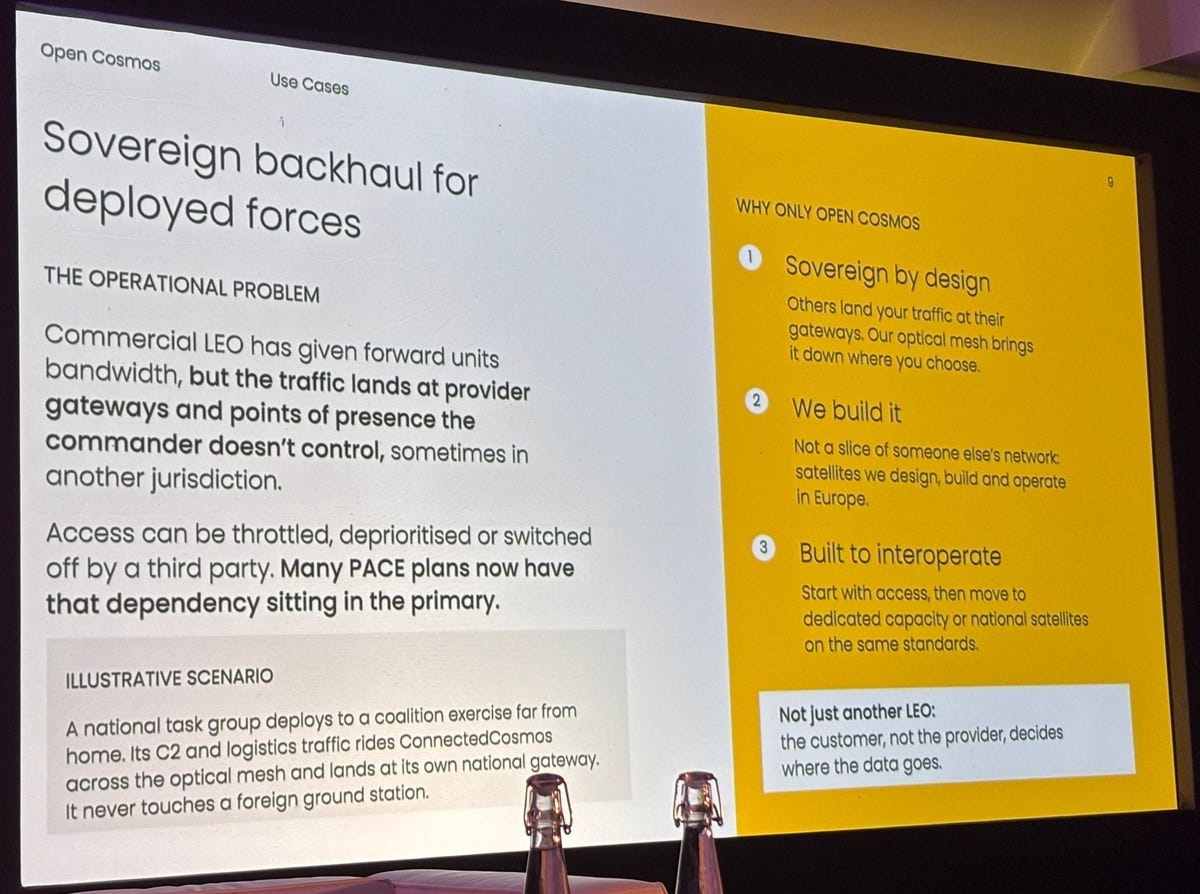
“We build the satellites. We have full control,” he said. “It’s sovereign by design, so we can even hand over the whole infrastructure to our customers, and they control it.”
The approach mirrors OpenConstellation, a federated remote-sensing constellation to which several governments already contribute satellites and share capacity.
“We are able also to build that infrastructure for governments and allied nations, and for them to work together as well as to work with us,” he said. “That interoperability is very key.”
Allies could share capacity across the network while still keeping their own dedicated resources when they need them.
An audience member noted that defense buyers are fickle and rarely have enough money to own such a constellation outright, especially as satellites need regular replacement. Commercial users and coalition partners, such as Five Eyes members sharing global coverage, would be needed to keep it viable.
“The system indeed is built with many customers in mind. That is obviously suitable for defense customers, but there’s a lot of commercial customers and corporates that need to have ensured infrastructure,” Barrera Ars said.
He said many companies want it as a Plan B or Plan C.
“This constellation is viable if we pool all these different customers together, and that’s how we are designing it and talking to them,” he said.
The company still describes the network as designed around government and defense requirements from day one, rather than adapted for them afterward, an approach it sums up as defense first rather than consumer first. It plans to change the constellation batch by batch, so that partners’ needs can shape what flies next.
“We need to show the capability really fast early on. It’s very important that we build with the users,” Barrera Ars said.
From alert to image
Unattended sensors on borders, bases and infrastructure can report that something has changed, but not why. Sending a patrol to find out is slow and costly, and sometimes exactly what an adversary wants. A sensor going dark tells operators that something has happened, but not what.
“When you are in the field, you need that real-time actionable intelligence in your hands,” Barrera Ars said.
Open Cosmos links its remote-sensing satellites, including synthetic aperture radar satellites, to the same network, and every satellite carries IoT terminals. The satellites monitor constantly, gathering images and radar data.
“We do edge processing, so we detect changes in the areas that our customers are interested in, and then we are able to alert if something of interest is detected,” he said. “It alerts the full constellation, and then we continue monitoring.”
Satellites passing next zoom in on the area, and the images reach the user terminal directly without touching the ground.
In one example, a sensor at a remote pipeline valve goes dark at 2 a.m. Satellite images then show a vehicle on site, so the decision to send a response team rests on evidence rather than a guess.
He said the system could also track vessels in real time after a cable cut in the High North.
“Satellites are coming out of our factory now, going towards the launch site, and we’ll be launching them in batches in the coming weeks and months,” he said.
ConnectedCosmos is planned at 192 satellites. Open Cosmos launched the first two in January after building them in under three months, and expects close to 100 in orbit by 2028 and global coverage, linked by an optical mesh, by 2030. It raised €300 million in September to speed up the rollout.
“Launch accessibility is a concern. It is something that we see in the market evolving really fast,” Barrera Ars said.
“Even last minute, with satellites ready to launch, we could literally change them from one rocket to another one,” he said. “What we are doing now is literally buying rockets in advance. That’s how we are securing capacity for the future.”
The satellites are over-tested so they can fly on any launcher, and Open Cosmos has partnerships with almost every launch provider. The company closely follows unproven new launch firms, as well as established players with a track record.
Open Cosmos expects to use rockets it has already bought in the coming weeks.