


Europe has repeatedly opened the door to a lead in quantum computing, only to watch the advantage slip away.
Former European Central Bank chief Mario Draghi warned in 2024 that the region’s technology gap with the United States and China was widening. Britain, meanwhile, remains excluded from parts of the European High Performance Computing infrastructure.
The cause is not a shortage of money, according to one health-tech entrepreneur at the center of the field. It is Europe’s own instincts.
A habit of leaving markets to sort themselves out, paired with 27 member states each rooting for their own national champions, has slowed the kind of coordinated push that built rivals’ early leads.
“There’s some kind of European DNA that perhaps needs to be adapted for us to join the leadership in quantum,” said Sella Brosh, chief executive of NVision. “The member states each pull in different directions, rooting for their own champions, and that has always been the case.”
“Europe needs to set the standards on its own and have the same level of centralized expertise that the US government has built,” he said.
Brosh founded NVision in Ulm, Germany, in 2015.
Its POLARIS platform boosts magnetic resonance imaging (MRI) signals to measure metabolism in real time, letting doctors judge how a tumor is responding to treatment within days rather than the months traditional scans can take.
POLARIS is already installed at close to 20 cancer centers worldwide, including Memorial Sloan Kettering Cancer Center, the University of Cambridge and the Technical University of Munich. NVision raised $55 million in a Series B round anchored by healthcare giant Abbott in May 2026, bringing its total funding to $120 million.
Abbott joined as the round’s sole strategic investor in diagnostics, and NVision was also named a winner in Fast Company’s 2026 World Changing Ideas Awards this year.
The new capital backs a computing platform called Photonic Integrated Quantum Circuits (PIQC), using organic-molecule qubits on photonic chips to speed drug design.
NVision announced a further expansion in July, into South Korea, where a €2.5 million Horizon Europe-backed project will deploy POLARIS at Yonsei University to study brain metastases, one of oncology’s hardest imaging challenges.
Europe has deep scientific knowledge across architectures, error correction and qubit types, Brosh said, but researchers have stayed too long in an exploratory phase without pulling it together to scale.
“I think the good news is it’s not too late,” he said. “We can still bring that into Europe.”
He said that message is one of the most important he wanted people to take away. He said that once standards are set, architectures can be stress-tested and funding directed at what works, letting Europe own the chokepoints in the technology.
He warned that without that internal expertise, the proprietary knowledge needed to compete simply will not exist on the continent.
Whoever wins compute
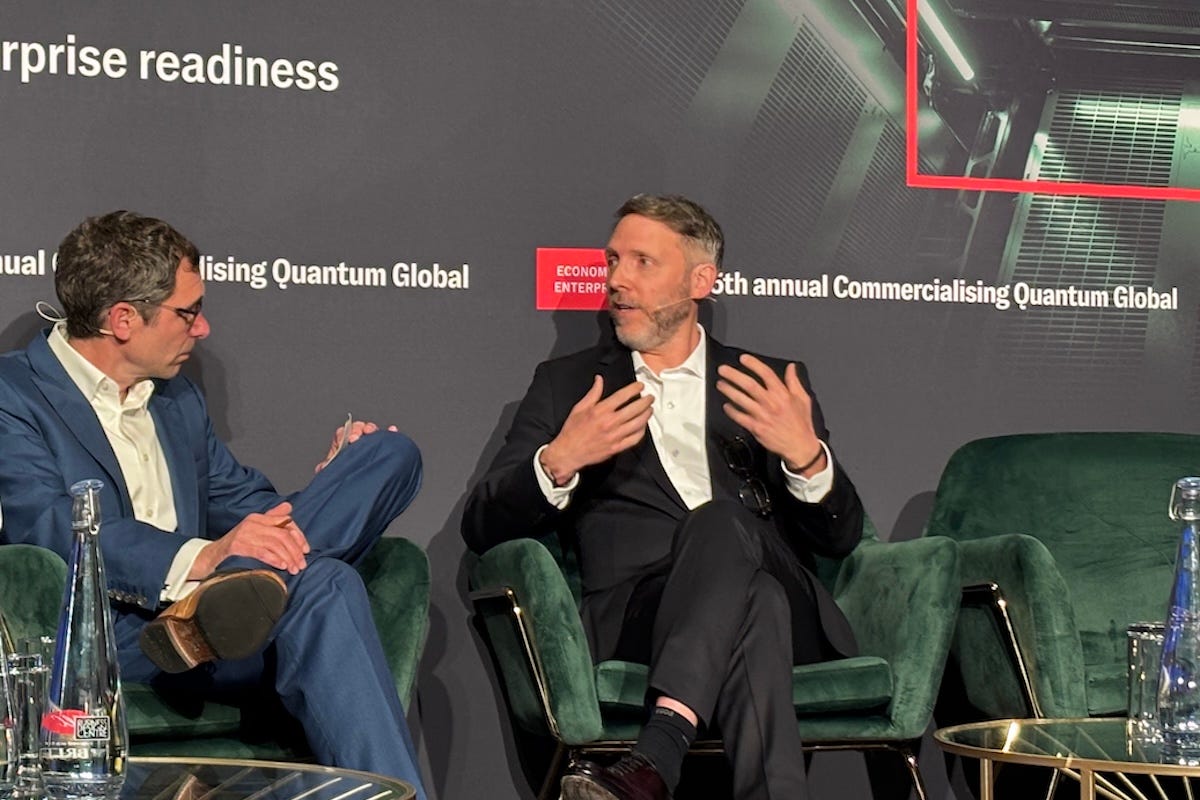
Brosh made the comments in a fireside chat with Jason Palmer, host of The Economist’s “The Intelligence” podcast, at the Commercialising Quantum Global 2026 conference in London. The event, organized by Economist Enterprise, examined how Europe can secure sovereign capability in quantum hardware, supply chains and talent.
Quantum is not an ordinary industry, Brosh said. It is a general-purpose technology that reshapes everything it touches.
“Quantum will be the best of times and the worst of times for those who do not own it,” he said. “Whoever wins compute wins everything.”
He said he discussed the idea with NVision investor Pat Gelsinger, the former chief executive of Intel. Better materials, better chemistry and optimized logistics all flow from compute, he said, calling it an enabling technology for nearly every other industry.
Brosh pointed to two recent developments as warning signs set against that promise.
The United States tightened control over advanced artificial intelligence (AI) models such as Claude Fable 5, briefly restricting exports after its June 2026 release before lifting the curbs weeks later.
Google published a study cutting by 84% the qubits needed to break the cryptography underpinning Bitcoin, using a zero-knowledge proof that withheld the method.
“Shor’s algorithm, the cybersecurity issues and the ability to use machine learning to manage overwhelming amounts of data for mass surveillance represent the worst of times,” Brosh said. “I don’t think Europe wants to ask permission from anyone to use quantum.”
He pointed to the United States’ Quantum Benchmarking Initiative (QBI), run by the Defense Advanced Research Projects Agency (DARPA), as a concrete model for Europe to copy in building its own domain expertise. A company is never fully eliminated from the program even if it hits a bottleneck in the assessment process. Participants can return once they have a credible path to scale.
“What was special about this is that it created a continuous intellectual conversation between companies and DARPA,” he said.
He said the program draws on around 500 experts assessing paths to scale across different qubit types, including photonics.
DARPA’s own published structure confirms a three-stage evaluation running through 2033, with companies advancing through architecture review, detailed research planning and independent hardware verification. Eleven companies, including IonQ and Quantinuum, have already advanced to the program’s second stage.
“That intellectual conversation between the government and the companies is one of the strongest driving forces behind the dominance of the US,” he said.
Owning the chokepoints
Europe had the initiative once. Brosh said the region was the first mover in quantum computing, ahead of both China and the US, thanks to the European Union’s Quantum Manifesto, launched in the Netherlands in 2016. It became the bloc’s Quantum Flagship program two years later, in 2018.
Around 2018 and 2019, NVision received more funding from the European Commission than from private investors, Brosh said. That public backing let the company grow before it eventually attracted more private capital.
“We kept continuing this exploration phase without starting to consolidate and understand what could actually scale into fault-tolerant quantum computers,” he said. “Nobody knew at that stage.”
Brosh said Europe can still close the gap.
“We still have time. There are so many chokeholds in building these scalable systems that Europe can still find the places where it controls them or is part of the critical value chain,” he said.
He cited IMEC, the Interuniversity Microelectronics Centre in Belgium, as one of Europe’s strongest assets in silicon photonics.
He also pointed to deep quantum-algorithm talent in the UK. All 27 EU member states have already signed the European Declaration on Quantum Technologies (EDQT), committing to build what the bloc calls a “quantum valley” of research and industry, a framework Palmer referenced during the discussion.
Brosh said Europe should not simply copy the US and DARPA’s approach. It should build its own version, starting with hands-on domain knowledge.
“It starts with knowledge: building a program that is equivalent to the QBI,” he said. “We need to understand what is really needed, from first principles, to build a fault-tolerant quantum computer.”
He said the work needs to start now, before the chokepoints he describes close for good.