


Quantum computers cannot become useful on hardware alone. The physical qubits at their core are inherently noisy, and without constant correction they produce little more than static.
The fix lies in software-defined logical qubits, abstractions built on top of physical hardware that require constant, real-time artificial intelligence (AI). Errors must be decoded and corrected, and noise calibrated, on microsecond time scales, or the system collapses back into noise.
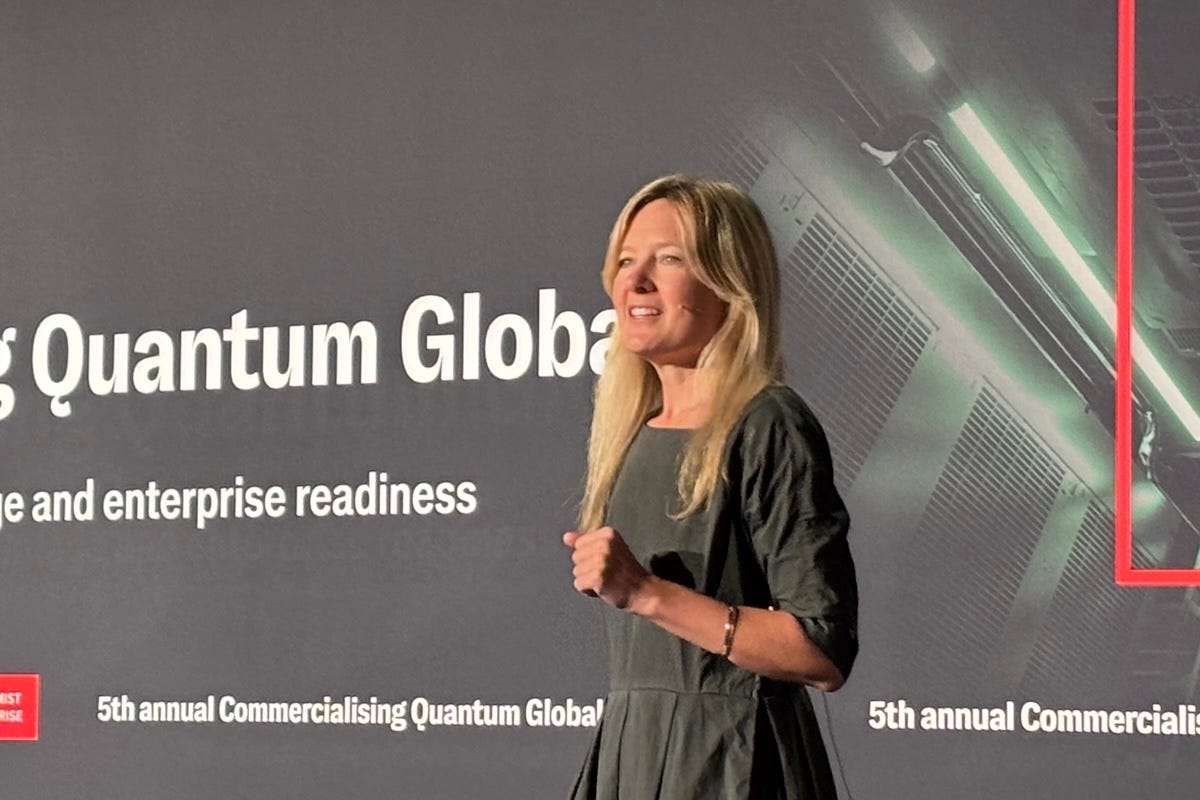
“It’s AI that can help make our logical qubits sing,” said Krysta Svore, vice president of applied research for quantum computing at Nvidia. “Without AI in the loop, you just have noise.”
“There is no useful quantum future without AI and intelligence integrated into our qubits,” she said.
The company’s answer is Nvidia Ising, a family of open models built to decode and calibrate logical qubits at scale. A 35 billion parameter vision-language model handles calibration, tuning a quantum computer in hours instead of weeks or days.
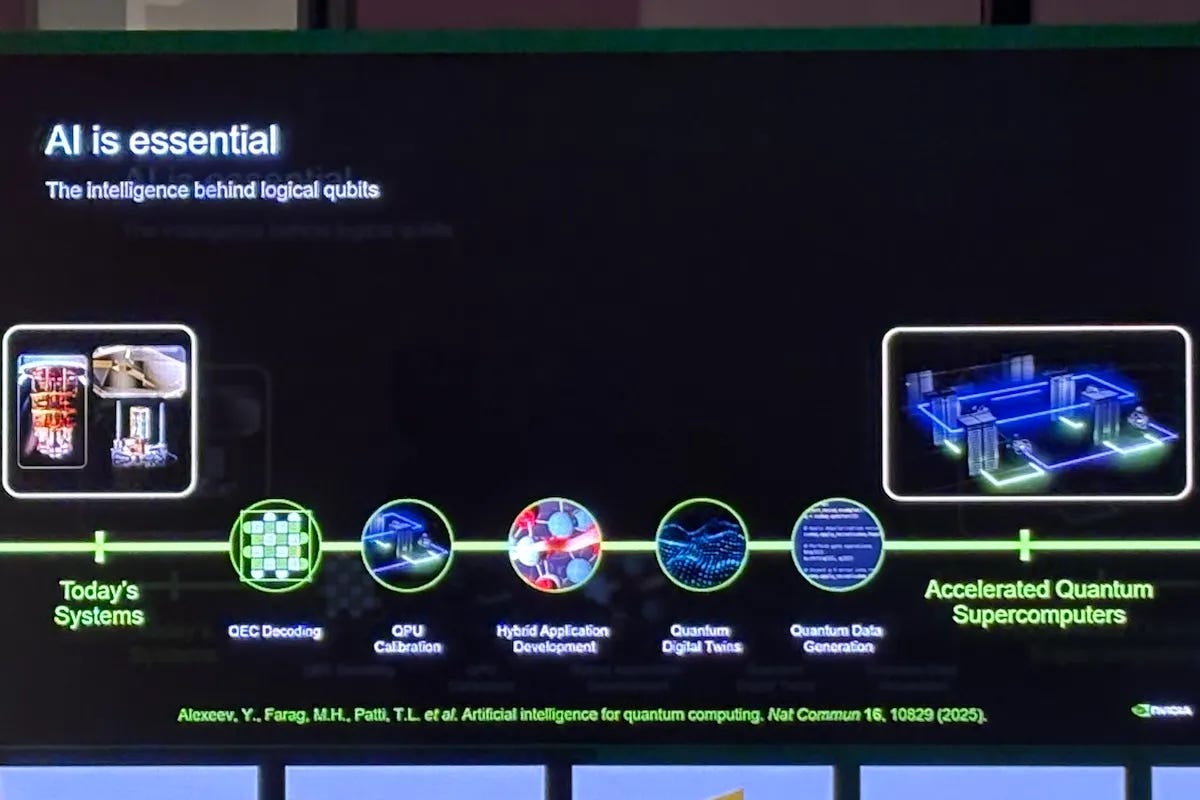
A second model, a 2 billion parameter convolutional neural network, performs the decoding. Nvidia says it runs two and a half times faster than earlier approaches and delivers a threefold improvement in logical error rates, both central to the reliability of logical qubits.
“The upgrade isn’t just a quantum machine,” Svore said. “It’s also a modern stack for science that integrates AI and quantum together, so that they strengthen each other.”
Nvidia has released the models, their data sets and benchmarks openly, letting hardware makers and research labs fine-tune them for their own qubits rather than starting from scratch. The models are already in use across the quantum ecosystem, from national laboratories to commercial hardware makers.
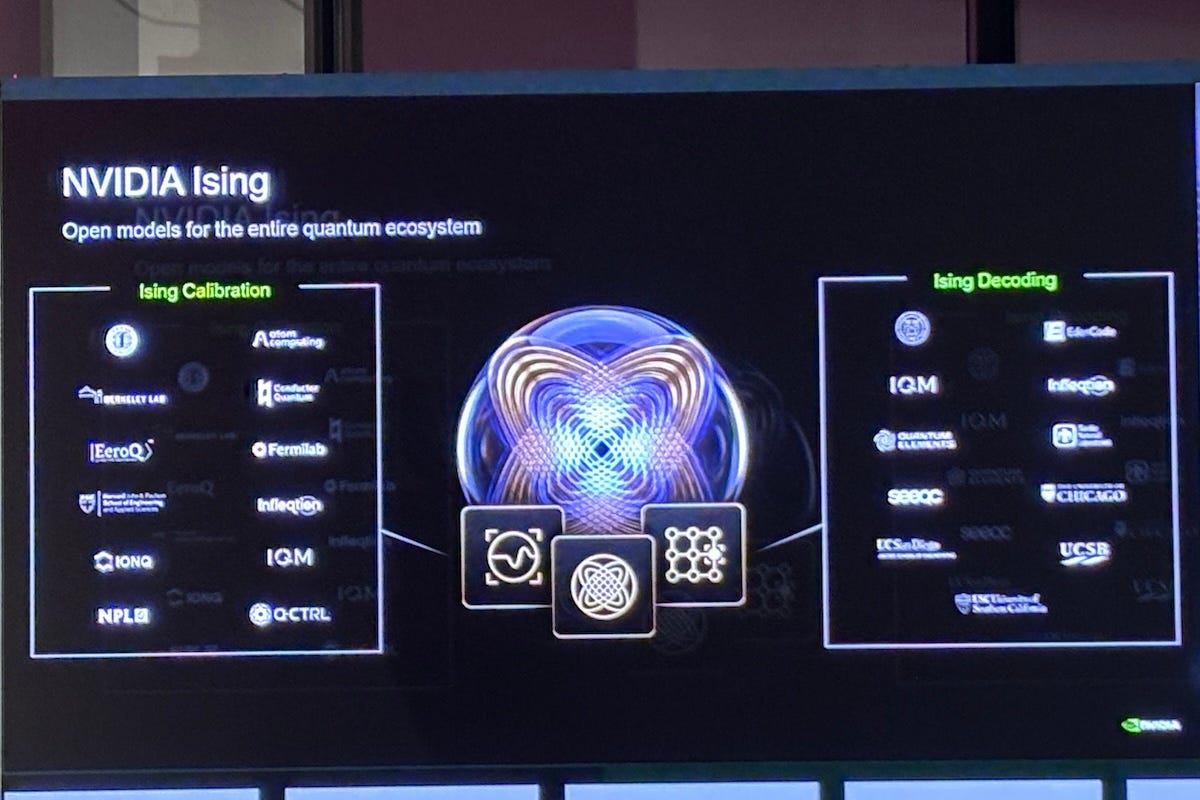
Svore said the goal is a foundation the wider ecosystem can build on, rather than a closed product, one piece of a platform Nvidia intends to keep expanding as more of the convergence between AI and quantum takes shape.
A new science stack
The quantum computing scientist made the case for this convergence in a keynote at the Commercialising Quantum Global 2026, a conference organized by Economist Enterprise in London that focused on the path to practical quantum computing.
The two loops of modern research, physical simulation and data-driven learning, are converging into a single stack spanning simulation, AI and autonomous discovery agents.
“For 400 years, science has really had one loop: observation, theory, experiment,” Svore said. “Now we’re running another loop on top of that.”
That second loop runs on data at a scale never available before and on models capable of reasoning. The resulting stack rests on three converging capabilities:
Simulation, accelerated to produce first-principle models
AI, which produces learned models from data
Agents, a new layer that ties the two together
“This isn’t just a faster science,” she said. “I’d argue it’s a different type of science, one where the instrument, the model and the experimenter start to merge and become one.”
“Cycles that took years can now take weeks or even days or even seconds,” she said.
That compression is driven largely by autonomous agents, systems capable of running entire research cycles without a person in the loop. She said it marks a complete workflow upgrade, one built for agents that increasingly talk to other agents rather than waiting on human review.
“These agents in science aren’t just a chatbot,” she said. “It’s a system that proposes a molecule, simulates it, evaluates it, reasons over the search space, and then proposes the next one without human intervention, autonomously.”
“Organizations that don’t build for an agent-driven loop will be out-cycled on discovery time,” Svore said.
Early gains from agent-driven discovery are expected across materials science, climate research, chemistry and medicine, she said.
Quantum as instrument
A scientific instrument is only as useful as our ability to interpret what it reveals. Quantum hardware produces data that classical, digital systems cannot efficiently collect, manufacture or generate on their own.
“Galileo had the telescope. We have quantum devices,” she said. “AI and quantum are not two separate stories. They’re one. Quantum produces data, AI reasons over it.”
That data can be used to train and fine-tune AI models, sharpening predictions in chemistry, materials science and medicine, fields she says classical computing alone cannot reach.
“There is no separate quantum problem,” she said. “At the core, scientific problems need quantum to be solved.”
Connecting that instrument to Nvidia’s AI infrastructure required a new piece of hardware. The company built NVQLink, an open, low-latency interconnect linking graphics processing unit (GPU) supercomputers to quantum processors.
“We can think of NVQLink as bringing real-time AI to qubits, enabling the decoding of them and the stabilizing of them,” Svore said.
The link is designed to run on the microsecond time scales needed to correct and stabilize a logical quantum processor, connecting it directly to supercomputers running CUDA-Q, Nvidia’s platform for programming across classical and quantum hardware as one system.
The design lets organizations program across CPUs, GPUs, quantum processors and other accelerators as a single addressable system, reserving quantum processors for the tasks only quantum can do and for producing the specialized data that feeds back into training AI models more broadly.
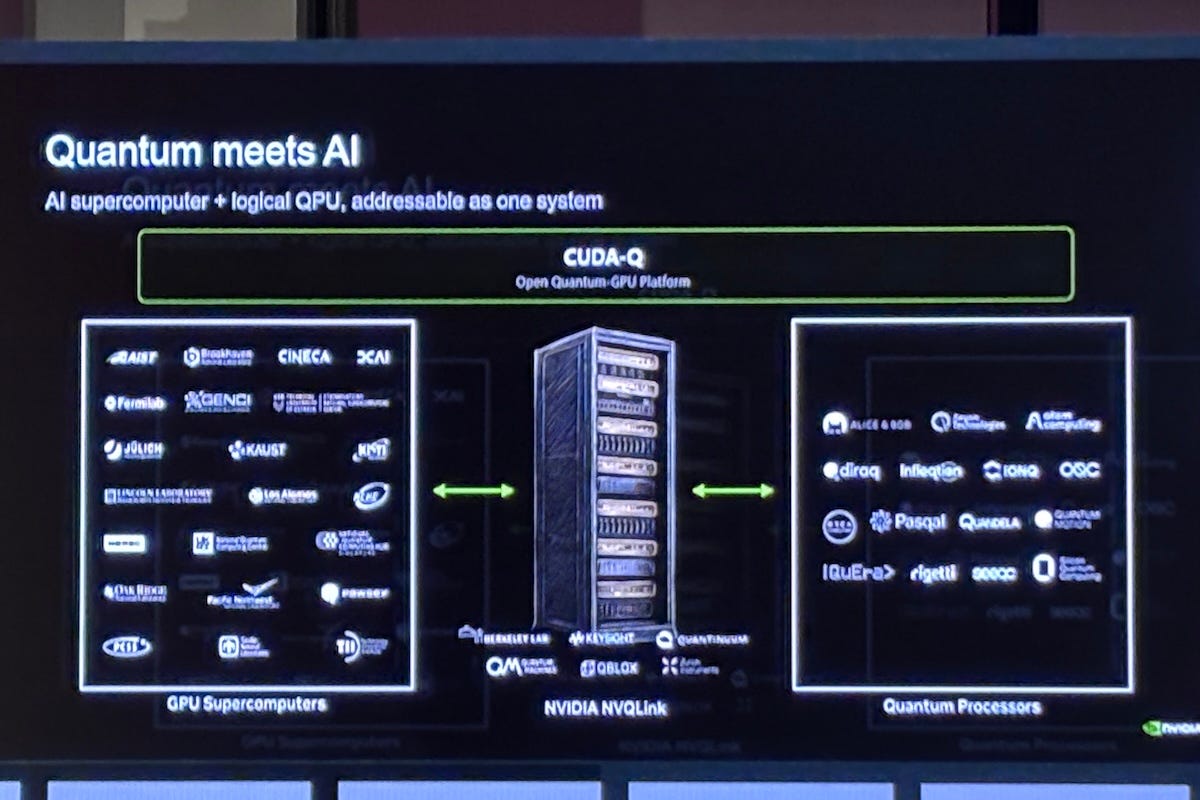
“Integrating GPUs and AI really means scaling up to millions of operations and hundreds of logical qubits,” she said.
She said the work ahead goes beyond the qubits themselves, to include data architecture, engineering talent, workflows and hybrid applications. The hardware will be there. The open question is whether the ecosystem can use it.
“The speed of science today is a function of how many minds can touch the stack,” she said.
Reaching that scale depends on keeping the platform open. Progress requires open models, open data sets and open benchmarks so every developer and every type of qubit can participate.
“Open isn’t just a philosophy. It’s an engineering choice that determines how fast science moves,” she said. “Whether you’re a pharma company, a national lab or a graduate student, we all should be building on the same foundation. That’s how progress compounds.”
Nvidia says the next milestone is scaling from today’s noisy processors to systems running hundreds of logical qubits and millions of operations, a shift the company expects to unfold as its open models and interconnects mature across the wider quantum ecosystem.