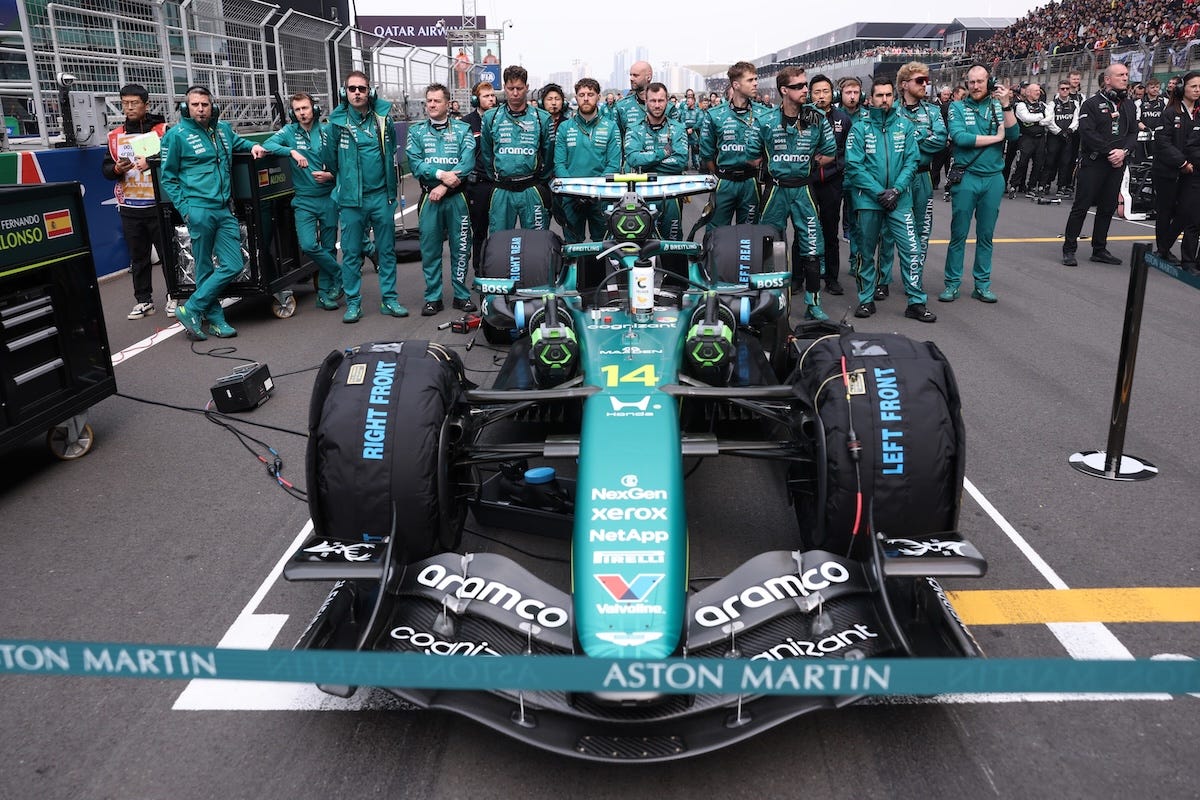
A ransomware attack on a Formula One team is no longer a distant hypothetical. It is a calculated strike at the most valuable asset in the sport: race data that took years to accumulate and milliseconds to lose.
As artificial intelligence (AI) makes data more central to competitive advantage, protecting it has become as important as generating it. For the Aston Martin Aramco Formula One team, the answer lies in building a data infrastructure that can recover instantly and govern intelligently.
“In the unforeseen eventuality that there is a ransomware attack, we have the ability to recover the data in real time and avoid the denial of service that can be so painful and embarrassing to the enterprise,” said Puneet Gupta, Vice President and General Manager, UK and Ireland, NetApp. “NetApp guarantees recovery of data when there’s a ransomware attack, and that is very powerful in today’s environment.”
Eric Ernst, Commercial Technology Ambassador for the Aston Martin Aramco F1 Team, framed the threat in operational terms. The team uses NetApp’s ransomware protection to guard wind tunnel results and performance data: assets that represent years of engineering work and define the competitive edge of a car traveling at 200 miles per hour.
“Data sitting on an FTP server in a zip file is pretty much useless to me,” he said. “The data needs to be in an active way accessible to my AI workstreams and LLMs [large language models].”
Gupta said the AI era has introduced an entirely new dimension to data governance, one that goes beyond securing data to verifying its authenticity.
“Let’s take an example: you have an image, and somebody does something to that image and creates what we call image plus one, and then image plus two,” he said. “The ability to have governance around what the real image is, when it goes online, for people to know what’s doctored and what’s not, governance in the AI world will become extremely important.”
The concern extends beyond motorsport. As AI-generated content proliferates across industries, the ability to verify the authenticity of data, whether an engineering simulation, a financial record or a medical image, will become a defining challenge for enterprises. NetApp is already working to address this through its data platform.
He outlined four pillars the company believes enterprises must address: data infrastructure modernization, cloud transformation, cyber resilience and AI readiness. The first three together, he said, create a truly AI-ready infrastructure.
Cyber resilience, he stressed, is not just about prevention but about guaranteed recovery. NetApp’s platform includes autonomous ransomware protection (ARP), which detects suspicious behavior and enables compromised systems to be restored without data loss.
NetApp serves as the official data storage partner of the Aston Martin Aramco F1 Team. The partnership, which began nearly four years ago, covers data infrastructure across the team’s AMR Technology Campus in Silverstone and at all 22 race locations on the Formula One calendar.
The company counts 95% of the most innovative enterprises in Europe, the Middle East and Africa (EMEA) among its customers.
F1’s AI arms race
Speaking at a media briefing at the AMR Technology Campus in Silverstone, Northamptonshire on May 19, Ernst and Gupta were joined by Grant Caley, Solutions Director and Field CTO, NetApp UK&I, for a panel moderated by Yolanda Ducille, VP Global Communications, NetApp.
The event, organized by NetApp, brought journalists to the team’s Silverstone base to explore how data and AI are reshaping motorsport competition.
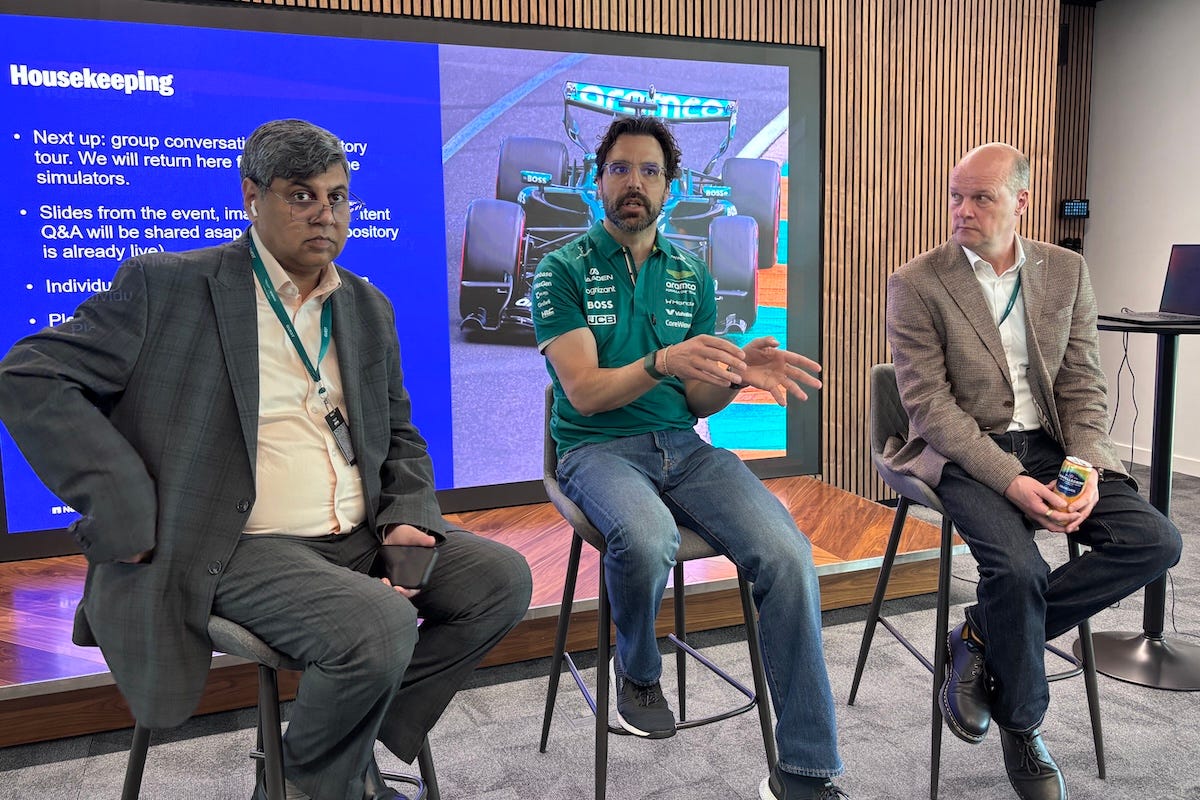
Ernst drew a sharp distinction between AI as a tool and AI as a replacement.
“We can outsource with AI intelligence, but we can’t outsource experience,” he said. “Data draws a map. AI will give us the trajectory, and it’s for the human to decide on that trajectory: do we go fast, do we break the speed limit, do we build it this strong or this light?”
He said the period of broad experimentation is over and a more disciplined phase has begun.
“The experimentation part is over. We tried everything,” he said. “It’s now where the people who put the money down want to see the results coming back. We’re getting into business-type AI, where I’m really only going to do this if it really brings something back.”
Simply giving everyone access to general tools like Cohere, Gemini or ChatGPT will not deliver results. The advantage lies in identifying specific use cases with the maximum output. Ernst said teams willing to invest in that discipline in a cost-constrained environment will come out on top.
The AI arms race in F1 is already well underway, with some teams using AI to mine publicly available data, including professional networking platforms, to map the size and structure of rival engineering departments.
Silicon Valley represents the frontier, with the rest of the world operating months behind. Teams that reach the newest models and workflows earliest gain a compounding advantage.
Gupta echoed the point, citing a characterization he had come across recently. The industry spent four to five years quietly building the infrastructure that now makes AI-driven racing possible, and the challenge ahead is converting that existing base into a fully AI-ready environment without starting from scratch.
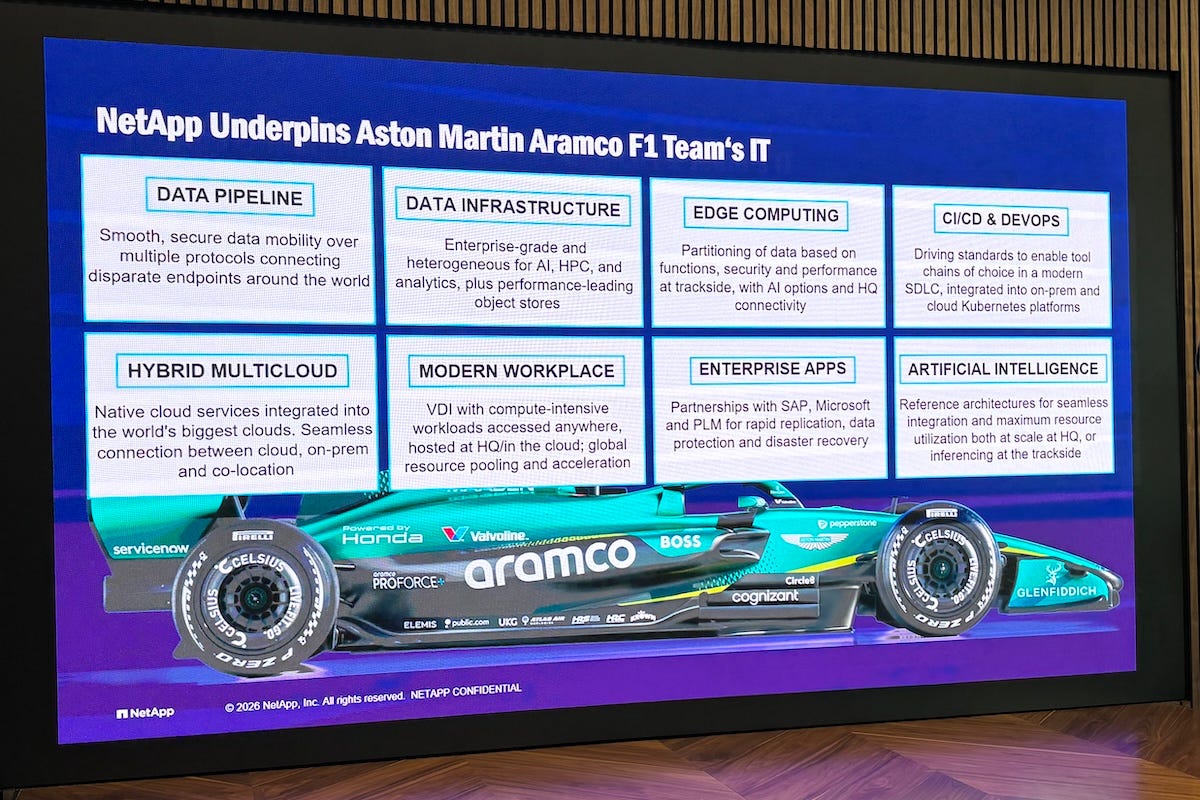
“An F1 team today is like a real-time AI analytics and simulation company which is attached to a racing organization,” he said. “Decisions are driven by AI, and AI is powered by data, and we are in the business of managing data.”
Ernst then turned to where he sees AI heading next: inside the car itself. He envisioned an LLM running on-board, trained on years of driver radio communications and acting as an intelligent co-pilot. He was careful to note this reflects his personal vision, not current Aston Martin strategy.
“There’s like an R2-D2 [the iconic robot companion in the Star Wars film series] on a car that understands the driver, what he wants to know and doesn’t want to know, because every driver is different,” he said. “If these cars start talking, imagine what that does for media. Suddenly the car has a soul, suddenly you have personality.”
Edge to headquarters
Caley offered the technical grounding for Ernst’s vision. On-board LLM deployment would rely on edge inferencing: a compact, trained model running on a discrete processing unit with no cloud dependency, cutting latency to the minimum required for real-time driver feedback.
The Fédération Internationale de l’Automobile (FIA) will likely regulate what AI can and cannot do on a car, and the driver must remain in control of all vehicle adjustments. Caley stressed that an LLM will not autonomously make setup changes to the car.
“You can train an LLM on how the driver wants to be spoken to,” he said. “There are years of radio communication data from Fernando Alonso or Lance Stroll, and you can tell what they want to know, what they don’t want to know, and how they communicate from the races.”
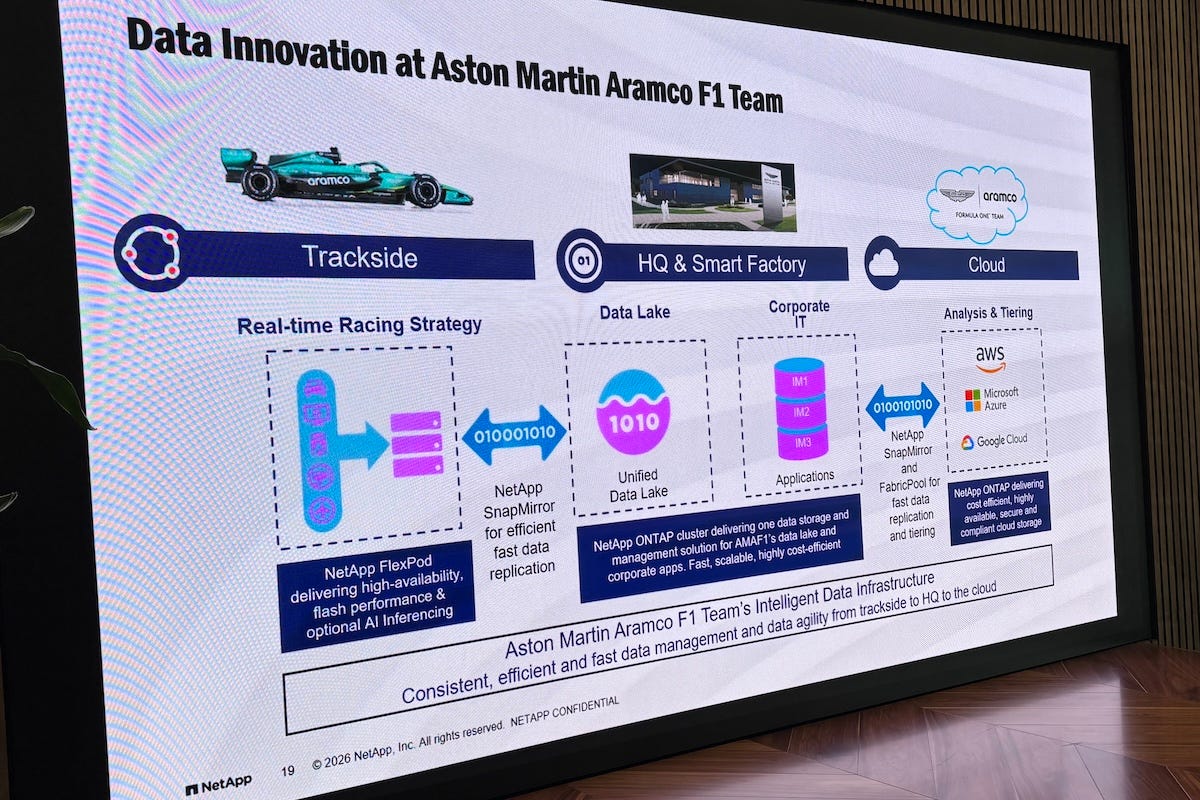
Underpinning all of this is a data pipeline that spans continents and endures considerable physical punishment. Each F1 car carries 300 to 500 sensors and generates approximately 1.5 terabytes of data per car per weekend, equivalent to one million data points per second.
That data moves from the car through a federation system to the garage, then synchronizes to a truck-based second data center at the track, with a further subset transmitted in real time to mission control at Silverstone. When the car enters the pits, an umbilical connection delivers the full sensor dataset.
Caley said NetApp consolidated all of Aston Martin’s previously fragmented platforms into a single data infrastructure, breaking down silos and eliminating the technical debt that had slowed the team’s ability to act on data quickly.
Ernst described the operational reality of keeping this infrastructure running under race conditions. Storage units travel through airports, trucks, and forklifts and endure extreme climates, yet must meet data center standards. Only 58 engineers are permitted at any race venue.
“If that data layer turns off on track, it doesn’t matter how fast the car goes; they will not be able to run the race,” he said. “You can’t have an army of IT engineers waiting for something to happen. You have to have people that can wear different hats.”
Caley said the same edge-and-core architecture that serves F1 maps directly onto other industries. Retail AI vision systems tracking inventory shrinkage, automotive manufacturers running parallel design simulations and financial services firms connecting distributed offices to central data centers all face structurally similar requirements.
Any organization managing more than 100 terabytes of data is a potential NetApp customer, and the more advanced its engineering, the greater the value the platform can deliver.
“If we designed a technology that was only specific for racing and Aston Martin, we wouldn’t have many customers,” he said.
Looking ahead, Ernst pointed to quantum computing and new materials as the next frontier. Quantum could eventually eliminate the need for physical wind tunnels by simulating aerodynamic conditions virtually, a development that would reshape how teams allocate budget and build cars.
He also described emerging materials capable of changing their stiffness in response to electric charge, creating morphing structural elements that adapt to conditions on the fly. The combination of quantum computing, advanced AI and adaptive materials will meld into an entirely new approach to engineering performance in motorsport and beyond.