


European and NATO defense planners are increasingly confronting a paradox at the heart of modern space strategy. The rapid growth of commercial satellite services is accelerating capability while introducing new systemic vulnerabilities.
Governments and militaries now depend heavily on private providers for communications, surveillance, and data services once dominated by sovereign systems. What was once a largely state‑controlled domain is now intertwined with a competitive and fast‑moving commercial marketplace.
“There is an increasing reliance on commercial services, which is awesome and something we want. But it also creates a lot of vulnerabilities, especially when it comes to SATCOM (Satellite Communications) and space-based ISR (Intelligence, Surveillance, and Reconnaissance),” said Daniel Hilgert, senior space coordinator at NATO.
“Satellite services are part of the critical infrastructure embedded in the services we use every day. We’re talking about energy, military, healthcare, and financial systems that depend on the availability of space services,” said Ivan Janes, chief systems and products officer at Telespazio Germany.
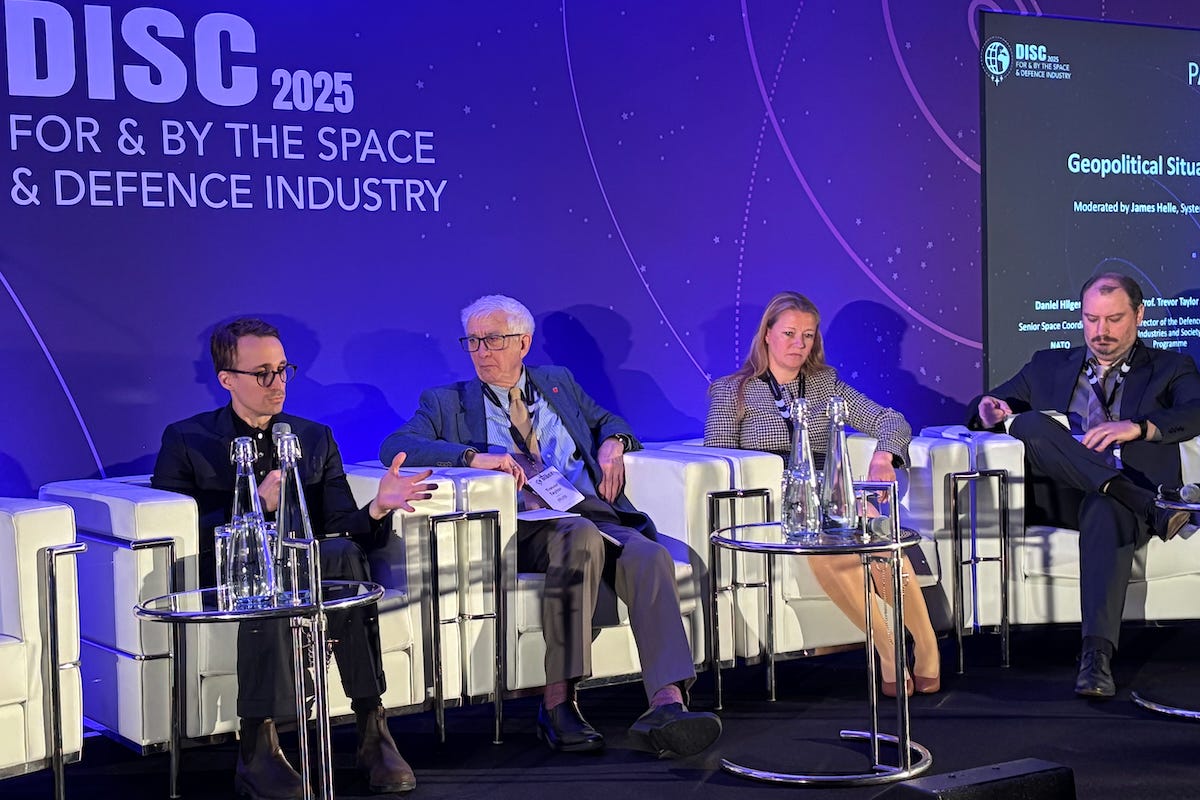
The discussion took place at the 2025 Defence In Space Conference (DISC) in London. Speakers from NATO, academia, industry, and defense research organizations examined how geopolitical competition is reshaping space policy, investment, commercial partnerships, and alliance strategy.
The growing dependence on space services reflects a bigger structural change. Satellites now underpin vast segments of civilian and military infrastructure, turning space into a foundational layer of modern economies.
Panelists emphasized that the impact extends far beyond defense. Satellite connectivity, navigation, Earth observation, and timing signals now support banking, logistics, emergency response, aviation, maritime transport, and energy distribution.
This expanding reliance has heightened concern about resilience across the entire space architecture. Systems must be protected across three layers: the space segment, the ground segment, and the communications links connecting them.
Janes said the security challenge must be addressed across the entire supply chain.
“Cybersecurity is not an optional cost that we have. It is an essential enabler of the systems and services going forward,” he said.
He said operators must strengthen resilience across the space segment, ground infrastructure, and communications links, warning that the overall system is only as strong as its weakest component. He added that digital twins and simulation technologies are increasingly being used to model risks and test the resilience of space systems.
“NATO does not own and operate its own space assets, so we rely on national data and, hopefully, more and more commercial data. The role of the NATO Space Operations Center (NSpOC) is to bring that data together and feed it into a common operating picture,” Hilgert said.
He said no single nation can observe the entire space environment on its own, making shared standards and interoperability essential.
European spending surge
Rising security concerns are driving a major increase in European defense‑space investment, signaling a new phase of market expansion.
Antje Nötzold, research associate and lecturer at Technische Universität Chemnitz, said Germany’s multibillion‑euro investment plans represent a dramatic policy shift.
“It is a very strong signal that Germany is going to improve its resilience and deterrence in space by enhancing flexibility, redundancy, variety of systems, and responsiveness,” she said.
The investment plan includes new geostationary communications satellites, a constellation of approximately 100 low-Earth-orbit satellites, space‑based missile-detection sensors, and active counterspace capabilities.
“We want to have around 100 LEO satellites for satellite communication, and we’re also talking about active counterspace capabilities. That is something completely new for the German armed forces,” Nötzold said.
She said Berlin is also considering inspector satellites designed to operate near other spacecraft, as well as improved space domain awareness systems. Until now, she noted, German military satellites have had limited defensive capabilities.
The shift reflects a broader recognition that Europe must bring greater sovereign capability to allied operations while reducing reliance on external suppliers and strengthening cooperation between NATO and the EU.
The panel on the geopolitical situation in the space domain was moderated by James Helle, systems and programs analyst at Stellar Solutions.

Warfighting reality
The strategic context is changing rapidly as space becomes an operational domain for deterrence and defense.
“Allies took an important decision to agree that any attack on an allied space system could trigger an Article 5 situation. It really integrates space into our deterrence and defense posture,” Hilgert said.
Article 5 is NATO’s core collective‑defense clause: an attack on one member is treated as an attack on all. Under the 1949 North Atlantic Treaty, allies must assist the targeted country, including by using armed force, a commitment that now explicitly extends to space systems.
NATO has surveyed member states to understand reliance on commercial and sovereign capabilities. The results show heavy dependence on commercial SATCOM and space‑based intelligence, often from a limited number of providers.
Hilgert said NATO is developing new playbooks and procurement strategies through a program called Thor. The initiative aims to define responses to crisis scenarios and identify the capabilities required to execute them, including potential forward‑leaning measures.
“We see how Russia and China are learning how we operate and are updating technology, so we need to update ourselves as well. This is not going to be a once‑in‑a‑lifetime effort,” he said.
Trevor Taylor, director of the Defence, Industries and Society Programme at the Royal United Services Institute, warned that space conflict would be difficult to control and could deter investment.
“If combat occurs in space, it’s going to be very difficult to control. If there isn’t a credible deterrence feeling, that would surely deter commercial and scientific investment,” Taylor said.
He also warned about orbital debris risks and the risk of escalation, referencing the Kessler effect, in which cascading collisions could render parts of space unusable for decades.
The Kessler effect, first proposed in 1978, describes a scenario in which the density of debris in low Earth orbit becomes so high that collisions trigger a chain reaction, creating more debris and potentially making entire orbital regions unsafe for long periods.
Nötzold highlighted China’s successful satellite docking and refueling in geostationary orbit in mid‑2025 as a major milestone and a new concern, saying the development adds ambiguity to future in‑orbit operations and competition.
Forward trajectory
Speakers said the next phase of space competition will be defined by how quickly governments and industry can turn cooperation into operational capability.
Panelists stressed that shared standards, data‑sharing frameworks, and new procurement models will determine whether allies can quickly scale resilient space architectures to keep pace with rising geopolitical pressure.
Hilgert said defense organizations must become more informed customers and more transparent partners with industry to strengthen long‑term resilience across allied systems.
The panel concluded that the race for resilient space infrastructure is no longer theoretical. The decisions made in the next decade will shape how secure, accessible, and commercially viable the space domain remains.