


Orbiting artificial intelligence (AI) data centers may sound like an easy escape from water-hungry cooling on Earth, but their heat has no easy way out.
A one-megawatt facility, about the size of a modest university computing cluster, would need more than 3,000 square meters of solar panels. That is roughly the size of the International Space Station (ISS) array, the largest ever launched, which took 23 years to assemble.
“This is an unfortunate thing that Hollywood has done for us. It’s so easy to imagine launching some gigantic thing up into Earth orbit, and it’s cold in space, so this is great,” said Lindy Elkins-Tanton, principal investigator of NASA's Psyche mission and director of the Space Sciences Laboratory at the University of California, Berkeley.
She said space offers no air or water to carry heat away, so all the collected energy must radiate back out into a vacuum. Each square centimeter of chip produces about 100 watts of heat, while a radiator of the same size sheds only about 0.1 watts.
“You need 1,000 times more area of radiators than you have chips, and so on the face of it, the energy balance doesn’t close,” she said. “I know that there are groups out there that claim they’ve figured it out, and I’m curious.”
She would love to see it work but said it needs more technology development than is publicly known.
Earth-orbiting communications satellites carry only 100 to 200 square meters of solar arrays, which makes a 3,000-square-meter array for a single megawatt enormous by comparison.
Elkins-Tanton has led Psyche, a NASA mission to a metal-rich asteroid of the same name, since 2011. The spacecraft launched on a SpaceX Falcon Heavy on October 13, 2023, and is now about halfway to its target. Its solar arrays cover 75 square meters, the second largest ever sent into deep space.
Chips generations behind
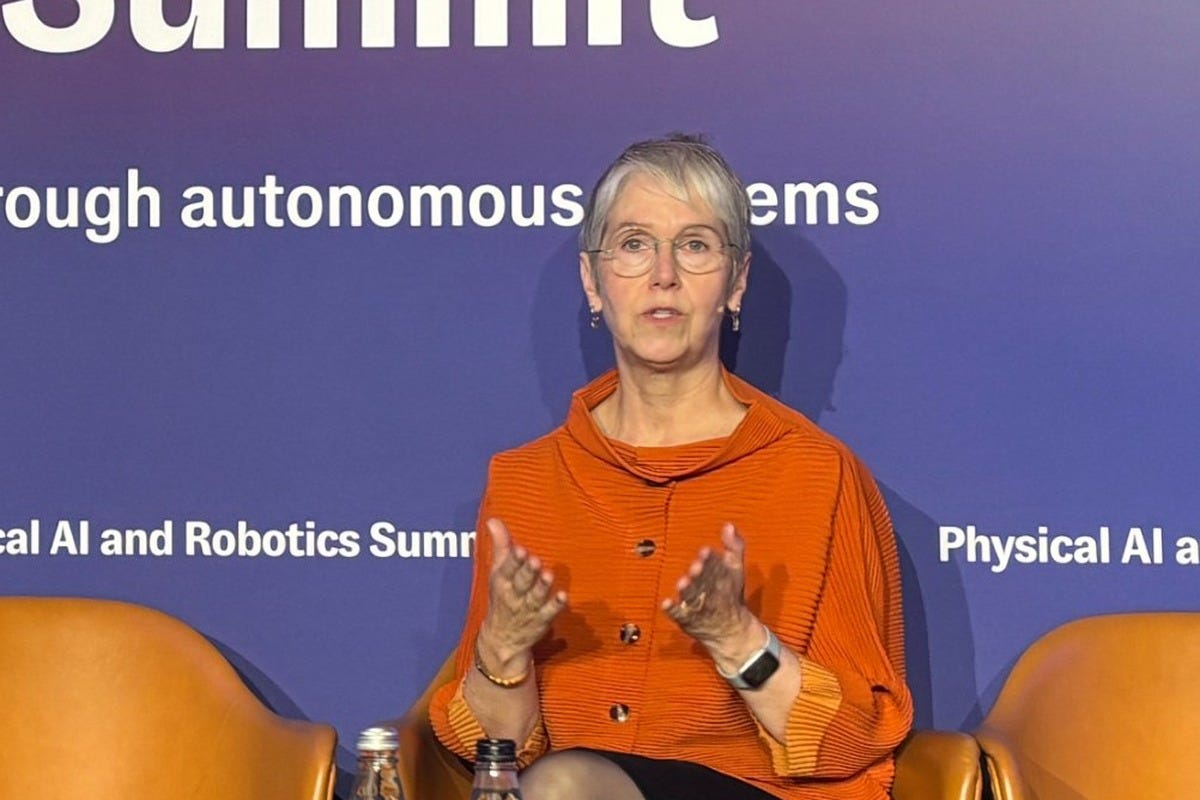
Elkins-Tanton spoke at a fireside chat moderated by Alex Hern, an AI writer at The Economist, at the Physical AI and Robotics Summit, organized by Economist Enterprise in London on October 13. The session explored where the intelligence that runs robots should live.
She said the bigger barrier, which also affects low Earth orbit (LEO) and space data centers, is hardware.
“The radiation-hardened chips that we need to use in space are generations behind what we’re all using on the ground right now, and so there’s a real hardware limitation,” she said.
Cosmic rays add another hazard. A single-event upset (SEU) occurs when one strikes a chip and wipes out a function or piece of data. Earth’s magnetic field and atmosphere largely shield chips on the ground, but even extra hardening cannot fully protect them in space.
Science spacecraft are often bespoke, built once for a single use.
“Risk tolerance is a big deal. If we need to spend six years building this spacecraft and then we’re going to fly it for 15 years, it has to work because it cannot be repaired after it’s launched,” Elkins-Tanton said.
Psyche runs no generative AI, only older forms of machine learning long used in space. Its software was tested for years under every possible circumstance, with fault monitors that scale back the spacecraft’s functions if something goes wrong. Everything has to be fully deterministic.
“A lot of the generative AI that we’d want to run on board is non-deterministic, so you’re not quite sure what answer it’s going to come out with, and that doesn’t work so perfectly for spacecraft,” she said. “So you have to have some kind of post-processor that’s going to put guardrails up.”
AstroForge, an early-stage space mining company she advises, is developing AI-run autonomous spacecraft for Earth orbit.
Security favors keeping decisions on board, and she worries about snooping and tampered commands at all times.
“Any time that you’re communicating with something using radio waves or using laser, you have the possibility of interception. You have the possibility of spoofing,” she said. “It’s a huge security advantage if you can do all your decision-making on board, and none of it goes off and comes back on.”
Laser links are somewhat more secure than radio, which anyone can hear, because you can limit their geographic spread. A NASA laser communications demonstration aboard Psyche sent a cat video in 2023 from about 80 times farther away than the Moon.
“It saddens me because this is not the world that I would want to be in, but space is absolutely a place of nationalism now, and a proxy for war on Earth,” she said.
She said anti-satellite tests have already happened, and the threat that debris clouds from broken-up satellites could make launches difficult is real, though not as imminent as people say. She called such threats the biggest the sector faces.
Ground in the loop
Latency adds a further case for onboard intelligence. Psyche is about 15 light-minutes away, so a command and its reply take at least half an hour, and contact is impossible when the spacecraft is on the far side of the Sun.
“There’s no business case for anything in space that closes outside of Earth orbit. Earth orbit is where business happens in space, and latency is still a problem with that,” she said.
She said delays to LEO become undetectable once ground dishes cover the entire planet.
Collision avoidance is one of the biggest challenges. SpaceX has effectively been building a distributed compute facility in orbit, and thousands of satellites could soon run AI and make their own orbit decisions.
“It sounds great until you realize that the different constellations probably don’t talk to each other. Everyone else’s satellites won’t necessarily know what’s going on,” she said.
Satellites in the same constellation could coordinate orbit changes, but rivals would be left in the dark. That would force “ground in the loop” decision-making, with signals routed down to Earth and back up.
She sees more promise in onboard AI for science, where communications back to Earth are the bottleneck.
“What if you had a scientist on board who could look at the data that’s being gathered and say, let’s condense it in the following way?” she said.
Discovery often depends on serendipity and on what an expert knows to be unusual. Peer-reviewed studies have found that expert scientists watching a remote robot’s video feeds were often wrong about what they saw, so more data must be interpreted when no one is there.
“If you get a nicely trained AI on board, getting the information and changing what information is coming in, maybe some decisions can be made faster and more efficiently,” Elkins-Tanton said. “Then the data can be condensed and downloaded more efficiently.”
She said the stakes in planetary science are lower because no lives are at risk, unlike AI in drug production, where the human risks are gigantic.
Psyche is due to reach its target in 2029 and orbit it for 26 months. No photos of the asteroid exist yet. It will be the first visit to a world with a metal surface, and NASA's Deep Space Network will post unedited images within 30 minutes of arrival.
“We don’t edit them or censor them because we want to share with everyone in the world,” she said. “My dearest hope is that in the 100 days as we make our approach to the asteroid, all of you will be looking at the pictures with us, and we’ll be able to say this is something unusual and interesting.”
She expects the mission to reveal something about the materials that made Earth, which could help explain why Earth is habitable while Venus and Mars are not, and could point to economically valuable materials on smaller, Psyche-like asteroids that cross Earth’s orbit.