


The chips running artificial intelligence (AI) still follow an 80-year-old design that burns much of its energy moving data between memory and processors.
That design, known as von Neumann architecture after mathematician John von Neumann, separates memory from processing. It worked for decades, but AI models with ever more parameters now shuttle vast amounts of data back and forth, and some chipmakers want to copy the human brain instead.
“The biggest problem in AI is energy consumption. It’s so bad that we’re now starting to think about sending data centers to space,” said Taner Ozcelik, chairman and chief executive of Mythic.
He said energy was a problem even before AI arrived, and data centers have made it much worse. He lives in Silicon Valley and has spoken with many people working on orbiting data centers, some of whom have publicly announced their plans.
“We have figured out the algorithm of the human brain: the neural networks, how it works, the math behind it. But the hardware is very old and happens to be very wrong. Imagine having an 80-year-old running a marathon and challenging him every day,” he said.
Computing also went digital, forcing everything into bits of zero or one.
“Nature doesn’t do that. There are no bits in the human brain. There are no bits in insect brains, and they do amazing things. Some insects do things that our big data centers cannot do,” he said.
AI computing is mostly matrix multiplication, a simple calculation repeated countless times. Mythic packs that calculation into a single transistor, which stores the data and does the math in the same place. He likens it to how neurons and synapses work in the brain.
Mythic says its current 28-nanometer chip uses about 1,000 times less energy than graphics processing units (GPUs), even though leading chips now use 2-nanometer processes.
“Humans consume 20 watts; 10 watts of it goes to intelligence. We have 250-megawatt data centers today that are not close to human beings,” he said.
He said shrinking the transistors could add another 100 to 1,000 times, leaving AI hardware roughly a million times away from nature. He compared the $10 million cost of hiring a top computer scientist for 30 years with the billions spent on data centers.
“You’re spending billions of dollars in these data centers, so they’re not even close. So you have to think radically,” he said.
Mythic, a Palo Alto-based analog AI chipmaker, is already mass-producing its current chip, which it calls an analog processing unit (APU). It raised an oversubscribed $125 million funding round in December 2025.
Cents per million tokens
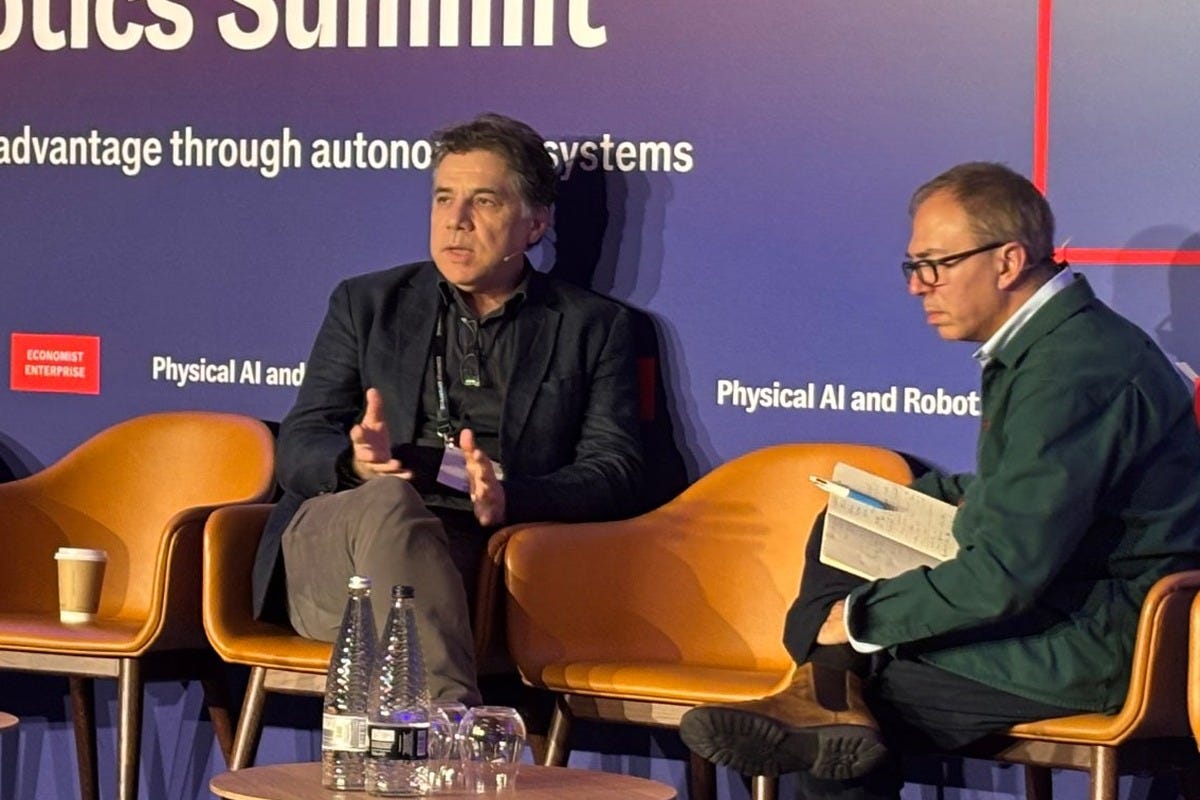
Ozcelik spoke in a fireside chat titled “Moving past Moore’s law: the power behind high-performance robotics” at the Physical AI & Robotics Summit, organized by Economist Enterprise in London on October 13. Kenneth Cukier, deputy executive editor of The Economist, moderated the session.
Ozcelik held up the chip on stage. It sits on a small card with no separate memory chips around it.
“There’s no memory around it. We pack everything inside. So the memory is the computer,” he said. “The device that I showed you is in the tens of dollars. Nvidia sells in the tens of thousands of dollars. Now they’re not identical; they don’t do exactly the same things.”
He said Mythic’s new chip can process a million tokens for half a cent, cheaper than even Chinese open-weight models.
Mythic’s December release gave the same figure for 100-billion-parameter models, based on its own benchmarks. It put the cost for 1-trillion-parameter models at about 4 cents per million tokens.
“There’s a huge cost war going on in AI, which will commoditize and democratize the models. The value proposition and the monetization will go to the app layer, just like it happened with the internet,” he said.
He blamed the architecture for keeping AI costs so high.
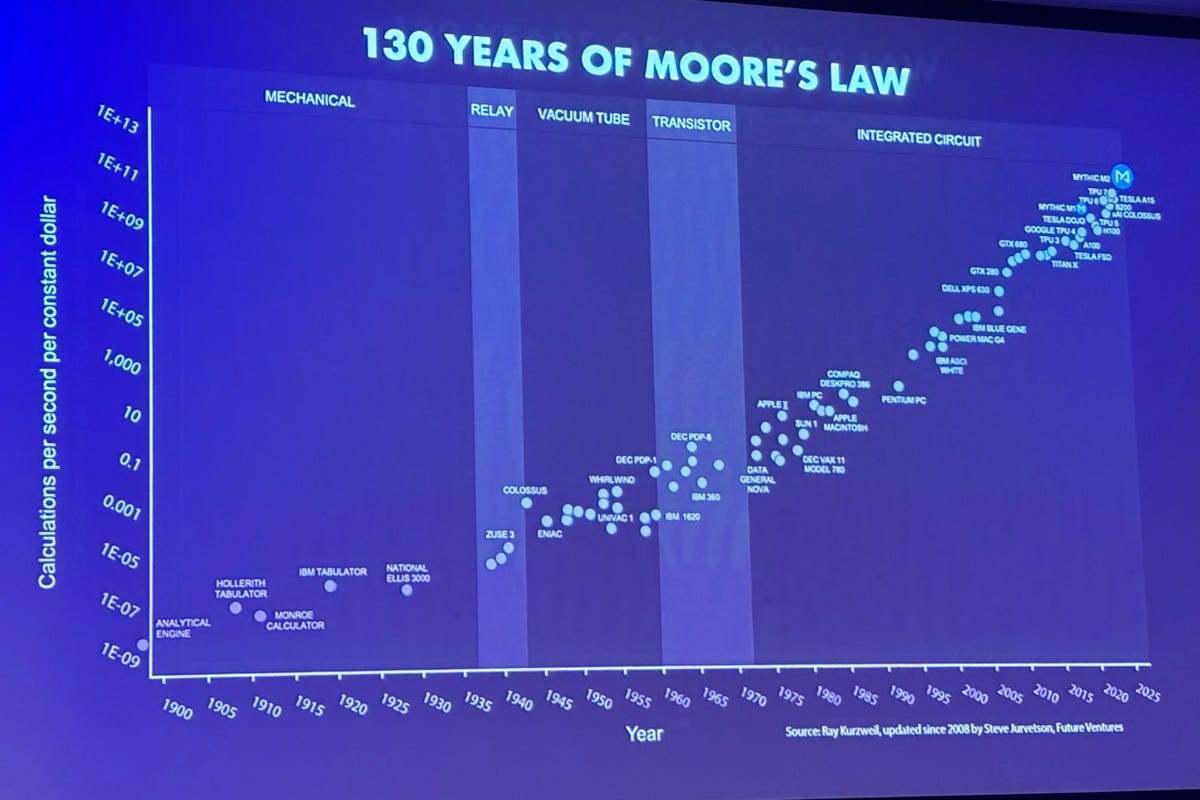
The chart, compiled by futurist Ray Kurzweil and updated since 2008 by Future Ventures' Steve Jurvetson, tracks computing power per dollar from mechanical calculators to today’s AI chips. Jurvetson was Mythic’s first investor and sits on its board.
Ozcelik founded Nvidia’s automotive division and ran it for 10 years before joining Mythic as chief executive in June 2024.
Deep learning runs mainly on matrix math, which GPUs handle far better than conventional central processing units (CPUs). That turned Nvidia, once best known for gaming graphics chips, into the dominant supplier of AI hardware.
“That’s what disruption is about. It’s easier said than done. I have worked for Jensen for 10 years. He shaped my life. It is a formidable company. There’s no toppling them overnight,” he said, referring to Nvidia founder and chief executive Jensen Huang. “But we can coexist. We don’t have to topple each other.”
He said Nvidia has many strengths that remain relatively unknown, and that he has huge respect for the company.
Chip architecture is becoming more heterogeneous, he said, citing Nvidia’s $20 billion licensing and hiring deal with inference chipmaker Groq in December 2025, the rise of Cerebras and newcomers such as Etched.
Four markets at once
Ozcelik said Mythic’s biggest challenge is chasing four markets at once:
Data centers, the fastest route to market, where the company is working with the biggest players
Automotive, which he called another trillion-dollar industry
Robotics
Defense
“This architecture mimics the human brain. So what do you do when you have something that literally mimics the human brain at the hardware level? You want to go all in. You want to platformize this and make it usable anywhere and everywhere,” he said.
Mythic is borrowing Huang’s idea of “100% R&D leverage,” which means building one thing and selling it everywhere.
“Blackwell and the Rubin chips that you’re buying have my automotive transistors in them. You just don’t know about it because they’re all fused out,” he said.
He said Nvidia’s general managers used to pound the table to get their own transistors into each shared chip, because Huang was adamant that one design should serve every business. Mythic is now trying to do the same.
Mythic also has a chiplet strategy, something he said Nvidia lacks. Its small chips can be combined in two dimensions, with software mapping each AI network onto them, so the same silicon can go into different systems at different scales.
Mythic counts Lockheed Martin and Honda as corporate partners and investors.
Ozcelik said Lockheed has backed the company for a long time, and the analog chips could give drones and robots longer flight times and better classification.
DCVC, a backer since 2016, led the December round, joined by NEA, Atreides, SoftBank Ventures Asia and Future Ventures.
Mythic’s current chip uses a 28-nanometer process, with wafers made in Japan.
Ozcelik said production is moving to GlobalFoundries in Dresden, Germany. Some AI tasks still need digital processing, which is why Mythic bought German chip designer videantis this year to build hybrid analog-digital systems.
Hannover-based videantis designs digital processors for embedded AI systems. The deal, which needed clearance under German foreign investment rules, also widens Mythic’s presence in Europe and is meant to speed deployment in cars, robots, factories, defense systems and data centers.
Ozcelik said research suggests attention layers, which give AI models much of their power, will eventually run on analog chips too.
“This analog computing architecture will be very popular in the end. In fact, what I postulate is that we’ll be able to do pretty much everything in analog. It’ll be all like nature. Then all bets are off,” he said.
He said his biggest task now is getting the technology to everyone who wants it, as fast as possible.