


Mining executives see artificial intelligence (AI) as a way to stretch scarce engineering expertise, but not to replace it, as fewer people enter the profession.
Enrollment in mining engineering degrees has fallen 70% in Australia in a decade and by almost half in the US.
“The gray hair becomes grayer, and in many cases scarcer as well. But it is critical,” said Richard Sellschop, senior partner at McKinsey & Company.
“I don’t think anything can replace experience and good technical work. It is still the most fundamental aspect of our business,” said Christopher McCleave, chief technical officer of Vale Base Metals.
Responding to an audience question on whether experienced staff must still halt AI-driven decisions that go astray, he said suppliers of AI tools for geology and exploration call him about once a month, but none has yet found a true positive.
Sellschop said the talent squeeze is getting harder because the industry needs to grow. Some mining tasks need not be so laborious. Updating a mine plan to the point where a company can make an economic decision often takes four to six months, but AI could cut that to a day, he said.
“We’re not quite there yet. People aren’t doing that at scale, but there’s technically no reason we couldn't. AI is not going to replace the mine planner, but will let the mine planner be a lot more efficient in his or her job,” he said.
Joachim Braun, division president of process industries at ABB, said weak education systems, remote sites and the career choices of younger generations all make skilled workers hard to find.
One of ABB’s best customers for advanced digital tools, an African state miner headquartered in Morocco, uses them to guarantee consistent quality where qualified staff is scarce, he said. AI can also record experienced operators talking through their work and make that knowledge available to younger, less experienced staff in context when they need it.
“I don’t think that the primary objective is to substitute [human expertise], but to complement it. It’s not to say the AI knows better how to operate, but it can help you to operate very consistently in the way you have imagined you want to operate,” he said.
Toni Laaksonen, CEO of FLSmidth, said each mining process generates huge amounts of data, and simulations for a new process or product can take months.
“You cannot rely fully on AI. You need to combine the expertise with these solutions. Then you can process this faster,” he said.
Off a low base
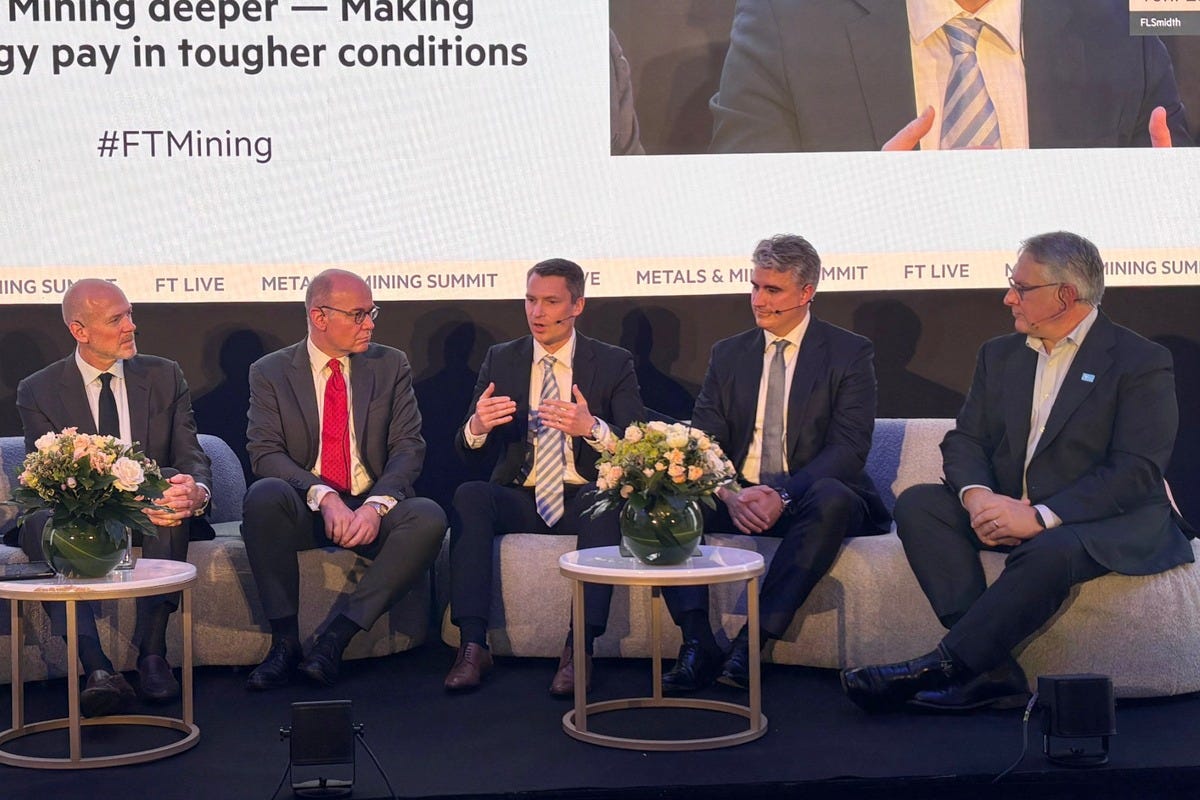
The comments came at the FT Metals & Mining Summit, organized by FT Live in London on October 15, during a panel on making mining technology pay in tougher conditions. Alex Hamer, assistant companies news editor at the Financial Times, moderated the panel.
Sellschop said McKinsey’s latest State of AI report ranks mining as the second-lowest adopter of AI across sectors. Only engineering and construction, an industry mining relies on heavily, ranks lower.
“I agree that the acceleration is there. It’s also off a low base,” he said.
Mining’s spending on research and development (R&D) is below 1%, also low by other industries’ standards. He said the biggest opportunities for technology and AI lie in deeper, lower-grade and more challenging orebodies.
McCleave said miners are impatient and want technology that works immediately. Single-point fixes must be adapted to operations that keep running, which makes them hard to scale, but miners adopt technology quickly once it works. He said uptake of new technology is growing across the industry, though it is not easy.
Matt Pearson, co-founder and chief exploration officer of Fleet Space Technologies, said the large language models (LLMs) transforming other industries just don’t fit mining.
“We see so many clients dumping all their data into [a chatbot] and hoping for the best, and going, ‘What’s my MRE (mineral resource estimate)?,’” he said. “That’s not a strategy.”
He said tools built specifically for the industry are now taking off. AI was a dirty word a year ago, but miners are now willing to invest quickly in combining their data as they collect it.
Seismic surveys (which map underground rock by tracking how vibrations travel through it) produce huge three-dimensional (3D) datasets that clients found powerful but hard to use, Pearson said.
“It’s a perfect problem for something like AI, if you’ve got a world model built rather than a language model, built to understand geology, and that’s been a huge unlock,” he said.
Fleet Space is about to release a world model trained on 10 million synthetic worlds. He said it performs as well as a human when fed only drilling data, and adding seismic data accelerates exploration programs by years. Its predictions so far have all come true, he said.
Pearson said core scanner data can now update the whole geological model and MRE in real time, and the few customers using it change the model every day.
“Agile geoscience is a good philosophy of what you want to do, but agentic geoscience is what makes it happen in real time,” he said.
He said a year saved on a big deposit is worth about $100 million in net present value (NPV).
Software ages faster
Braun said maintenance budgets are still drawn up with mechanical equipment in mind, while remote operations open a channel that has to be managed for cybersecurity.
“The more software-based solutions you deploy, the more they will have significantly higher obsolescence and require a lot of love and care compared to mechanical equipment. That’s a mindset change,” he said.
Sellschop said a few mining companies have suffered debilitating cyberattacks over the past two to four years.
Mining is a physical business, so hardware changes more slowly than software and can often be retrofitted with new sensors and automation. If a company values its data and builds the skills to use it, replacing an AI model matters less, he said.
“The real value sits in the data and the insights and the people within your company that are starting to get value from that,” he said.
Laaksonen said most FLSmidth equipment runs for 20 to 40 years, so new technology must fit it.
Pearson urged miners to move from annual or quarterly decision cycles to smaller weekly decisions, as AI models are updated every quarter. McCleave said that is a challenge for boards, because the market likes long-term strategy.
Mines run kits from many suppliers, with little oversight of the whole operation, Braun said.
“It’s fantastic if your trucks are doing great, but are you reaching your production target? Maybe the bottleneck is somewhere else,” he said.
He said ABB advised BHP to scrap the truck haulage design at an Australian mine and rethink it from scratch. A hoist replaced the trucks. Under tougher mining conditions, automation has moved from a cutting-edge option to a must-have, he said.
“We have no shortage of data, and it’s what we do with the data,” McCleave said.
He said underground mines lack the real-time detail available in open pits. Vale uses MineSense sensors to see what goes into each truck, but only the producer can pull suppliers’ systems together, and that takes time and scarce talent.
Productivity in mining is flat to declining, unlike in most other industries.
Sellschop said improving it is worth $450 billion to $750 billion to the industry. Data science applied to haul trucks has cut fuel use by 4% to 6% in several regions by advising individual drivers and fine-tuning road design and operating settings.
Braun said robots can now place explosive charges, guided by AI trained on input from experienced operators. An underground mine with no people and no combustion engines would need no ventilation, saving about a third of its energy.
“It’s also the easiest business case you’ve ever had. Technology which helps us achieve better safety outcomes is an immediate sort of entry into our business,” McCleave said.
Laaksonen said FLSmidth is developing ways to change mill liners without anyone entering the mill, and to replace crusher wear parts from above. He said these solutions keep maintenance workers out of the line of fire and are quickly adopted by miners.