


Militaries can no longer count on their communications surviving the opening hours of a war, as satellite links and ground stations become early targets.
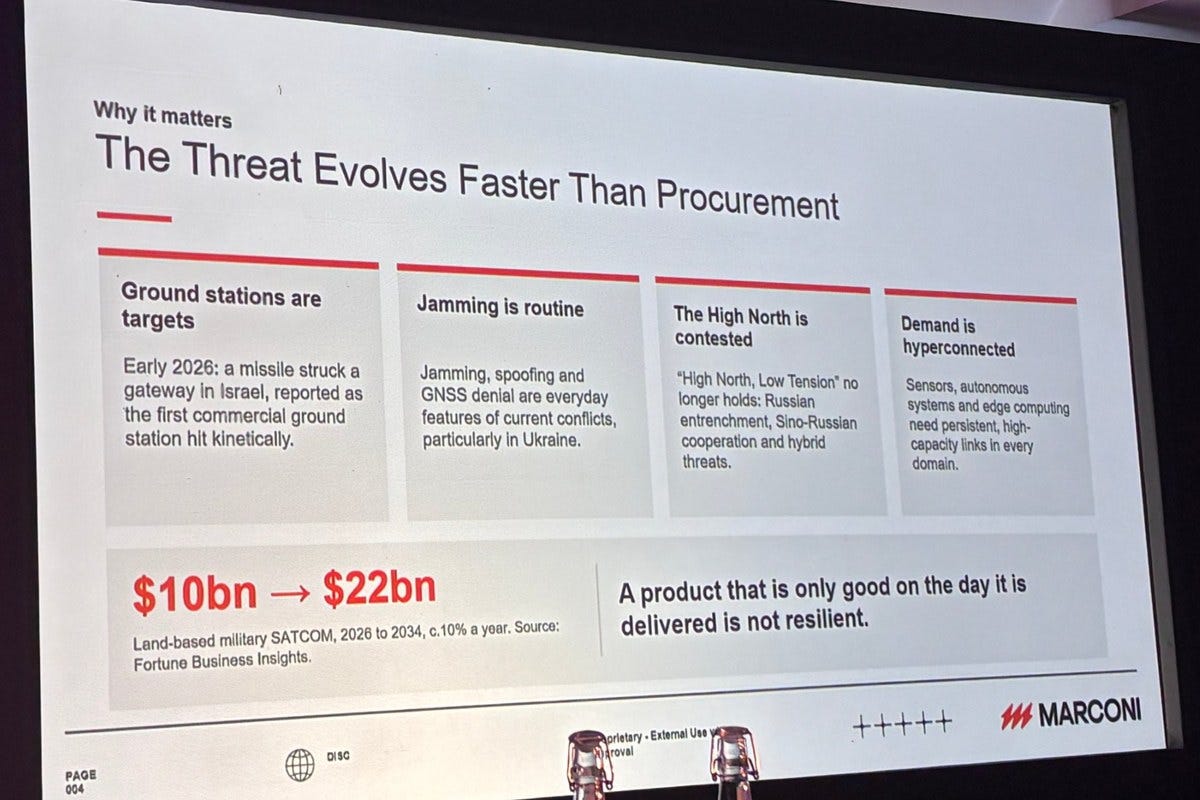
About an hour before Russian forces crossed into Ukraine on February 24, 2022, a cyberattack hit Viasat’s KA-SAT satellite network. Britain’s National Cyber Security Centre later said Russia was almost certainly behind it. In March this year, missiles struck SES’s Ha’Ela teleport in Israel, the first commercial ground station reported hit kinetically.
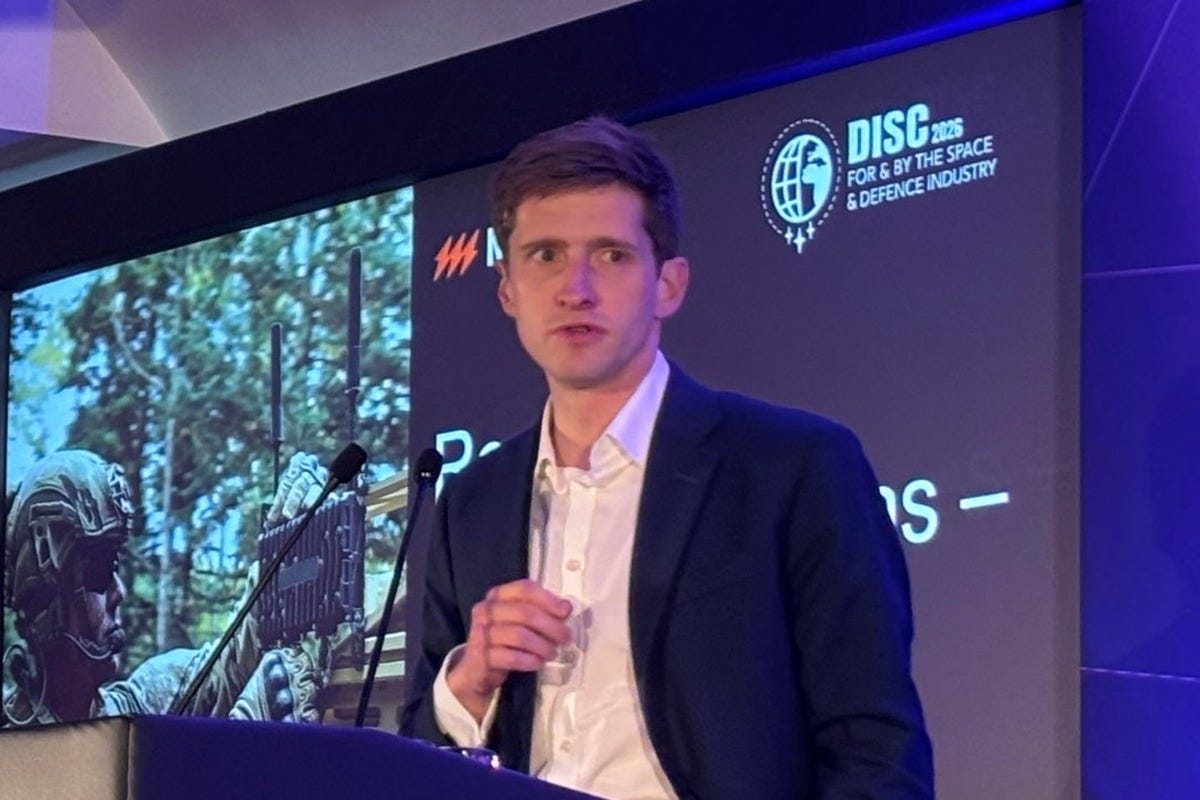
“The threat is evolving faster and faster. The enablers, with communications infrastructure being one of those key enablers, are going to be a target before the first shot is fired,” said Henry Nelson, UK president of Marconi Technologies. “Growth in spending is not going to be growth in resilience, and a product that is only good on day one is not resilient.”
Britain’s Defence Investment Plan puts £2.5 billion into the cyber and electromagnetic domain, and the market for land-based military satellite communications (satcom) is forecast to more than double to $22 billion by 2034. Nelson said the plan also stresses that the UK’s digital targeting web must work in a contested spectrum.
Commercial technology brings its own risk, as Starlink’s role in Ukraine has shown.
Russian forces began fitting Starlink terminals to strike drones, partly because the satellite link resists jamming. In February, Ukraine’s defense minister announced a whitelist, worked out with SpaceX, so only registered and verified terminals could operate.
“As technology proliferates, control of it reduces. In one war, one commercial communication capability was a lifeline for Ukraine and a tool in the hands of Russia,” Nelson said. “It was something that had to be reconfigured within weeks to overcome the threat.”
He said an early Royal United Services Institute (RUSI) study of the war found the electromagnetic spectrum would not be denied but continually disrupted. Britain’s Strategic Defence Review has also said procurement must be measured in months, not years.
“The question for industry is no longer: Is your kit resilient? It’s: Are we ready to change it when the enemy changes, and at the pace we can’t imagine now?” he said.
Marconi Technologies is a veteran-run defense technology company and the successor to the Canadian Marconi Company and Britain’s Gigasat. It makes tactical radios, troposcatter and satellite communications systems in Tring and Montreal, and has delivered thousands of systems to the UK Ministry of Defence (MoD), NATO and the Canadian Armed Forces.
Developing in contact
Nelson delivered the keynote “Resilient Communications” on October 27 at the Defence in Space Conference (DiSC) 2026 in London. The two-day conference, now in its fourth edition, is organized by and for the space and defense industry.
He said resilience has two sides. Being resilient by design means fielding kit that can be relied on today. Being resilient by evolution means keeping pace with the threat and out-innovating it, which he said gets far less attention than it should.
“In theater, whatever we field will be probed, jammed and countered. In conflict, we’ll find the equipment we start with is not sufficient to get to the end, and the product has to evolve,” he said.
He said defense buyers have traditionally procured at arm’s length, specifying every requirement in detail before a product is built.
“A requirement written in isolation builds a product that is fielded, and by the time it’s fielded, the threat has moved on. Normally, the result is an urgent operational requirement that results in the same process just happening faster,” Nelson said.
He cited a May article on Ukraine’s defense technology sector, which found the fastest firms build close to the fight and push updates over the air. In one case, jamming knocked out first-person-view (FPV) drone video until a firmware update let drones switch frequencies once jamming was detected.
Britain’s Project Octopus follows the same model, pairing a Ukrainian interceptor drone design with British engineering.
“Development in contact does not mean cutting corners. It means putting engineers and users together in the same room earlier, in the field together, and keeping them together longer,” he said. “Technology that survives first contact is technology that was developed in contact.”
Nelson said open standards can also cut recovery time. In the KA-SAT attack, hackers reportedly overwrote the flash memory in modems, and Viasat responded by shipping thousands of replacements, a fix measured in weeks to months.
“In an analog world, your interoperability was delivered by a coaxial cable that gave you the natural interoperability, but in a digital world that’s been broken,” he said.
The Digital Intermediate Frequency Interoperability (DIFI) standard fixes this with one packet structure, so any compliant digitizer works with any compliant modem. It has more than 50 members, and the US Army has written it into a recent modem pre-solicitation.
He said DIFI allows a software-based recovery, letting operators switch to undamaged gateways or even run modems in the cloud. A DIFI-based set-up can recover in minutes or hours.
“It’s not necessarily by having these open standards that you’re compromising security. You still have the encryption and the air gapping that you require,” Nelson said.
The High North test
Nelson said the High North, the Arctic and the far north of Europe, is the hardest test of resilience by design, and RUSI has said the era of Arctic exceptionalism is over. Russian entrenchment, Sino-Russian cooperation and hybrid threats have ended the old “High North, low tension” consensus.
Infrastructure in the region is scarce and hard to repair, and logistics are stretched. Few undersea cables exist, and Baltic incidents have shown them to be gray-zone targets. Satellites are often the only practical long-range link, while extreme cold and winds punish equipment.
“The technical challenge in designing products for the High North pushes our engineers to their limit,” he said. “A terminal design for the Arctic is a snapshot of resilience. It’s a snapshot of today’s threat and planning. With resources scarce, we can’t plan for every eventuality.”
NATO is moving further north after Finland and Sweden joined the alliance, and exercises such as Joint Viking, Nordic Response and Arctic Forge are growing.
Nelson set out five principles for resilient tactical communications:
Multiple orbits and frequency bands, so none becomes a single point of failure
Layered paths that combine satellite links, troposcatter, high-frequency (HF) radio and tactical radios
Open, modem-agnostic architecture that avoids vendor lock-in
Lightweight kit that is simple to set up in extreme conditions
The right antenna for each system
“It’s not just picking the fashionable flat panel antennas. It’s thinking about the right antenna for the system and the right tool that you’re going to need,” he said.
He said people matter most. Industry needs engineers who can build while troops are deployed and refocus quickly on problems found in the field, which means working with universities and drawing on veterans’ experience.
“We need to think about zigzag careers. That’s people jumping in and out of the MoD into industry and out of industry, and not just in the large primes,” Nelson said. “Not one company in the room has the answer to every problem.”
Marconi has worked with satellite modem maker iDirect for almost 20 years. Trusted partnerships and shared standards such as DIFI will speed innovation, Nelson said.
He urged defense buyers to purchase an 80% solution that can evolve, put signalers and industry engineers together and specify open interfaces. He said they should also use commercial capacity while holding a defined sovereign minimum, and plan satellite, troposcatter and radio links as one architecture.
He said exercising with degraded communications in peacetime matters too, as that is when the real problems surface, well before the next conflict tests them.