


Make, a Prague-based artificial intelligence (AI) automation platform, is gaining traction in the enterprise market with a cost advantage it says most competitors cannot match: running rule-based automation workloads on its platform can be done at significantly lower cost than routing the same tasks through Claude-based AI agents.
The company said the bill for Claude-based AI escalates quickly at enterprise scale and that most organizations cannot afford to run all their automation through it. Make positions itself as one of the few platforms that support both approaches within a single environment, allowing customers to route each workload to whichever method is cheaper and more appropriate.
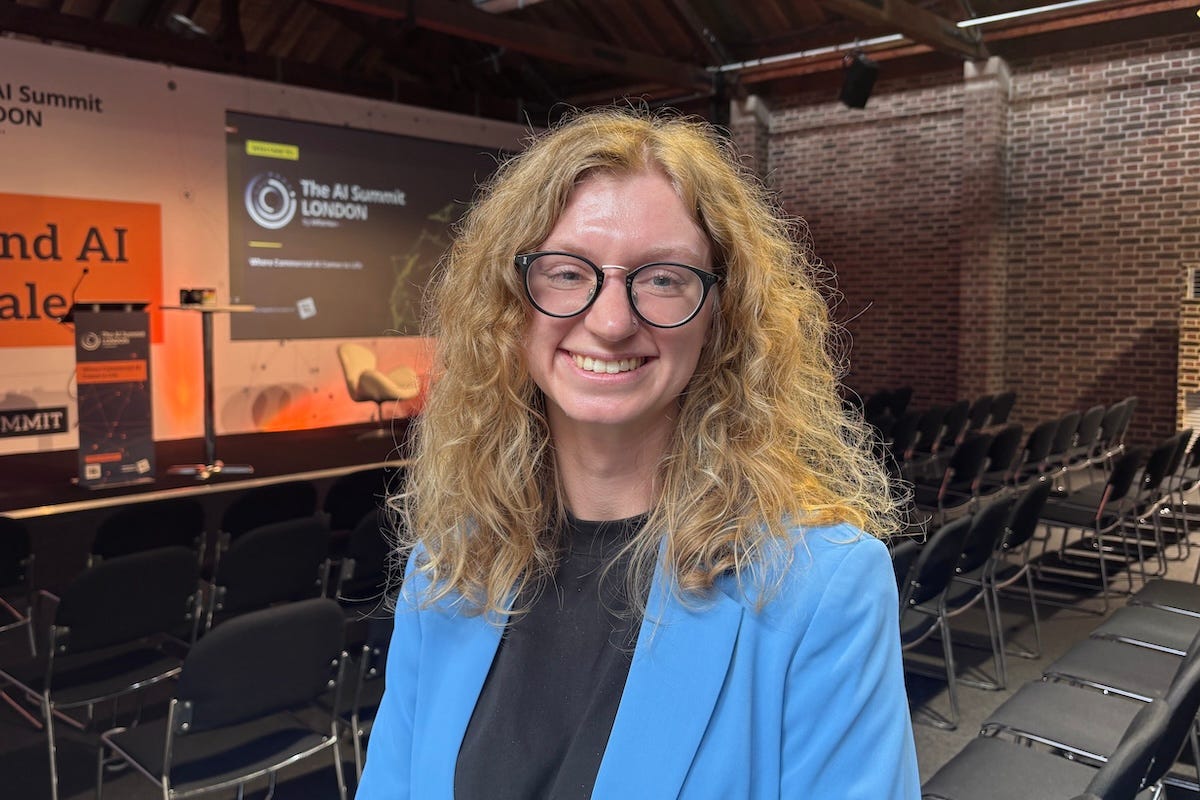
“You really cannot run everything on Claude because of how expensive it is,” Sara Maldon, Head of Business Automation & AI at Make, told TechJournal.uk in an interview on the sidelines of a recent AI event. “The second consideration is governance and observability, which come back to the management and visualization of operations. For enterprise AI, that is very important.”
Deterministic, or rule-based, automation follows fixed steps and always produces the same output from the same input, making it fast, predictable and cheap to run. AI agents, or the non-deterministic approach, use judgment to handle complex or unpredictable situations where rigid rules would fail, but at a significantly higher per-task cost.
Maldon said running rule-based workloads on Make can cost significantly less than routing the same tasks through Claude-based AI agents, a gap she described as decisive for enterprises managing large volumes of routine tasks.
“We are one of the platforms that offers both AI agents and rule-based automation. The cost of running things on agents through Claude can be up to eight times that of running them in rule-based automation on Make,” she said.
The third pillar of Make’s enterprise pitch is architectural openness. Rather than providing pre-built workflows, Make gives customers the tools to design their own operations from scratch, a deliberate contrast to platforms that impose fixed processes.
“On Make, you can build anything; you can connect anything. The bet is that we do not provide things out of the box for you right now, but you can build basically anything. It is simple to build, and simpler to build than before. We are still in the game of: it is your operations, however you want it,” she said.
Make was founded in Prague in 2015 as Integromat, acquired by Celonis in October 2020, and relaunched under its current name in February 2022.
Celonis was founded in 2011 at the Technical University of Munich, developing process mining tools to help enterprises detect inefficiencies and optimize their operations. It struck a landmark reseller agreement with SAP in 2015 and has since expanded globally, with headquarters in Munich and New York and a valuation of $13 billion.
Make operates today as an independent business unit within Celonis, with more than 300 employees and its product and engineering teams based primarily in Prague.
Doubling revenue, staying small
The AI Summit 2026, organized by Informa and held in London, brought together executives from across the technology industry to discuss the state of enterprise AI adoption. Speaking on the sidelines, Maldon outlined a broader company strategy that she said is as much about preserving culture as it is about commercial growth.
She said Make has deliberately held its headcount flat at around 300 people while pursuing aggressive revenue growth. The vehicle for this is an internal AI transformation program that Maldon leads, which is designed to demonstrate that automation and AI agents can absorb the workload that would otherwise require new hires. The program has become a live test of the platform’s own capabilities.
“One of the justifications and the missions behind launching the AI transformation program was to protect our size as a company, while continuing to grow in terms of business metrics. The mission was actually to double the revenue with the same headcount,” she said.
“The philosophy of that is not just necessarily for efficiency’s sake. As someone who has been at Make for two and a half years, I think it is an incredible company from a culture standpoint. Getting around is very easy because we are still not that many people,” she added.
Maldon described a working environment in which a deliberately small headcount creates unusually direct lines of collaboration. She said colleagues regularly approach her to demonstrate the AI agents or automation prompts they have built, a dynamic she credited to the company’s decision to stay lean.
“I go around the office and I know every single person,” she said. “The company internally is very interconnected, and it is very easy to get information, to meet people, and to collaborate, and we want to protect that at all costs.”
Make’s visual-first design underpins both its cultural argument and its product roadmap.
Maldon said the rise of vibe coding, the practice of building software by describing a vision to an AI assistant in natural language rather than writing code line by line, makes the ability to see and manage complex automation environments more valuable, not less.
“Visual communication has always been the number one way to drive communication and collaboration, and that is why being visual as a differentiator for us holds a lot of value, especially in the era of vibe coding,” she said.
“We want to be a place where businesses build their operations functions, not just a simple personal productivity workflow moving data from one place to another, but actually building processes like customer support, ticket routing, the logic after a sales call, engineering operations,” she said. “Once you build those different operational functions, you can then visualize them and see them in a holistic perspective.”
Operations, not industries
Maldon said Make does not target customers by industry. The company’s customer strategy is defined entirely by function: it serves the operations teams that build and run the internal processes of any organization, regardless of sector.
“We are not industry-specific at all, and we do not plan to be. We can serve any industry. What we are intentional about is who we serve in terms of functions. We know that we are very good at building out operations profiles in different departments,” she said.
These include revenue operations, go-to-market engineering, marketing, customer support and engineering operations.
Outside Make, Maldon has founded a side venture called Persist, focused on one of the more persistent challenges in enterprise technology: measuring whether AI investments are actually delivering results. The platform generates a single score for a company’s AI performance, benchmarked against peers and broken down by team.
“Measuring AI impact is a hard question that no one, in my opinion, has solved very well yet, and I think everyone will need to solve it at some point or another. It is my way of contributing to that topic because I deeply care about it,” she said.
She said the problem became clear over two and a half years of leading Make’s internal AI transformation, during which the same difficulty in linking AI tool adoption to measurable business outcomes recurred across organizations.
Maldon is also active in several communities focused on advancing women in technology. She participates in Women Applying AI, a global organization based primarily in Boston, and Wednesday Women, an executive network. She previously worked with European Women on Boards and She Loves Data, and speaks at conferences and industry events on the topic.