


Governments building military space power must increasingly decide which satellite capabilities to own outright, which to draw from allies, and which to buy from commercial operators.
Satellite communications, Earth observation, positioning, navigation and timing (PNT) and space domain awareness now underpin military operations and decision-making. Space assets are also no longer just support tools. They have become potential targets, and their availability can no longer be taken for granted.
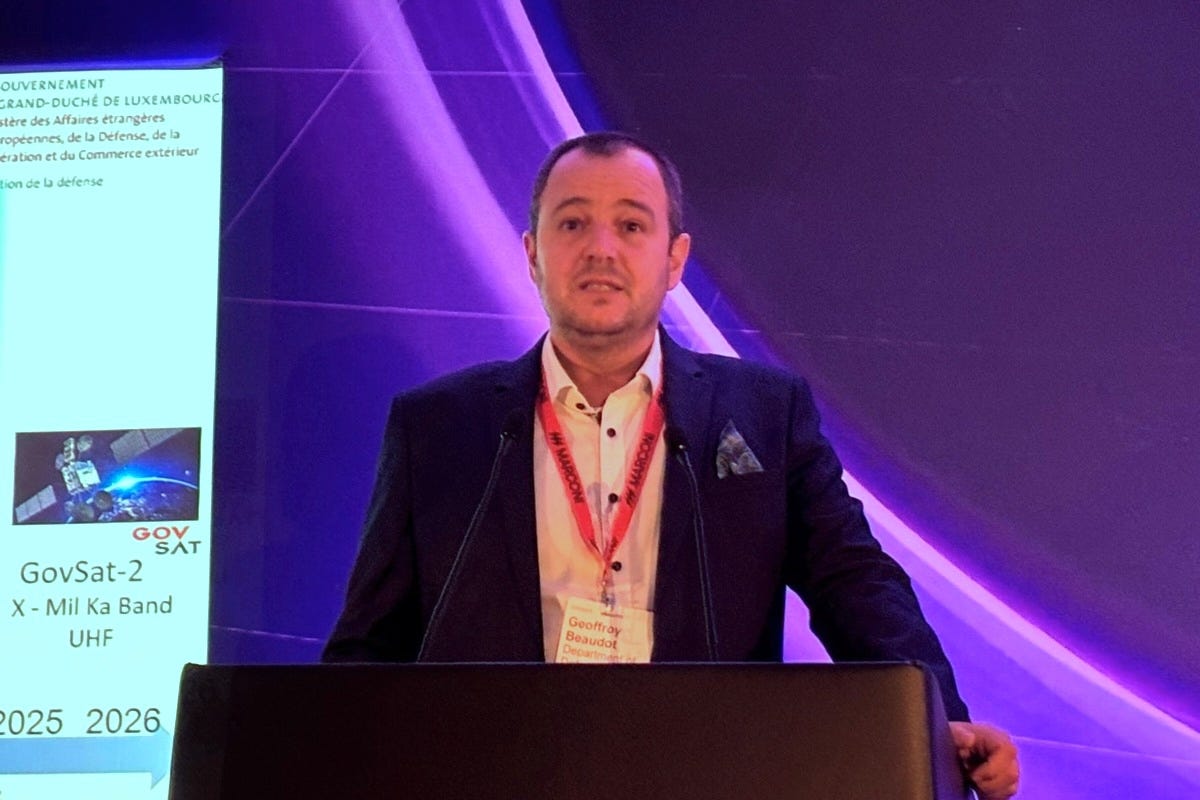
“The speed of innovation in the commercial space sector is now such that defense cannot afford to develop every capability in isolation,” said Geoffroy Beaudot, head of space at Luxembourg’s Directorate of Defence.
“The objective is not to choose between sovereign capabilities and allied or commercial solutions, but to combine them intelligently while preserving the control and assurance required for military operations.”
He said Luxembourg combines three types of capability in one secure “system-of-systems” architecture:
Sovereign capabilities for control, assurance and autonomy
Allied capabilities for cooperation, interoperability and shared resources
Commercial capabilities for innovation, capacity and flexibility
He said the country invests where it can add genuine value rather than duplicating what allies already have.
“Sovereignty and cooperation are not contradictory concepts. Sovereignty gives us the ability to act. Cooperation allows us to multiply the operational value of that ability,” he said.
“Resilience is not only about hardening satellites. It’s also about diversification, redundancy, cybersecurity, operational flexibility and the ability to maintain essential services when individual elements are degraded or unavailable. Resilience must be considered from the beginning of capability development, rather than treated as an operational feature at the end.”
Luxembourg has a long-standing space industry with deep experience in satellite communications. Its Directorate of Defence, part of the foreign affairs ministry, published the country’s first Defence Space Strategy in February 2022 and has since added a Defence Industry Strategy.
He said space is even harder than it looks, and turning space ambitions into real operational capabilities is a separate challenge. A successful space industry does not automatically translate into defense space capabilities, which also take political ambition, a coherent strategy, sustained investment and the ability to turn technological opportunities into operational solutions.
Beyond owning satellites
Beaudot spoke on October 27 at the two-day Defence in Space Conference 2026 in London, giving a keynote titled “From Ambition to Capability: Luxembourg’s Contribution to Space Defence.”
In August 2025, Luxembourg launched the National Advanced Optical System (NAOS), the satellite at the heart of its Luxembourg Earth Observation System (LUXEOSys), on a SpaceX Falcon 9 from California. It is Luxembourg’s first nationally owned Earth observation satellite and gives its defense forces a new intelligence, surveillance and reconnaissance (ISR) capability.
“A satellite in orbit is not by itself an operational intelligence capability. The real challenge lies in establishing a complete chain from mission planning and imagery acquisition to processing, exploitation and dissemination to the end user,” Beaudot said.
He said that chain needs technology, trained staff, operating procedures, ground infrastructure, cybersecurity and effective governance. Access and operations are unclassified but controlled.
LUXEOSys reached initial operational capability in October, and work now centers on improving performance toward full operational capability. The dual-use system was designed from the start to serve Luxembourg, the North Atlantic Treaty Organization (NATO), Europe and trusted partners, supporting national needs as well as “in-kind” contributions to international partnerships.
“We are not investing in Earth observation simply to own the satellite, but to deliver better situational awareness, more informed decisions and stronger collective security. We want to deliver an effect on the ground,” he said.
Secure satcom is the other pillar. GovSat-1, a geostationary (GEO) satellite launched in 2018, is run by LuxGovSat, a public-private joint venture between the Luxembourg government and satellite operator SES. It carries X-band and military Ka-band and is expected to last beyond 2038.
The next step, GovSat-2, is a hardened and protected military satcom system built for increasingly contested environments. It adds anti-jamming measures and ultra-high frequency (UHF) capability.
Beaudot said GovSat-2 will significantly increase Luxembourg’s capacity, protection and operational flexibility, with more capacity over Europe, Africa and the Middle East. Users get non-pre-emptible access to capacity, so it cannot be bumped by other customers, along with secure services such as geolocation and secure anchoring.
“Resilience cannot depend on a single satellite or orbital regime. Each orbital regime offers distinct advantages to be assessed against specific operational requirements,” he said.
He said Luxembourg is pursuing a multi-orbit approach:
GEO for wide coverage, suited to large deployed headquarters and resilient long-term connectivity
Medium Earth orbit (MEO) for high throughput, lower latency and flexibility that can strengthen the resilience of terrestrial networks
Potentially low Earth orbit (LEO) for distributed architectures and more diverse communication paths
Its MEO Global SATCOM program uses SES’s existing commercial O3b mPOWER constellation to give government and defense users high-performance connectivity.
Smarter use of data
Luxembourg also backs NATO’s Alliance Persistent Surveillance from Space (APSS) initiative, which aims to make better use of diverse space data sources, including commercial ones, and turn them into actionable intelligence for the alliance.
NATO wants to collect on high-priority areas at least once an hour under its joint intelligence, surveillance and reconnaissance (JISR) vision for 2030 and beyond. That means building a “virtual constellation” that pulls national and commercial space data into NATO systems.
Luxembourg also contributed to Smart Indicators and Warning Broad Area Detection (SINBAD), which uses satellite imagery and analytics to spot visible change such as new construction, altered infrastructure and unusual concentrations of vehicles and equipment.
SINBAD showed how commercial Earth observation data, advanced analytics and artificial intelligence (AI) can sharpen surveillance and detection.
“Meaningful contributions to NATO do not necessarily require developing new satellite constellations. They can also come from integrating existing capabilities and improving data exploitation,” he said. “The objective should not be to maximize the number of systems we possess, but to maximize the operational effect we can generate from them.”
Protecting space assets starts with knowing what is happening in orbit, which is where space domain awareness comes in.
Beaudot said militaries must detect, characterize and assess threats from congestion, interference, hostile activity and other disruption. Luxembourg supports NATO’s Strategic Space Situational Awareness System (3SAS), which uses existing NATO headquarters geographic information systems to provide space situational awareness, alerting functions and a joint strategic picture for alliance decision-makers at headquarters level.
“We can only protect what we can see. We cannot ensure resilience without understanding the threats we are facing,” he said.
He said ambition must translate into capability, capability into resilience, and national capability into collective contribution. No nation can ensure space security alone, making cooperation among governments, NATO, the European Union and industry central.
“Strategies and political commitments are essential, but their value is ultimately measured by the operational effects that they enable,” he added.
“We do not measure our contribution by the number of satellites we own, the scale of our national space program or the size of our space command. We measure it by the operational value we deliver, the partnerships we build and the contribution we make to our collective defense.”
With LUXEOSys heading toward full operational capability and GovSat-2 on the way, he said even small nations like Luxembourg can have a disproportionate impact in space.