


Thin margins push logistics firms to shift the risk of robot investment onto suppliers, leaving them exposed when a vendor disappears or drops support for older machines.
Physical artificial intelligence (AI) is making warehouse robots faster to test and reprogram. But early returns are often low, as companies must first change processes, upskill workers, and reassure staff, which drains energy and resources. Economists call this pattern the productivity J-curve. For logistics operators, the question is who carries that early cost.
“We recognize this pattern. I always want to have a back-to-back solution in,” said Arjan van Baarle, global head of contract logistics technology adoption and transformation at Kuehne+Nagel. “Especially in logistics, our margins are thin, so we’re risk-averse, and we try to bring the risk back to the suppliers.”
Under this back-to-back model, Kuehne+Nagel invests in the technology when it signs a customer contract and matches the supplier agreement to exactly the same length, including maintenance.
“It also means for the supplier that they need to go all in. Sometimes after three years the supplier is gone, and then we still need to work with the equipment, and they’re not there anymore,” he said.
He said some suppliers decide to upgrade their technology and then stop supporting the older systems still running in customers’ warehouses. At the same time, AI is changing how quickly his team can test robots and fix problems once they are installed.
“With AI entering into the equation, we can be much faster in testing,” he said. “We can be much faster in reprogramming, but that also means that if something goes wrong, we are much faster in adjusting at the right moment in time. It will help us tremendously in bringing more of those solutions live.”
Kuehne+Nagel was founded in Bremen, Germany, in 1890 and is headquartered in Schindellegi, Switzerland. It runs sea, air, road and contract logistics businesses in more than 100 countries. Its contract logistics arm provides warehousing and distribution services.
Don’t be the first
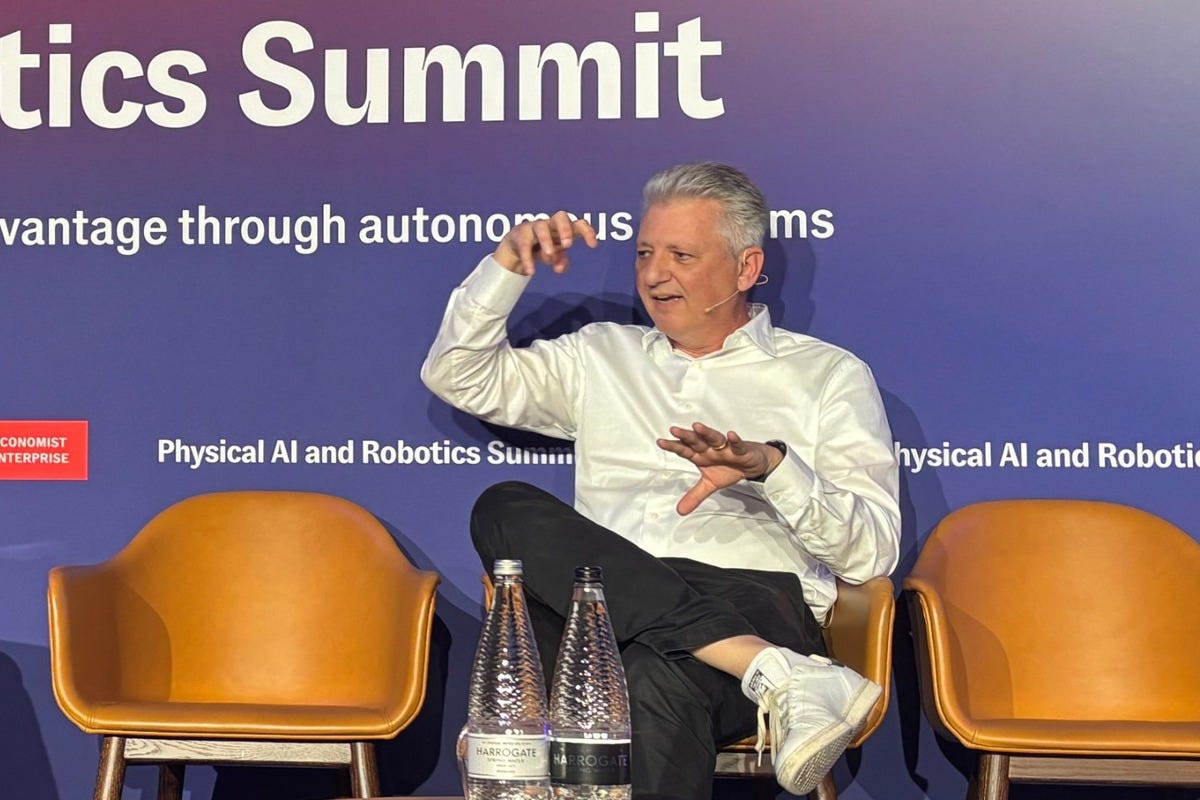
Van Baarle spoke at a fireside chat moderated by Eddie Milev, editorial lead of Tech Frontiers at Economist Enterprise, during the Economist Enterprise Physical AI & Robotics Summit in London on October 13. The session focused on building a robotics strategy that survives beyond the pilot stage.
Asked what advice he would give to companies that try to scale robotics too quickly, van Baarle offered three recommendations:
Stress-test the equipment
Look at the supplier’s strategy, structure and culture, not just the device
Check whether the supplier already works with system integrators and get their feedback
“The first advice is to test the hell out of it. Try to do all the crazy stuff that you’re officially not allowed to,” he said. “Try to jump in front of the AGV (automated guided vehicle) or the AMR (autonomous mobile robot). See if it really stops. Understand how it works.”
“Not only look at the device itself, but also look at the company’s strategy, structure and culture behind it, because that will always reflect what you see in the product itself,” he said.
The company sees its role in the industry as safeguarding its customers.
“If it’s a Chinese company new in the market and does not have anything running outside China, then don’t be the first. I want to be the second, not the first,” he said.
Van Baarle runs teams in Singapore, the US, and Europe, and compares lessons across regions, including what China's progress in physical AI can teach. Robot suppliers in China offer different products at different prices from those used in Europe because of differences in regulation and safety rules.
“China is still a little bit ahead technology-wise, but behind on safety and those kinds of things,” he said. “By bringing this team together, we have the opportunity to look further in the future. It will give us a much more stable view, but also gives us the opportunity to translate to our customers what works and what doesn’t work in what area and what region.”
Robots moved into corners
Technology is only half of the challenge. Five years ago, the company tested a cleaning robot at a site in Canada that stopped working every night at around midnight or 1 am. A camera installed to find out why showed that forklift truck drivers, afraid for their jobs, were moving it into a corner.
“Change management is important. Make sure you bring the people along the journey and let them understand where it works and where it doesn’t work,” van Baarle said.
He said companies must also take away workers’ fear of losing their jobs, but middle management is the second hurdle. In his experience, frontline staff often adapt more easily than the managers above them, who worry more about their jobs or about no longer being seen as the knowledge center.
“Your middle management layer needs to think differently, work differently and adapt to the new technology,” he said.
On the technology side, warehouse systems have shifted to goods-to-person models that store bins, cartons and pallets and bring them to workers. But the picking itself is still not easy. For the past five years, the group has worked with vision systems to pick items from one carton and place them in another.
“Today we still have 99.4% or 99.5% precision, but that still means that if you pick 500 or 600 per hour, you still have two items falling down,” he said. “The minute we hit this one, this portion is going to be fully automated.”
A person still has to step in to help the robot. He said a generalizable vision model is already much easier to deploy across different enterprise functions, and automating other repetitive tasks will make a huge difference.
“It’s picking, but it’s also palletizing and unloading a truck. A lot of those repetitive tasks where humans still make a difference because we still understand how to palletize a pallet right with all those different carton sizes,” he said.
In the past, the company brought automation only to its biggest and bulkiest warehouses.
Cheaper mobile robots, easier to deploy and more scalable, are now bringing automation to mid-sized customers. Low-cost Chinese robots are spreading fast in e-commerce bin picking and carton movement, a trend he expects to continue, while pallet handling for fast-moving consumer goods (FMCG) firms remains largely old-fashioned.
“If I look at a pipeline three years ago, I saw only a couple of projects with big numbers on it. Today our pipeline looks completely different,” van Baarle said.
Kuehne+Nagel now has a much longer list of smaller automation projects for many more customers, rather than a handful of large ones. He expects the shift to let the company commoditize automation and grow even faster.