Military satellites cannot receive hardware upgrades once in orbit. An open docking standard now in development aims to change that, allowing any manufacturer to send a servicing vehicle to an existing satellite and transfer new hardware in space.
The approach addresses a structural problem in satellite design. Components are selected years before launch and cannot be replaced in response to evolving threats, hardware failures or new mission requirements.
“We are in an age where space is not only congested and contested, but has become a warfighting domain. You have to build more resilience into the system,” said Marco Tantardini, Space Strategy and Business Development Lead for Europe at Lockheed Martin UK.
For most of the space age, the hardware limitation was accepted as a fact of life. Procurement cycles meant hardware was often obsolete before a satellite reached orbit.
“Historically, you could upgrade the software but not the hardware. What you had was what you had to stick with,” Tantardini said.
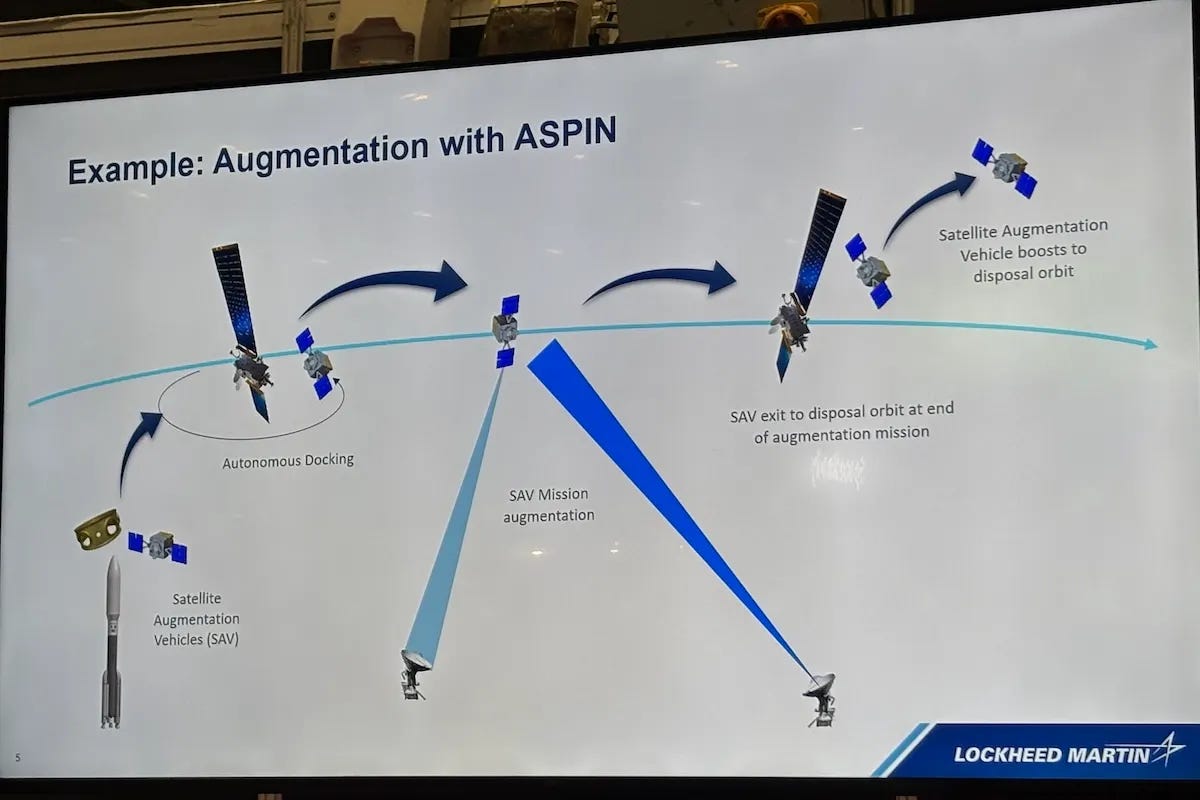
Lockheed Martin’s answer is the Augmentation System Port Interface (ASPIN), a non-proprietary docking standard whose Interface Control Documents are freely available to any company. Any manufacturer in the supply chain can build compatible Satellite Augmentation Vehicles (SAVs), not only Lockheed Martin.
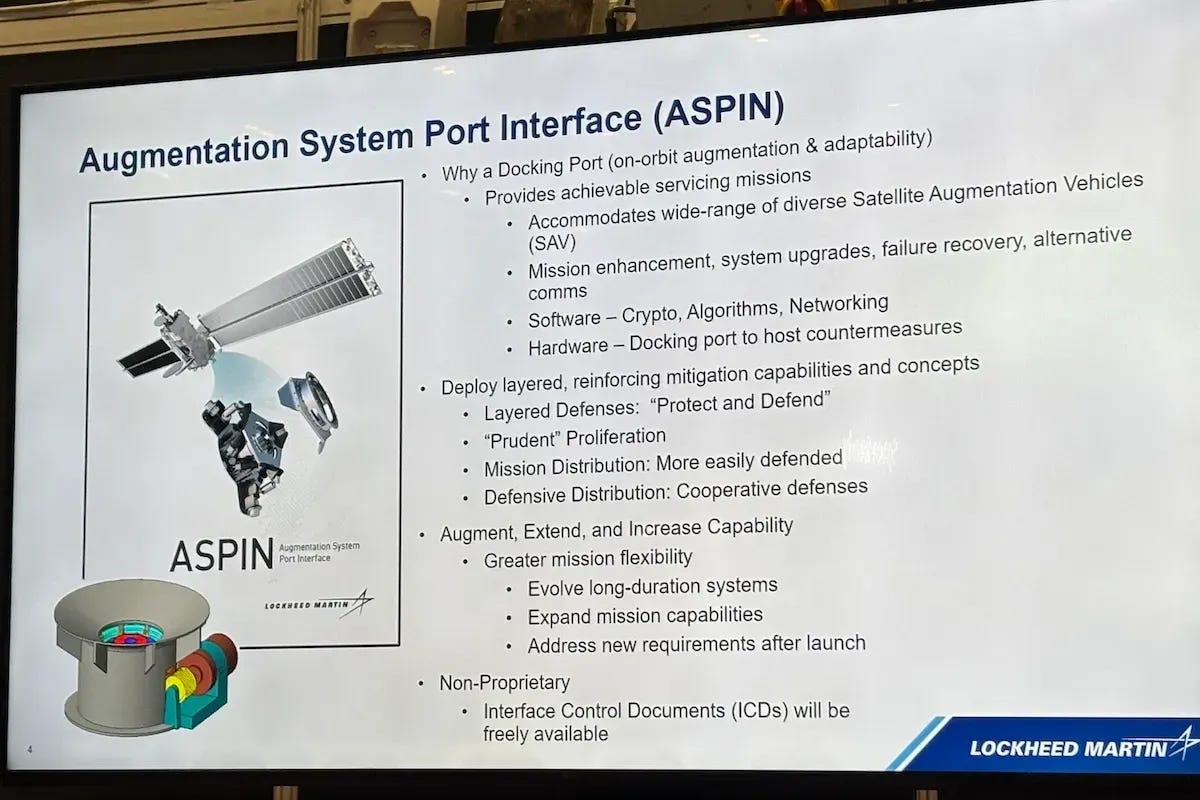
“ASPIN is open source, so it can be integrated not only on Lockheed Martin platforms but also by other partners in the industry. Anyone can access that interface,” he said.
ASPIN enables layered defenses through a protect-and-defend philosophy. Distributing missions across multiple augmented satellites rather than concentrating capability on a single high-value platform makes each spacecraft a less attractive target and creates a more resilient architecture overall.
The system supports mission enhancement, failure recovery, software upgrades covering cryptography and networking, and hardware additions including countermeasure modules. Multiple ASPIN interfaces can be fitted on a single satellite bus.
Lockheed Martin, one of the world’s largest defense technology companies, employs more than 120,000 people across four business areas. It is the prime contractor for NASA’s Orion crewed spacecraft and supplies military satellite communications to the Pentagon across multiple programs.
Space under siege
Tantardini was presenting at the 2026 Space-Comm Expo Europe in London. The event was organized by Space-Comm Limited in official partnership with ADS Group, the UK trade organization for aerospace, defense, security and space. His session was titled “How Space Connectivity Strengthens Community Resilience.”
An engineer by training, he holds a BSc in Aerospace Engineering from Politecnico di Milano and an MSc in Space Engineering from Delft University of Technology in the Netherlands. In 2021, he completed the Senior Executives in National and International Security program at Harvard Kennedy School.
Russia’s Luch satellites have for years performed proximity operations near European and commercial assets.
He cited a recent Financial Times report showing the craft had approached close enough to potentially intercept command-and-control signals. The topic, once largely absent from mainstream reporting, was now widely covered.
“You need strong encryption, and you need to protect yourself,” he said.
The full threat picture covers six categories of satellite communications (SATCOM) threats: nuclear bursts, direct-ascent anti-satellite (ASAT) weapons, co-orbital ASAT systems, cyber attacks, tactical jamming and physical attack.
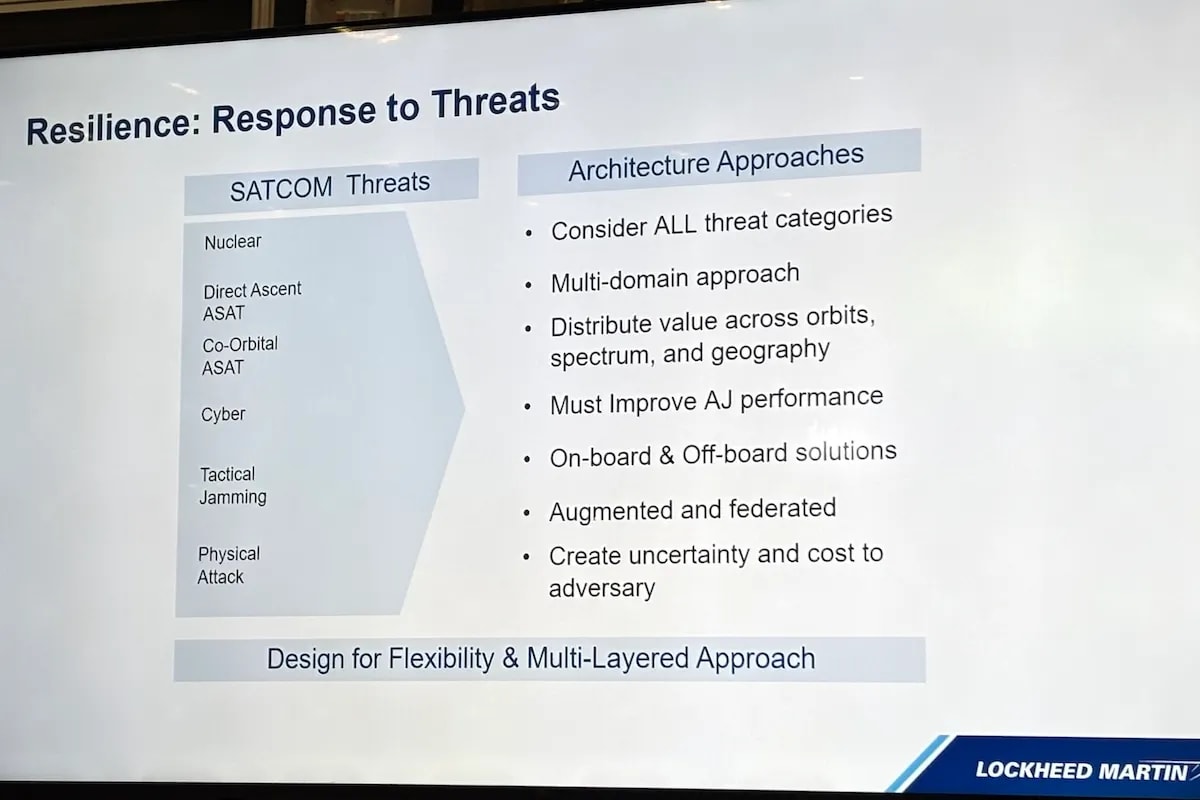
Responses must span both on-board and off-board solutions and improve anti-jamming performance across all frequency bands.
The overarching design principle calls for distributing value across orbits, spectrum and geography to create maximum uncertainty and cost for any adversary, through federated architectures, layered defenses and the ability to rapidly augment systems already in orbit.
The same logic reshapes orbit selection. Military satellite architecture once focused almost exclusively on geostationary orbit (GEO), where large, robust platforms offered secure, protected communications. The push for resilience is now driving a proliferation of orbits and a blurring of the line between commercial and military use.
“The frontier is to mix orbits and have a multi-band and multi-orbit mesh network,” Tantardini said. “One solution does not fit all.”
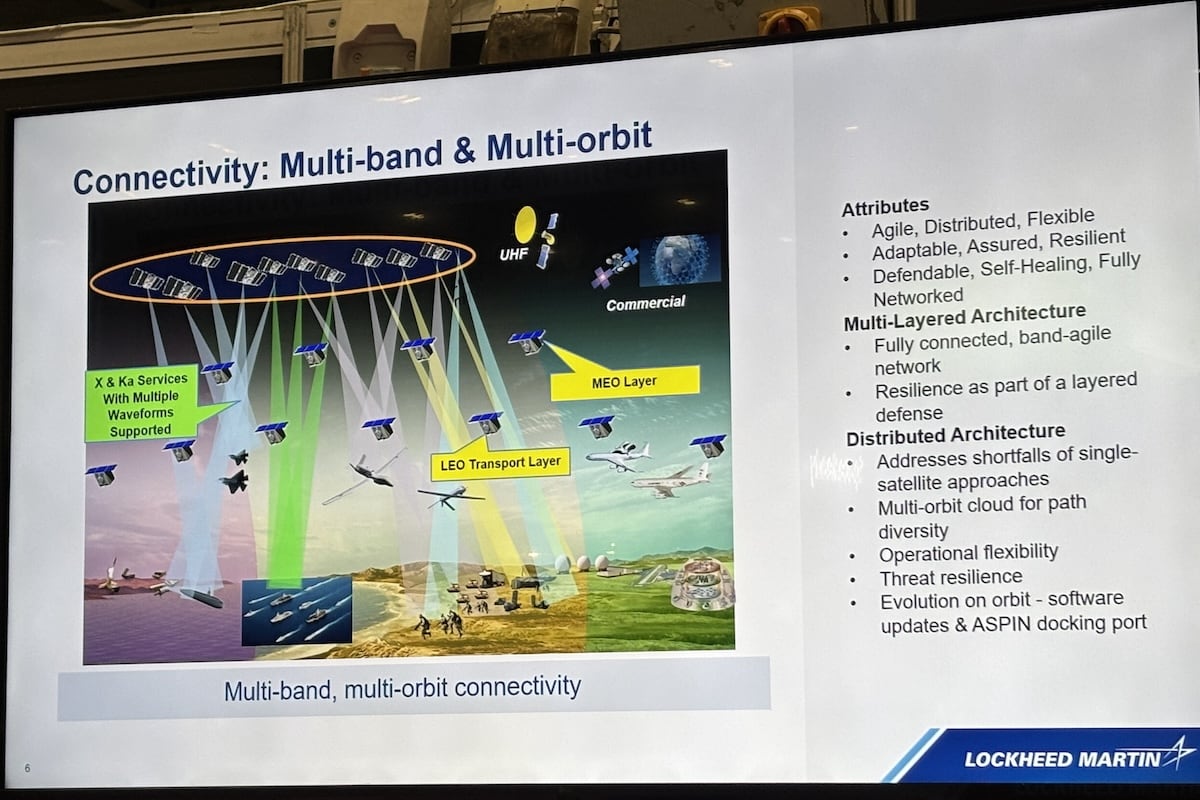
His presentation illustrated a layered architecture spanning GEO, medium Earth orbit (MEO), and low Earth orbit (LEO), with ultra-high-frequency (UHF) and X/Ka-band services, and a commercial satellite tier as an additional redundancy layer. The design targets an agile, distributed, self-healing and fully networked system.
The distributed model creates path diversity across an orbital cloud. Software updates over the link and ASPIN hardware docking together give the network the ability to evolve in orbit without triggering a new procurement cycle.
Lockheed Martin has delivered military satellite programs across all three orbital layers, from the Advanced Extremely High Frequency (AEHF) satcom system in GEO to GPS navigation satellites in MEO, having recently launched the GPS 3F spacecraft. The company also develops missile-warning and tracking constellations spanning GEO and LEO orbits.
Connecting all military domains
The next layer of the architecture is 5G.MIL, a corporate initiative spanning Lockheed Martin’s space and aeronautics divisions. It scales from small tactical deployments to global strategic operations, enabling secure voice and data links that function even through untrusted commercial networks.
The program uses distributed edge and enterprise cloud processing to maintain low-latency mission data flows, adapting its network topology dynamically as asset availability and radio frequency (RF) conditions change.
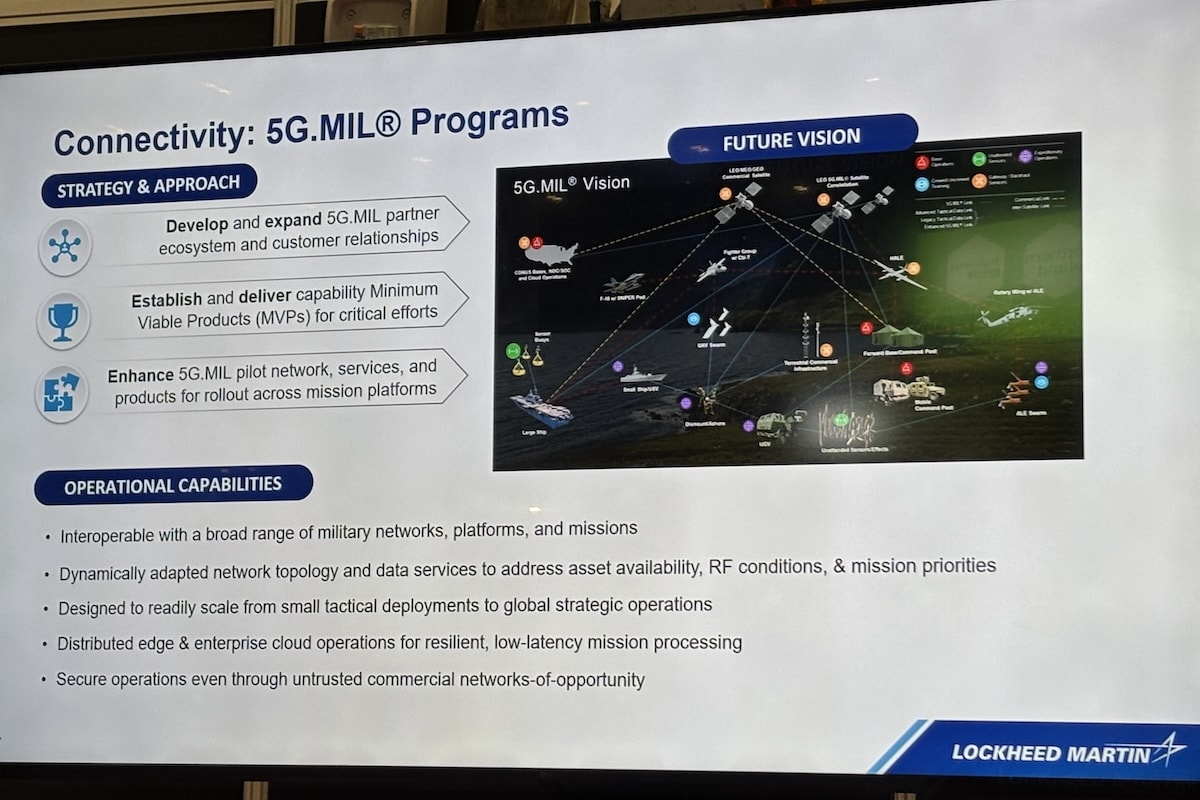
Lockheed Martin is testing the technology on a satellite called TacSat, primarily an intelligence, surveillance and reconnaissance (ISR) platform awaiting launch. The spacecraft carries a 5G.MIL payload alongside infrared sensing and advanced communications capabilities.
“It will provide voice and data satellite communication for military space assets, with the goal of ultimately making constellations more resilient in the event of disruptions,” Tantardini said.
These capabilities underpin a broader command framework known as CJADC2, or Combined Joint All-Domain Command and Control. The initiative aims to connect every component of a military force and its equipment into a single unified network.
CJADC2’s operating principle is to sense the battlefield, make sense of the information and act on it. Through automation and artificial intelligence (AI), it is designed to reduce decision times from minutes to seconds while integrating current and legacy systems and enabling U.S. allies to coordinate seamlessly across all domains/
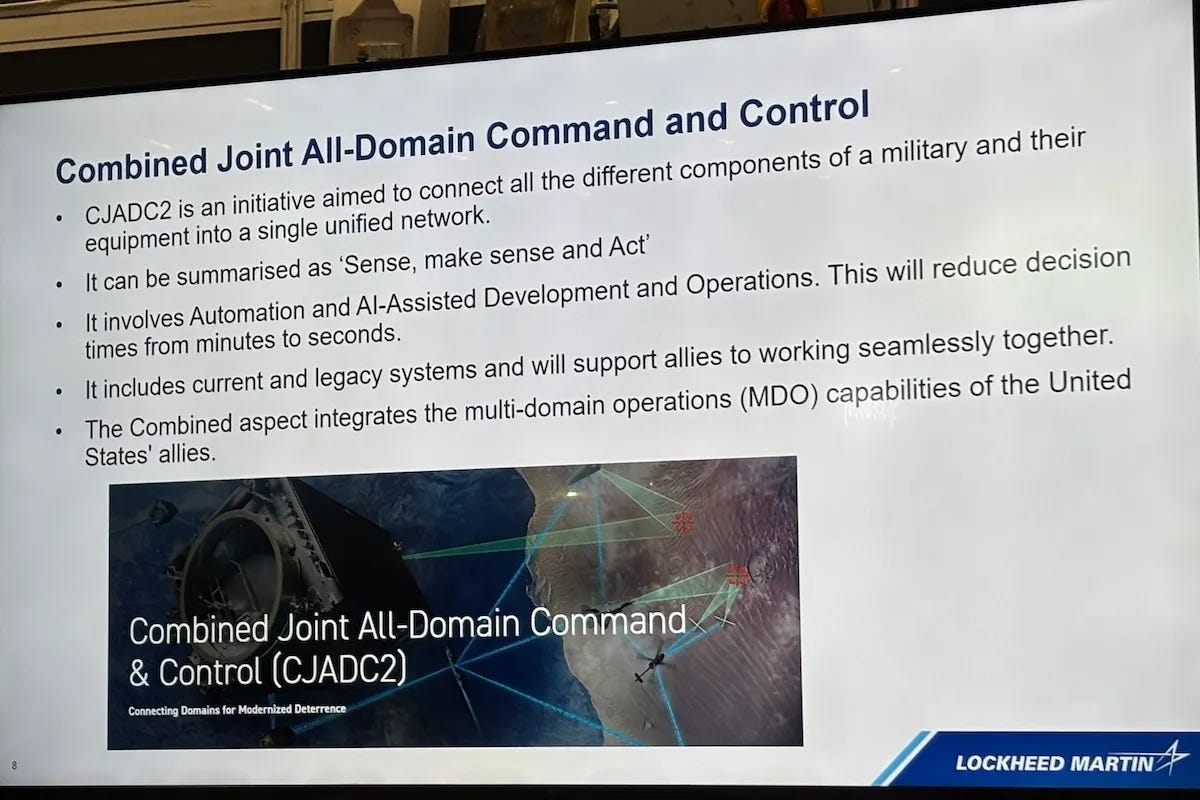
“CJADC2 is enabled by the space network and integrates and synchronizes military operations across all domains, enhancing decision making and coordination among the U.S. and allied forces,” he said.
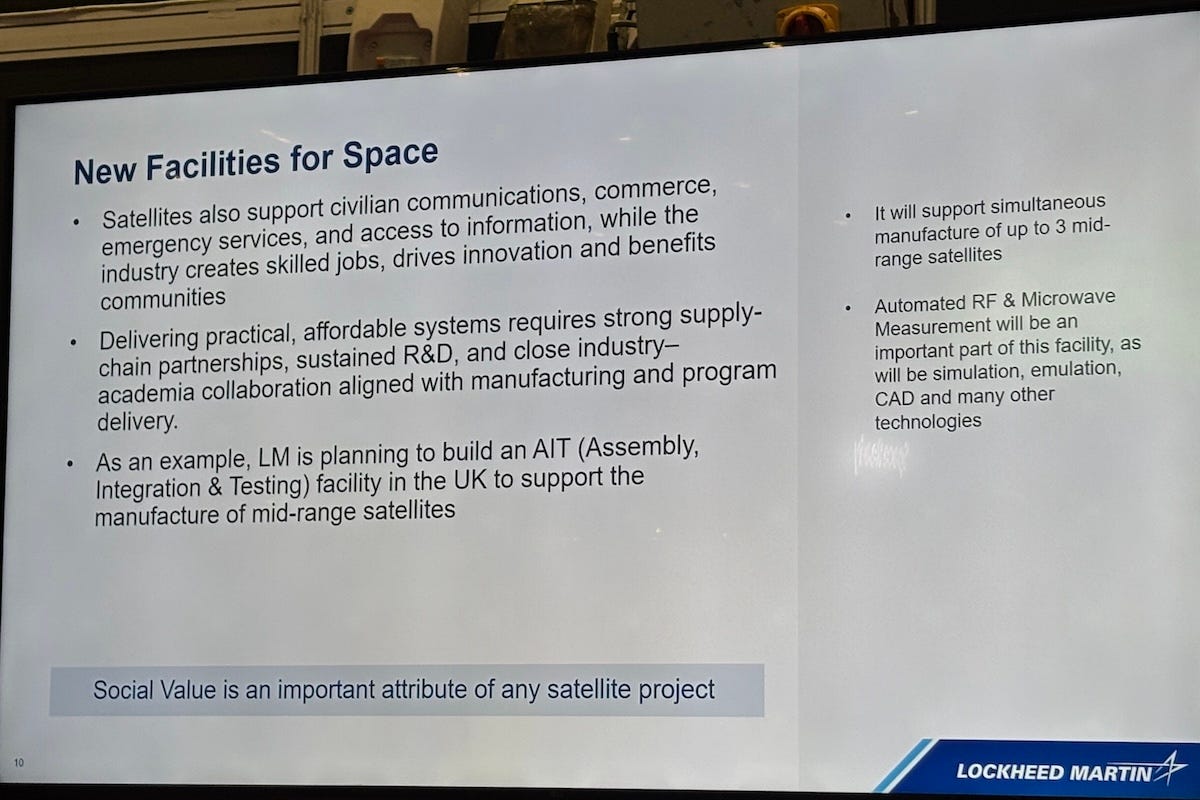
Lockheed Martin is planning to build an Assembly, Integration and Testing (AIT) facility in the UK capable of simultaneously manufacturing up to three mid-range satellites, equipped with automated RF and microwave measurement systems, simulation, emulation and computer-aided design (CAD) tools.
He said the solutions being delivered in the years ahead would be conceived and implemented by those currently at school or university.
The company's SMEUnite initiative already includes more than 180 British companies. A skills and technology center in northeast England known as the North East Space Skills and Technology Centre (NESST) is expected to create more than 350 jobs over the next two decades.
Lockheed Martin UK recently became the first defense company to achieve Defence Cyber Certification (DCC) Level 3, the highest tier in the Ministry of Defence (MOD) program to harden cyber resilience across the UK defense supply chain. The achievement comes ahead of an industry-wide deadline.
The MOD has asked all industry partners to reach at least DCC Level 0 by December 31, 2026, as part of the forthcoming Cyber Resilience Bill and National Cyber Action Plan, which together call on all organizations to reassess and strengthen their cyber resilience.
With TacSat’s launch pending and a UK AIT facility in planning, Lockheed Martin’s ambitions in British space are set to move from blueprint to build.