Artificial intelligence (AI) is entering a phase where competitive advantage is defined not just by model performance, but by infrastructure, talent pipelines, and the ecosystems that enable deployment at scale.
Across Europe and the UK, governments and enterprises are committing billions to data centers, high‑performance computing, and energy capacity. As this build‑out gathers pace, a more immediate constraint is emerging: the availability of workers capable of designing, operating, and integrating AI systems into real workflows.
“AI has shifted from experimentation to implementation, and in 2026, the focus is firmly on delivery,” Sue Duke, Vice President of Global Public Policy and Managing Director for EMEA and LATAM at LinkedIn, told TechJournal.uk in an email interview.
“Governments and businesses across Europe are investing billions in data centers and computing capacity, recognizing that AI infrastructure underpins economic competitiveness.”
“But infrastructure alone is not enough. Companies are competing for a limited pool of AI engineering and data center talent that is on the move across borders,” she said. “Jobs and growth will only follow where infrastructure, energy, investment, and skills are aligned.”
Duke said AI will change jobs, but evidence shows it is creating new roles even as it transforms others. Some of the fastest‑growing roles—such as forward‑deployed engineers, up more than 40× since 2023, and AI engineers, up more than 10×—did not exist at scale a few years ago.
She added that a generational shift is underway, with more young people starting businesses and moving into skilled trades and infrastructure roles critical to the AI economy. The priority for workers is to learn how to work alongside AI, as AI literacy is becoming a baseline skill across sectors.
Value shifts outward
Long‑term economic value from AI is expected to accrue primarily to the infrastructure layer and its surrounding ecosystem. Firms that build, power, and maintain AI systems are positioned to drive sustained job creation because every application depends on a physical and operational backbone.
This reflects how economic activity is expected to concentrate around the infrastructure layer, where suppliers, service providers, and operators support the deployment and maintenance of AI systems.
Duke said this shift means competitive advantage will depend less on building models alone and more on how effectively companies execute across infrastructure, operations, and the broader ecosystem.
LinkedIn’s workforce data shows the UK remains a leading AI talent hub, but in a sluggish, highly competitive labor market, winners will be those that build talent pipelines, convert adjacent skills, and move faster than competitors.
She said AI infrastructure is local and capacity‑constrained, meaning governments that align planning, energy, skills, and immigration policy will attract investment, while others risk falling behind.
Companies competing for a limited pool of AI talent cannot rely on traditional hiring. Skills‑based hiring is the unlock, she said, allowing firms to focus on capabilities rather than credentials, tap adjacent talent, and expand the effective workforce.
Skills misalignment
In the UK, employers report persistent talent shortages and difficulty retaining staff, even as many graduates struggle to secure entry‑level roles or apprenticeships.
Duke said this is one of the toughest entry‑level markets in years, where standing out depends on skills, adaptability, and networks. She pointed out that the fundamentals have not changed, but matter more than ever: clearly showcase skills, keep building both AI and human capabilities, and invest in relationships.
She said being connected significantly improves hiring outcomes, with candidates who invest in networks far more likely to secure roles. The UK does not lack talent, she said, but lacks alignment between what employers need and how individuals build and signal skills.
Bridging that gap is becoming a central labor‑market challenge, as employers prioritize demonstrable capabilities over credentials.
In May 2025, LinkedIn launched AI-powered job search, enabling conversational searches that match skills with job opportunities. The feature, initially available to Premium users, was expanded to all users and to additional languages—Spanish, French, German, and Portuguese—in January 2026. It is already used by about 1.3 million people daily, with more than 25 million searches a week, and early data shows users without a four-year degree are about 10% more likely to be hired.
The system is designed for speed and accuracy at scale. Results are evaluated using a second LLM-based system alongside human review, allowing LinkedIn to test far more outputs than manual checks alone.
Last November, LinkedIn launched a new feature, AI-powered people search, to improve how people and opportunities are matched. The platform is also refining its feed to surface more relevant content, allowing users to find professionals using natural language rather than keywords.
The feature, initially available to Premium users in the US, lets members describe the expertise they need and receive results based on skills and experience. Drawing on large‑scale professional data, it aims to improve discovery and help identify the right people at the right time.
Skills redefine roles
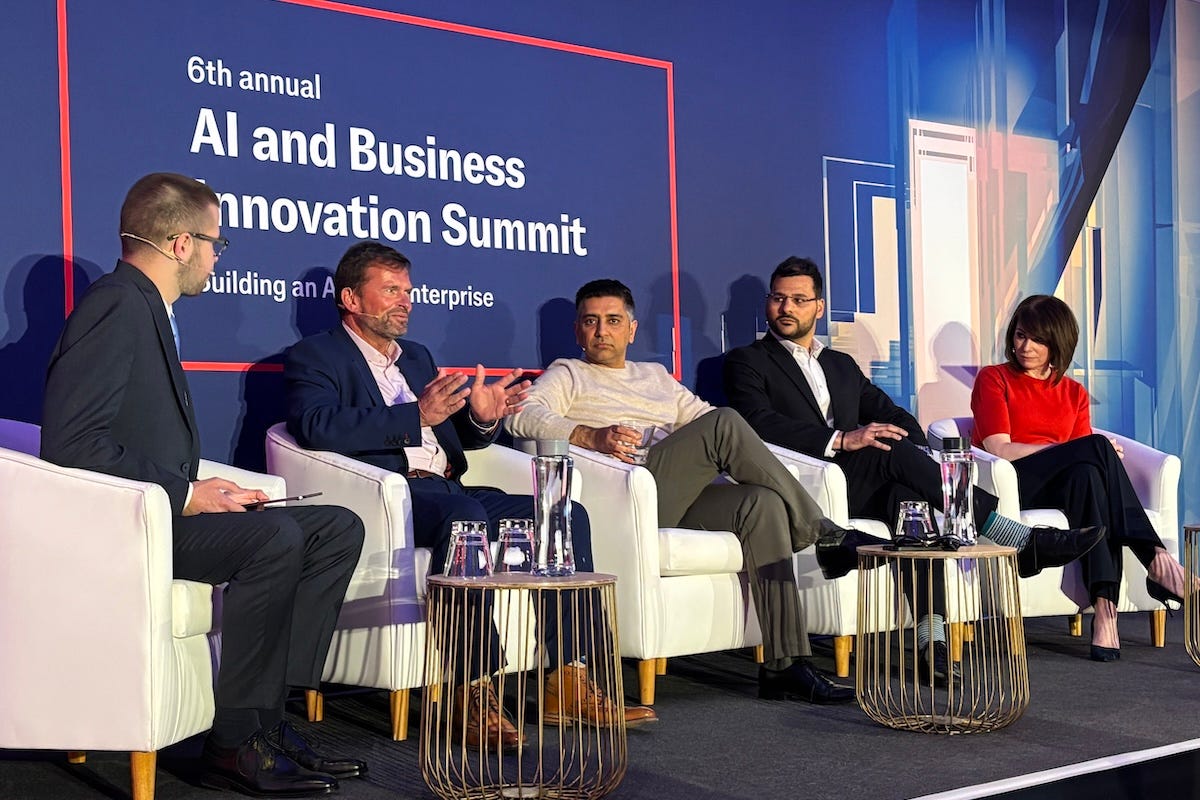
Duke also shared her views at the AI and Business Innovation Summit, organized by Economist Impact in London on March 25. The session, moderated by Eddie Milev, Editorial Lead for Tech Frontiers at Economist Impact, examined how AI is reshaping skills and roles.
“By 2030, for the average job, 75% of the skill set will have changed,” she said. “There are three buckets of skills that are crucial in this transition: AI technical skills, AI literacy skills, and those uniquely human skills that cannot be replaced.”
She elaborated three key skill areas:
AI technical skills: capabilities to build, deploy, and maintain AI systems, which remain in short supply across the market.
AI literacy: the ability to use AI tools, interpret outputs, and integrate them into daily workflows. Duke said that demand for AI literacy skills has risen sixfold over the past year and is “off the charts.”
Human skills: adaptability, systems thinking, creativity, and learning agility—capabilities that grow in importance as routine tasks are automated and work shifts toward judgment, coordination, and problem-solving.
Workers are expected to move across more roles over their careers, often over shorter timeframes, making the ability to learn and adapt central to long‑term employability.
Duke said the challenge for policymakers and business leaders is to ensure workforce development keeps pace with technology. Aligning education, training, and immigration policy with AI demand will be critical to competitiveness.
Workforce in transition
At the same panel discussion, other speakers focused on the skills people need as AI changes how work gets done.
Rajat Dhawan, Chief Technology Officer at Soho House, said generative AI has already changed day‑to‑day operations. In one case, drafting a customer email fell from about 14 minutes to 4 minutes, saving roughly 9-10 minutes per interaction.
He said these gains allow teams to shift toward higher‑value work that requires context and judgment, while some functions will need fewer staff as efficiency improves.
Devendra Jain, who leads frontier technologies for operations at the World Economic Forum, said the most valuable skills are those AI can amplify rather than replace. Organizations must balance automation with augmentation, emphasizing “super skills” such as problem‑solving, adaptability, and decision‑making.
Rob Clifford MBE, Chief Digital Officer at the Houses of Parliament Restoration and Renewal Delivery Authority, said productivity gains should be used to give employees time to learn.