


Humanoid robots are entering factory floors, but no one can yet say who is liable when a robot assembled from parts from several suppliers hurts someone.
A single robot may combine one company’s body, another’s hand and a third firm’s artificial intelligence (AI) model.
“Let’s say the robot hits someone. Who takes charge? Is it the model? Is it the hardware? Nobody really knows,” said Aaron Rohmann, director of Atlas at MicroAGI, a Munich-based robotics startup. “That’s also stopping us at the moment from deploying quicker.”
“I couldn’t get a single company to come, primarily for insurance reasons,” said Richard Ahlfeld, senior vice president of physical AI at CoreWeave, recalling his attempt to bring live robot demos to the company’s latest summit. “So we ended up with pre-programmed robots that do the same things they’ve done for the last 30 years.”
He said the experience bore out Rohmann’s point. He had invited roughly 100 physical AI companies in CoreWeave’s network to see their robots at work on their own sites, and even the pre-programmed machines needed coverage. Insuring a robot for a single day is expensive.
Rohmann said the liability problem is built into how robots are assembled today. In MicroAGI’s own workshop, a Unitree robot is fitted with a Sharpa hand and runs on an Nvidia model.
He said this hardware is improving quickly, but much of it is still in prototype form.
“It’s a technology that is currently making big jumps, but it still has a very long tail. Before you get an autonomous car onto the street, you have years and years of validation ahead of you to make sure that it is reliable across a lot of different zones,” Ahlfeld said.
He said that is why it will still take a while before production use cases move forward.
The 99.7% question
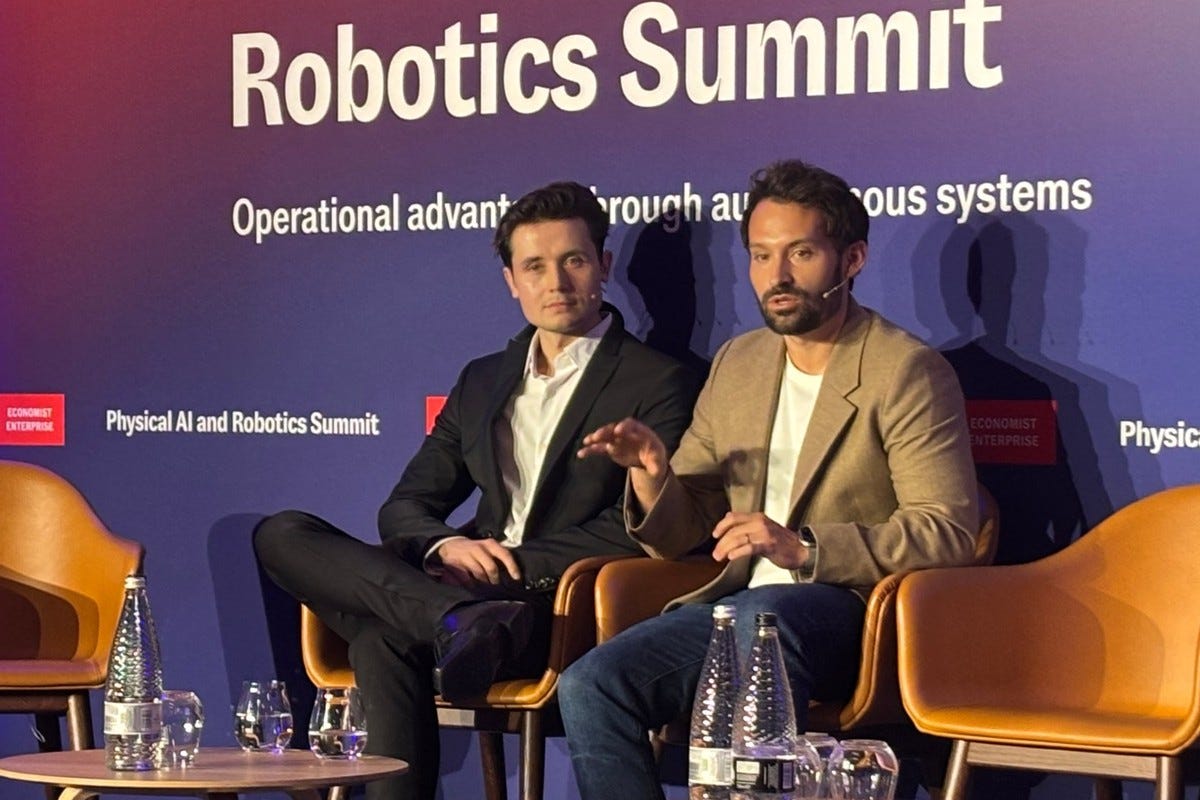
Ahlfeld interviewed Rohmann at the Physical AI and Robotics Summit, organized by Economist Enterprise in London on October 13. Their session, supported by CoreWeave, focused on how companies can move physical AI from pilots into production.
CoreWeave, a US-based neocloud, provides computing power for training AI models. It agreed to acquire Monolith, a London startup that Ahlfeld founded as an Imperial College London spinout, in a deal announced in October 2025. Ahlfeld now runs its newly created physical AI department.
MicroAGI raised $55 million in a seed round, which Ahlfeld called the largest in German history. Its Atlas platform aims to help industrial companies move robots from demos into production.
Rohmann said the bigger open question is whether today’s AI models and hardware are good enough. Safety is a large part of that, and he was in London the week before the summit to discuss standards with the British Standards Institution (BSI).
“Are we there yet, that you can reliably deploy a robot to around 99.7%? That’s the question,” he said. “If you have to put the humanoid into a robot cell because it’s not safe, then it’s really hard to deploy a robot.”
He said a humanoid makes the most sense when it moves on a mobile platform and combines two, three or four tasks.
“If you have a task that’s 24/7, then it might not make sense to put a humanoid there. Just build a machine, maybe,” Rohmann said.
He said demand is not the problem. Some enterprises, such as German industrial supplier Schaeffler, already have dedicated teams and may supply humanoid robot makers or deploy their own robots. Others are only starting to ask whether physical AI is relevant to them and want to test it with a focused proof of concept.
“The customers are there. The overall interest is there,” he said.
Ahlfeld recently toured more than 20 Bay Area startups, from Stanford dorm founders to firms that have raised billions.
He said robots' ability to learn is at a really exciting stage, and the idea that more data and compute produce more intelligence, which transformed language models, is now reaching the physical world.
“Maybe not all the demos yet are real. Maybe it’s still really hard to get into production,” he said. “There are a lot of things we still need to do, but you can see that there is something happening.”
Start with the task
Rohmann said the first step is always to pick a task that today’s hardware and models can handle. MicroAGI is hardware-agnostic, working with robots from Unitree, AgiBot, Galbot and Sharpa, among others. He has spent recent weeks visiting shop floors across Europe, MicroAGI’s main focus, in logistics, automotive, manufacturing and retail.
He said the process then runs in four steps:
Collect data on site
Train the model
Choose the right hardware
Deploy on site
“Collecting data on site is the best data that you can collect. We collect the object, the sequence of how someone is doing the job and also the edge cases,” Rohmann said. “If something breaks or falls down, if there’s a production stop, what’s happening? What’s the fallback plan? You only have that if you collect data on site.”
He recalled a site in Switzerland where a 100-year-old machine is so worn that operators cannot simply load copper parts into it. They need a specific hand movement to make it work, and a model can learn that only from on-site data.
Ahlfeld gave the hypothetical example of a carmaker that has never been able to automate feeding cables into a car door and wants to see whether physical AI could make the job faster and cheaper.
He said every factory needs its own fine-tuning, even when a robot starts with a generic dataset.
“Everything is very unique, and a lot of things have gone into very clear rhythms over the years that you want to retrofit your tool into,” he said.
People are increasingly filming those generic datasets. MicroAGI, founded in 2025 by former Formula 1 engineer Bercan Kilic, set out to collect data first and train models second. It hands out head straps so people can record egocentric, or first-person, video in homes, warehouses and factories.
Other sources include teleoperation and tactile gloves, but MicroAGI focuses on egocentric video. It launched with two products: Shift, which collects and annotates training data, and Atlas, which handles deployment.
Rohmann said he spent days in March and April at a camping table at the Pinakotheken in Munich, handing out head straps to the public in the rain. The footage is then annotated, turned into 3D environments and used for hand-pose tracking before it trains models.
“Instead of marking homework or serving coffee or working in a bakery, you can now wear a headset and train a robot in your spare time,” Ahlfeld said. “These initial data sets can get you started much faster and give the robot some basic intelligence.”
Training the models is a separate challenge. He said a large training run needs 50,000 high-performance graphics processing units (GPUs) working in unison, and a failure can waste $100 million. That is why neoclouds such as CoreWeave were created, and his department aims to help customers train such complex models for physical AI.
He said the US gained an edge in large language models partly because few would risk that much on a training run that might fail. CoreWeave is now building data centers in Europe.
Ahlfeld said anyone can now connect a roughly €300 Hugging Face robot to a frontier AI model and be amazed by what it can do, but turning such experiments into reliable production systems will still take years of validation.