


Fusion startups may be moving faster and attracting billions of dollars in fresh investment, but some of the industry’s biggest engineering problems still cannot be solved inside compact commercial labs.
As private companies race to deliver fusion power within the next decade, the debate is shifting from whether fusion works to whether massive public-sector projects such as International Thermonuclear Experimental Reactor (ITER) still have a role in the commercialization era.
“When we built windmills, and we really started harnessing windmills, we didn’t destroy the wind tunnels. We didn’t destroy the testing facilities,” Laban Coblentz, chief strategic advisor at the ITER, said during a fireside chat in London. “The two are complementary.”
“It was foolish to think that ITER could be built in the timeline that we said, and then we were going to build DEMO and tell everybody how to build 10,000 tokamaks,” he said. “That absolutely did not apply to something as complex as ITER.”
DEMO, short for DEMOnstration power plant, is the planned successor to ITER and is intended to become the first tokamak reactor to supply net electricity to the grid. While ITER focuses on proving fusion physics, DEMO is expected to focus on engineering feasibility, tritium breeding and reliable power generation.
The rise of private fusion startups has intensified pressure on large public-sector projects to prove they can still contribute meaningful scientific and engineering value.
Questions are also growing over whether ITER’s delays, rising costs and multinational governance structure could undermine its position as commercial fusion companies attract stronger investor momentum and pursue faster development timelines.
Coblentz pushed back against the idea that ITER and private fusion companies were competitors, saying many commercial firms were increasingly relying on ITER’s engineering experience as they moved toward integrated reactor systems.
“Private sector companies are eager to have ITER’s knowledge,” he said. “Commonwealth Fusion Systems’ employees are irritated at me because I’m still trying to dig up documents that they want access to.”
Several years ago, ITER staff were skeptical about collaboration with commercial fusion companies. Some employees even viewed private firms as rivals. That attitude gradually shifted as venture-backed companies started confronting the realities of reactor integration, assembly and plasma engineering.
Fusion companies initially focused heavily on plasma performance and magnet breakthroughs, but increasingly discovered that large-scale systems engineering remained one of the industry’s hardest challenges.
ITER’s role has therefore evolved beyond plasma physics. The project now functions as a large-scale industrial testing ground covering metrology, assembly systems, materials engineering and systems integration.
Those engineering challenges become harder rather than easier as reactor designs become smaller and more powerful.
“The twin problems of fusion, the most important thing, are size and precision,” Coblentz said. “Whether you’re trying to build magnets at giant scale or targets for inertial fusion, the precision is insane.”
Compact fusion systems may still face severe engineering risks despite rapid progress and growing investor enthusiasm.
“SPARC, the compact tokamak being developed by Commonwealth Fusion Systems, is going to do great things,” he said. “However, there’s a possibility that it could destroy itself in its first test run because they’re taking high risk.”
He said fusion developers are increasingly discovering that plasma breakthroughs alone are not enough. The bigger challenge is integrating multiple complex systems into a stable reactor.
ITER still contributes valuable knowledge on assembly sequencing, materials resilience, industrial-scale tolerances and long-duration reactor integration that many startups cannot yet replicate independently.
Fusion funding surge
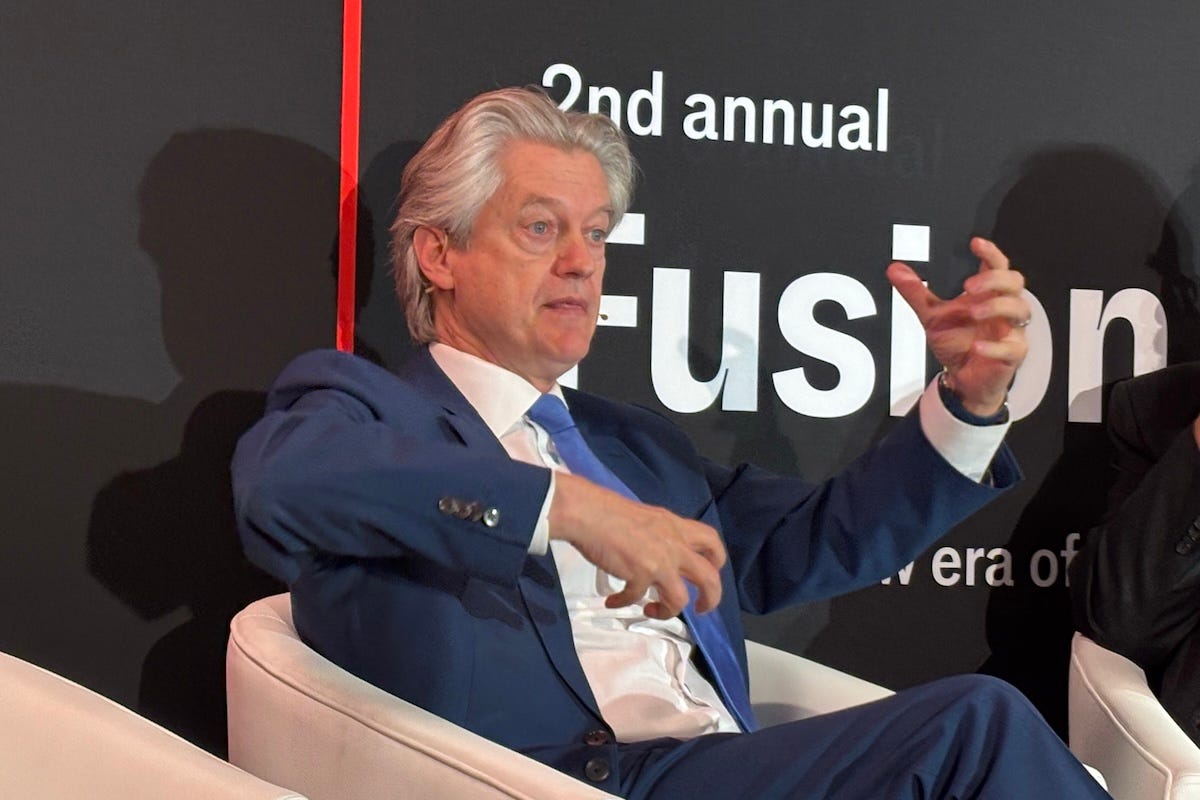
The discussion took place on April 14 during Fusion Fest in London, an event organized by Economist Impact. Geoffrey Carr, senior editor for science and technology at The Economist, moderated the fireside chat with Coblentz on ITER’s future role as private fusion companies accelerate commercialization efforts.
ITER traces its origins to 1986, when Euratom, Japan, the Soviet Union and the United States agreed to jointly design a large international fusion facility. Work on the concept began in 1988, with members approving the final design in 2001, laying the foundation for one of the world’s most ambitious scientific collaborations.
Construction began in 2013 with a budget of 6 billion euros (US$6.8 billion), but costs later rose sharply. ITER estimated total costs at about 22 billion euros in 2021, while the US Department of Energy projected the overall figure could eventually reach US$65 billion by 2039, when full fusion operations are targeted.
The European Union is expected to fund about 45.6% of the project, while China, India, Japan, South Korea, Russia and the US each contribute roughly 9.1%.
Investor confidence in fusion began shifting roughly five to six years ago as ITER’s physical infrastructure became more visible.
“About five or six years ago, investors started to invest in private sector fusion projects,” Coblentz said. “They said to me that their CEOs were seeing ITER’s progress and realizing these systems could actually be built.”
Earlier in ITER’s development, the Obama administration considered withdrawing funding while the project struggled with delays and limited construction progress.
At the time, only a small number of private fusion firms were active, including Commonwealth Fusion Systems and TAE Technologies.
Investor sentiment gradually shifted after ITER’s buildings, manufacturing systems and reactor components began materializing at scale.
“Our CEOs are seeing that you can build these components, and they realize that maybe this is feasible,” Coblentz said. “Investors really are starting to see this.”
He said proving manufacturability became especially important because fusion systems combine extreme physical scale with unusually tight engineering tolerances.
ITER’s large size is also partly intended to manage neutron bombardment on reactor walls. Compact systems using stronger magnets may reduce reactor size but can significantly intensify neutron exposure and materials degradation.
“The neutron flux is hitting at about the limit of our materials,” he said. “If you make the reactor much smaller with more powerful magnets, the number of neutrons hitting those walls goes up exponentially.”
He added that unresolved challenges involving tritium breeding, liquid metal walls and materials resilience continue affecting multiple fusion approaches across the industry.
The engineering challenge in fusion is often underestimated compared with the plasma physics challenge. Fusion development increasingly depends on the integration of magnets, materials science, assembly systems, precision manufacturing and computational modeling rather than breakthroughs in a single scientific field.
AI-designed reactors
Artificial intelligence (AI) and digital simulation tools are also becoming increasingly important in fusion engineering as developers attempt to accelerate reactor design and testing cycles.
“Nvidia just told me that they are using AI to transform digital twins for SPARC and other projects,” Coblentz said. “They’re doing it because we open-sourced a scientific simulation code last year.”
ITER recently released an open-source scientific plasma simulation code that external organizations are now using to refine digital twin systems for fusion reactors. AI-assisted simulations could help companies improve reactor integration, systems optimization and engineering analysis without relying entirely on physical testing.
The organization also continues contributing knowledge beyond plasma experiments through systems integration work and industrial-scale engineering experience.
“ITER’s purpose is knowledge transfer,” Coblentz said. “You should send us as many companies, graduate students and technicians as possible, let them learn and take that knowledge back.”
He said collaboration remains important despite growing commercial competition across the fusion industry.
As private fusion firms push toward commercial reactors, the debate is no longer centered on whether fusion research should move faster. Instead, the industry is increasingly confronting a different question: how much large-scale scientific infrastructure is still needed before fusion can become a reliable commercial energy source.