


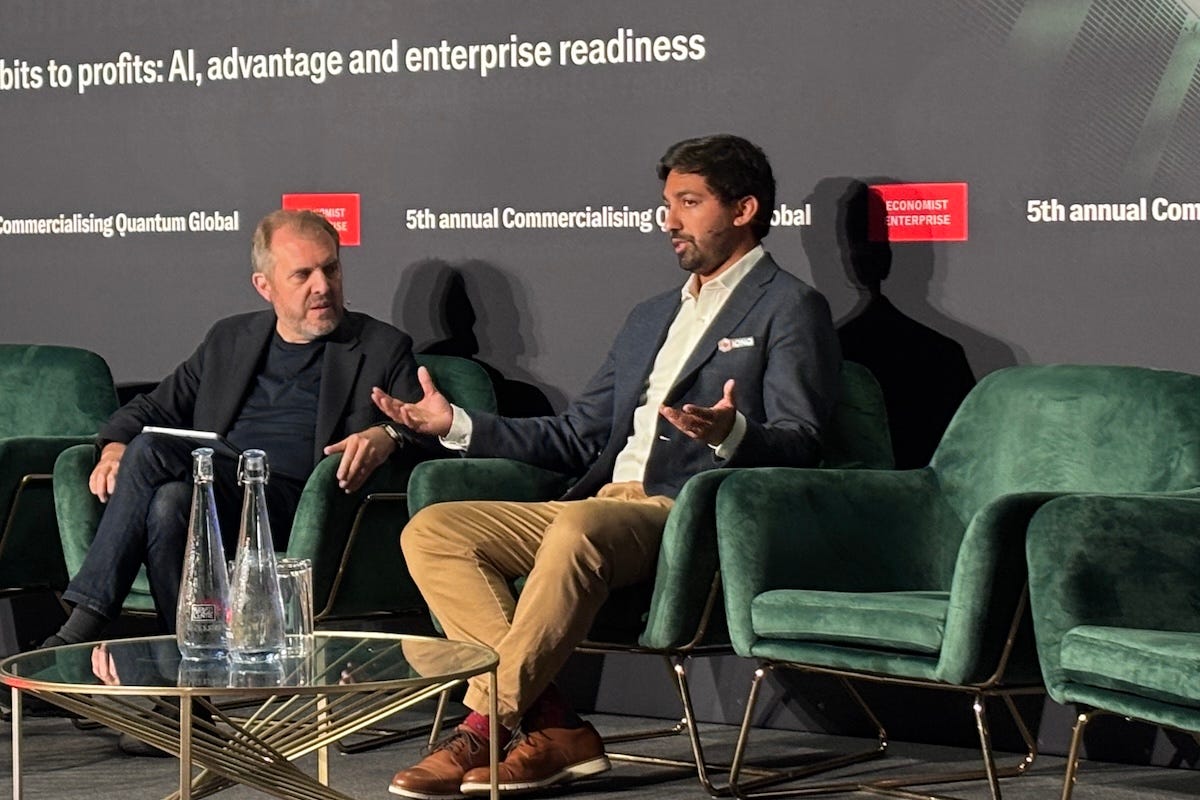
IonQ, a Maryland-based quantum computing company, has spent the past two years turning itself into a full quantum platform, pushed beyond hardware by customer demand and fears over so-called Q-Day.
The shift reflects a broader consolidation sweeping the quantum industry, as hardware, control systems and software converge into one ecosystem.
“If we were here 18 to 24 months earlier, I would just tell you that IonQ is a trapped-ion quantum computing company,” said Mihir Bhaskar, senior vice president of global research and development at IonQ. “We’ve changed a lot during this period.”
“We’ve been pulled into the quantum cybersecurity and networking space because our quantum computers have the possibility to scale and interconnect over networks,” he said. “Because our technologies also have applications for sensing and precision timekeeping, we’ve been pulled into quantum sensing.”
Bhaskar said the pull came from two directions at once: IonQ’s own technology, and customer concern over so-called Q-Day, the point at which powerful quantum computers could break today’s encryption standards.
“We’re starting to see an ecosystem forming,” he said.
“There are hubs where quantum hardware is being deployed, used and accessed, and there are multiple vendors appearing at these hubs.”
“Through all of the investment we’ve made in research, development and hardware, we’ve also created a lot of infrastructure we realize is very useful to the entire industry,” he added. “These are all things that IonQ now does as part of one quantum platform.”
IonQ’s 2025 acquisitions of Lightsynq and Oxford Ionics were aimed at building photonic interconnects and higher-density ion traps.
The deals feed a roadmap that targets 10,000 physical qubits on a single chip by 2027 and more than 2 million by 2030, and they follow a hybrid quantum-classical drug development workflow with AstraZeneca, Amazon Web Services and Nvidia that achieved a speedup of more than 20 times over previous benchmarks.
He said it is a sign of the industry’s growing maturity that companies are now focused on this connective tissue between technologies.
Not backing off
Bhaskar made the comments in a fireside chat with Tom Standage, deputy editor of The Economist, at the Commercialising Quantum Global 2026, an event organized by Economist Enterprise and held in London to discuss the state of quantum infrastructure.
The session examined quantum computing’s “missing middle,” the connective infrastructure needed to make the technology commercially reliable.
Bhaskar leads IonQ’s global research and development function. He previously worked at Amazon Web Services (AWS), where he watched cloud infrastructure scale rapidly to support the artificial intelligence (AI) boom, an experience he later drew on to describe quantum’s current stage of growth.
Standage asked whether the platform push signaled a retreat from trapped-ion technology, IonQ’s original specialty, in favor of diversification.
“It’s definitely not a retreat. We’re spending more and more resources on trapped-ion quantum computing,” Bhaskar said. “We’re manufacturing more systems every year, both internally for engineering prototypes and for systems deployed to customers and on the cloud.”
He said the expansion reflects growth of the quantum market rather than a retreat from core hardware.
“The quantum industry emerged from the lab over the previous decade, buying general-purpose components from cottage industries and putting them together to make our first prototypes,” Bhaskar said. “We now have a volume of interest in these quantum computers that outpaces the rate and scale at which we can manufacture using those cottage industries.”
He said that scale-up depends on manufacturing capacity built largely by hand today, which cannot keep pace with rising demand.
“There’s certainly a need to scale up the manufacturing of these systems,” he said. “Where that starts is in the semiconductor backbone.”
IonQ has moved to secure its own place in that supply chain.
“The foundries have to evolve,” Bhaskar said. “Most recently, in January, we announced our planned acquisition of a company called SkyWater, a US-based foundry with locations in Minnesota, Texas and Florida.”
The acquisition closed on July 31, following required regulatory approvals, under terms giving SkyWater shareholders $15.00 in cash plus 0.4883 IonQ shares for each share held. The combined company held its first joint earnings call in early August and plans an investor day in the third quarter of 2026.
The deal creates what IonQ calls the only vertically integrated full-stack quantum platform company.
IonQ, listed on the New York Stock Exchange and headquartered in College Park, Maryland, says it achieved a record 99.99% two-qubit gate fidelity in 2025 and now operates across the United States, Europe and Asia, including the United Kingdom. SkyWater continues to operate as a subsidiary, led by chief executive Thomas Sonderman, who now reports to IonQ chairman and chief executive Niccolo de Masi.
“SkyWater doesn’t build just trapped ions. They have a platform for superconducting routing and a platform for photonics, so it isn’t exclusive to trapped ion manufacturing,” Bhaskar said.
He said the improvement plan extends to production speed as well.
“Most semiconductor companies lock in a design and it takes six months before they get the chips back to verify whether the design worked,” he said. “Our goal is to shorten that cycle with SkyWater to three weeks.”
Open by design
IonQ’s hardware is already reaching customers through both routes.
“Just with an AWS account, Azure or GCP (Google Cloud Platform), you can access these machines,” Bhaskar said. “That’s been incredibly important for getting access, and for showing that we can build many generations of hardware that we’ve had on the cloud.”
“These are real systems that turn on. These aren’t just things that we put in PowerPoint slides,” he said.
The company has also sold hardware directly for on-premises use, generally deploying its newest machines there before making them available on the cloud. IonQ has sold several Tempo systems, its 100-qubit machines, and recently announced the first sale of a next-generation 256-qubit system, also for on-premises deployment.
On the networking side, IonQ partners with the US Defense Advanced Research Projects Agency, or DARPA.
The partnership centers on a US government program called the Heterogeneous Architectures for Quantum (HARQ), an effort to design a single networking standard broad enough that every quantum computing vendor, regardless of hardware type, would eventually need to adopt it.
“This is about designing the networking standard that all quantum computers and devices are going to have to connect through,” Bhaskar said.
Standage noted that DARPA has a track record of establishing earlier networking standards, and Bhaskar agreed.
He compared the industry’s current stage to the early years of graphics processors, before they became the backbone of AI computing.
“The analogy I like to tell, which is fresher in our minds with AI, is where Nvidia was when AI was an interesting research problem for researchers running one or a few GPUs,” he said. “These GPUs were curiosity devices for gaming and Bitcoin mining, and for AI researchers doing kind of weird stuff, in the early 2010s.”
Bhaskar said he watched that shift happen firsthand during his time at AWS.
“When those technologies were able to be deployed in the data center en masse and connected together and manufactured at scale, that compute power became available to support AI,” he said, adding that software, particularly quantum error correction, is a very important part of the platform.
“Nothing is as simple as all that. We are talking about quantum computing, after all, but the goal is to make it simple and accessible for end users,” Bhaskar said.
IonQ expects that work, along with continued foundry investment, to determine how quickly quantum computing becomes dependable infrastructure.