Global defence programmes are accelerating procurement of secure satellite communications, pushing manufacturers to scale faster and diversify production. Intellian, a global provider of satellite antennas and defence‑grade communications terminals, is capitalising on this momentum by expanding its manufacturing footprint beyond South Korea to meet heightened demand for resilient, verifiable systems.
This shift reflects a broader industry race to secure reliable multi‑band infrastructure for mission‑critical operations. Intellian’s growing presence across Asia, Europe, and the Americas is strengthening its ability to support government and naval customers seeking rapid deployment, assured performance, and continuity across international theatres.
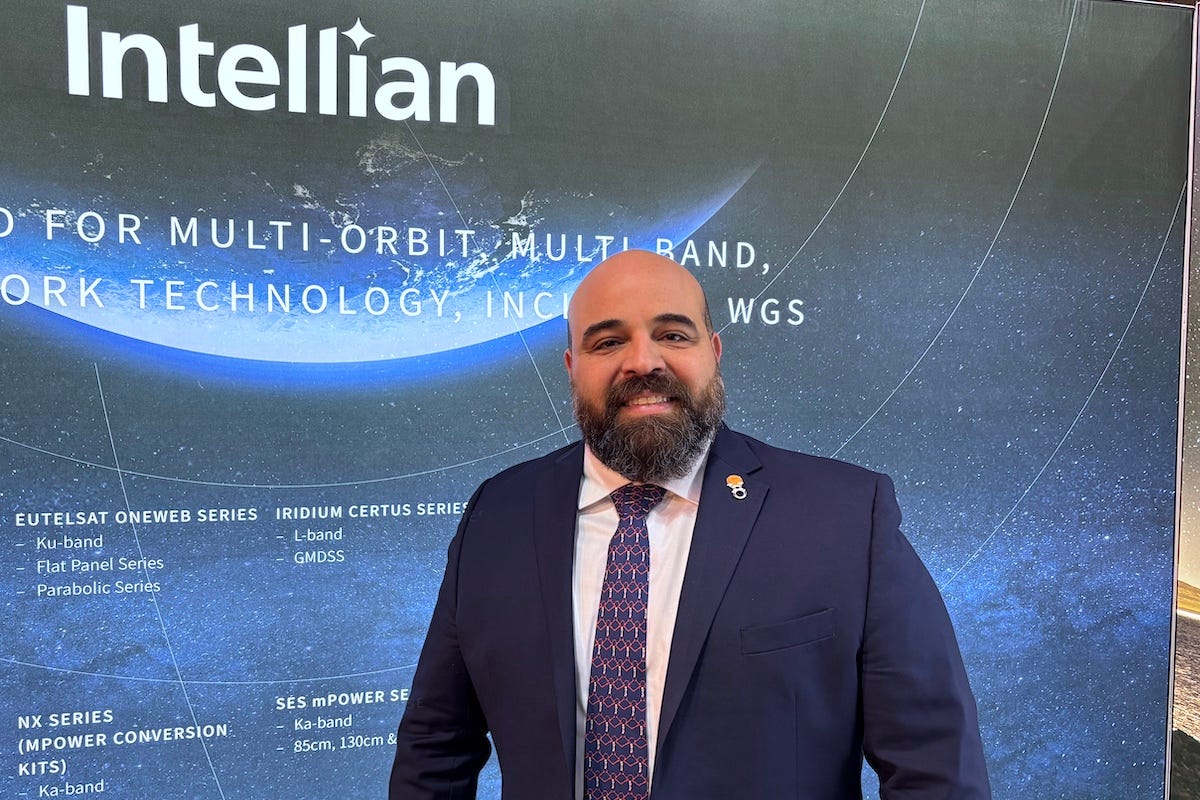
“We dedicate ourselves in the defence sector to the high‑end service of terminals,” Dr. Blad Stavropoulos, Senior Director Sales and Solutions Engineering at Intellian, told TechJournal.uk in an interview. “We do everything from the smallest TV antenna to resilient navigation and control terminals, and that engineering capability is what supports our global expansion.”
To meet rising global demand, Intellian operates two major manufacturing centers south of Seoul and is accelerating U.S. production, following the launch of its first U.S. manufacturing line in March 2025. The company’s sales footprint spans Singapore, Shanghai, Korea, Europe, and the United States, and is supported by roughly 700 employees, most of whom are engineers. Its portfolio ranges from compact maritime antennas to advanced defence platforms across multiple bands and aperture sizes.
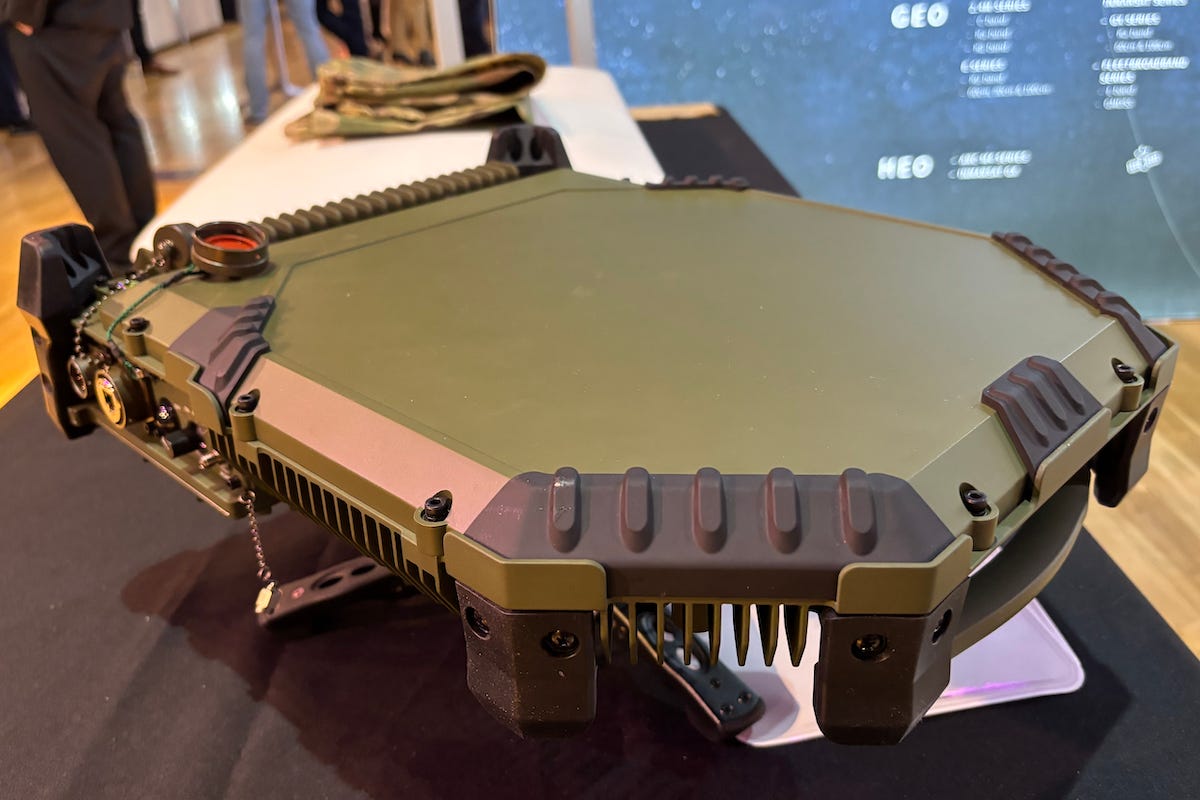
This expanding capability underpins Intellian’s work on the Wideband Global SATCOM (WGS) constellation. The Block 1 terminal—developed to meet stringent requirements set by Five Eyes defence agencies—operates on WGS and commercial X‑ and Ka‑band networks worldwide, forming the foundation of the company’s multi‑orbit, multi‑mission roadmap. X-band operates at 8-12 GHz, while Ka-band operates at 26-40 GHz.
Intellian’s establishment of its U.S. manufacturing line marked a pivotal milestone in this strategy. Located at the company’s U.S. headquarters in Irvine, California, the facility began producing Block‑series defence terminals immediately, strengthening the company’s ability to support U.S. government customers with domestically manufactured systems and shortening delivery timelines for high‑priority programmes.
Multi‑Orbit Engineering
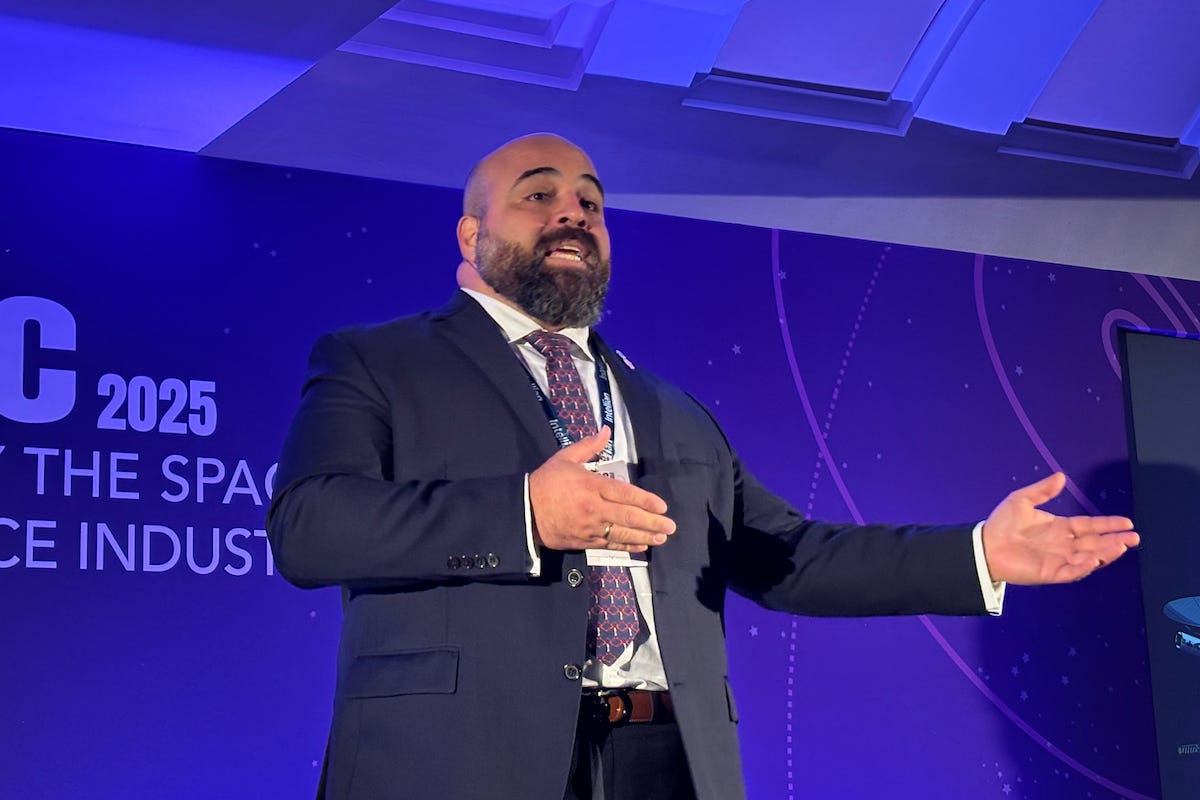
Delivering a keynote speech at the 2025 Defense in Space event in London, Stavropoulos outlined how WGS requirements sparked one of Intellian’s most demanding engineering efforts. A navy approached the company with a lengthy list of operational needs: simultaneous X‑ and Ka‑band operation, high power density within regulatory limits, fibre connectivity, compatibility with legacy and future vessels, and an architecture that eliminated HVAC‑dependent radomes.
HVAC stands for Heating, Ventilation, and Air Conditioning, while a radome is a blended word from “radar” and “dome.”
“The list was significant. The effort was paramount, and it was like climbing Mount Everest in engineering terms,” he said.
The company completed the system’s foundational design in seven months. Certification followed at an unprecedented pace.
“WGS usually takes people two to four years until they get a terminal done,” Stavropoulos said. “We were able to complete it in only eight months.”
The Block 1 architecture supports military Ka, commercial Ka, WGS X‑band, and additional international networks. It enables simultaneous dual‑band operations and is compatible with GEO (geostationary Earth orbit), MEO (medium Earth orbit), and LEO (low Earth orbit) constellations, marking a shift toward hybrid‑orbit defence communications.
Defence Platform Scaling
Stavropoulos also highlighted the forthcoming Block 22, a 2.2‑meter variant that carries forward the Block 1 multi‑band, multi‑orbit philosophy into higher‑capacity missions. The larger aperture improves efficiency for operations that require higher throughput while preserving the same flexible architecture.
Intellian is additionally adapting its technology for land‑based defence deployments. The new designs emphasise simplified cabling, waterproof exteriors and integrated electronics, reducing field‑level maintenance and supporting X‑ and Ka‑band across GEO, MEO and LEO constellations.
A key enabling technology is the IM8 intelligent mediator unit. Initially developed for the cruise industry, it consolidates multiple modem types into a single interface.
“People don’t want to be swapping modems constantly,” Stavropoulos said. Operators can now switch between commercial, military, and multi‑orbit service paths through a browser‑based interface.
Intellian’s engineering methodology prioritises deep collaboration with defence operators. Stavropoulos described an approach centered on iterative design, shared testing, and rapid refinement.
“We like to sit, hear the problems, identify the needs, go through the details, and then provide the solution they are looking for,” he said.
As the company extends its presence across maritime, land, and emerging mission domains, its next-generation terminals aim to accelerate multi‑orbit readiness while reducing integration complexity. The strategy reflects a broader defence trend toward compact, flexible, and geopolitically resilient communications systems designed to serve modern digital operations.
Global Support Network
Intellian is also reinforcing its service infrastructure to support its growing defence portfolio. Stavropoulos emphasised that “support and quality” are two of the company’s strongest differentiators, noting that these attributes are central to why operators in Asia and beyond are turning to the firm.
The company maintains six global service centers and collaborates with more than 50 service partners, forming a distributed ecosystem designed to keep mission‑critical systems online. Its Shanghai branch plays a central role in supporting new‑build vessels and regional operators, providing a local interface for repairs, spares, and technical assistance.
Multilingual support channels—including English, Chinese, Dutch, and Korean—help ensure operators receive consistent guidance regardless of geography. Combining these resources with digital service platforms gives defence users access to configuration tools, diagnostics, and remote monitoring capabilities, reducing reliance on on‑site intervention.
Stavropoulos added that customers increasingly value simplicity in managing complex communications environments.
Intellian is additionally assessing how these developments can scale into adjacent mission sets, such as unmanned ground assets, autonomous sensor stations, and future command‑and‑control nodes. By building on the same engineering principles that underpin the Block‑series terminals—multi‑orbit readiness, interoperability, and reduced operator burden—the company is preparing a technology base that can adapt to emerging defence requirements.
Future Communications Path
Looking ahead, Intellian is deepening its research investment to align with the next generation of GEO and MEO systems, while maintaining backward compatibility with established networks.
The transition toward hybrid‑orbit defence communications is accelerating, placing greater expectations on suppliers to deliver systems that integrate smoothly into existing command structures while accommodating evolving mission requirements. As operators seek clearer certification pathways, predictable timelines, and lower integration risk, industry competition is intensifying.
For Intellian, the coming phase will demand continued agility as defence agencies tighten evaluation standards and focus on long‑term resilience. The broader sector faces similar pressures: balancing innovation with operational reliability, and ensuring that multi‑orbit systems enhance rather than complicate mission execution.
As geopolitical uncertainty and digital mission demands shape procurement priorities, industry leaders will be tested on their ability to deliver communications architectures that are robust, adaptable, and transparent across their lifecycle.