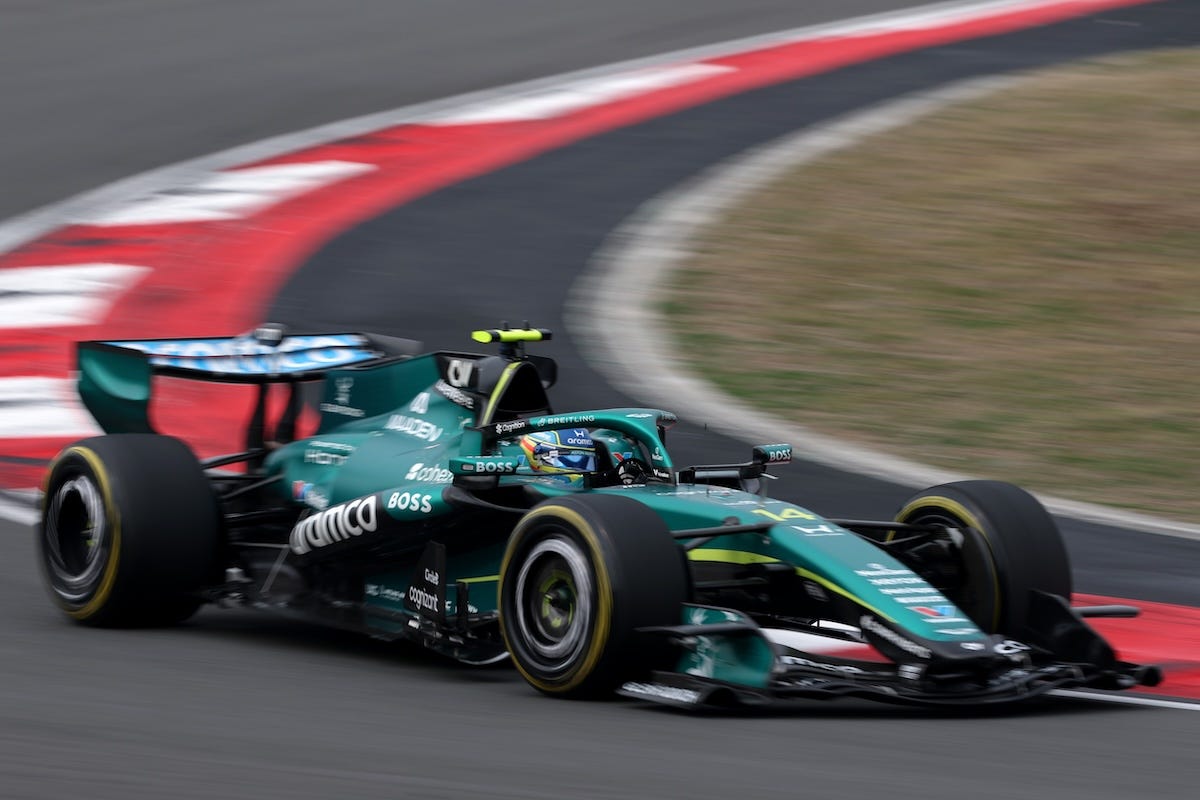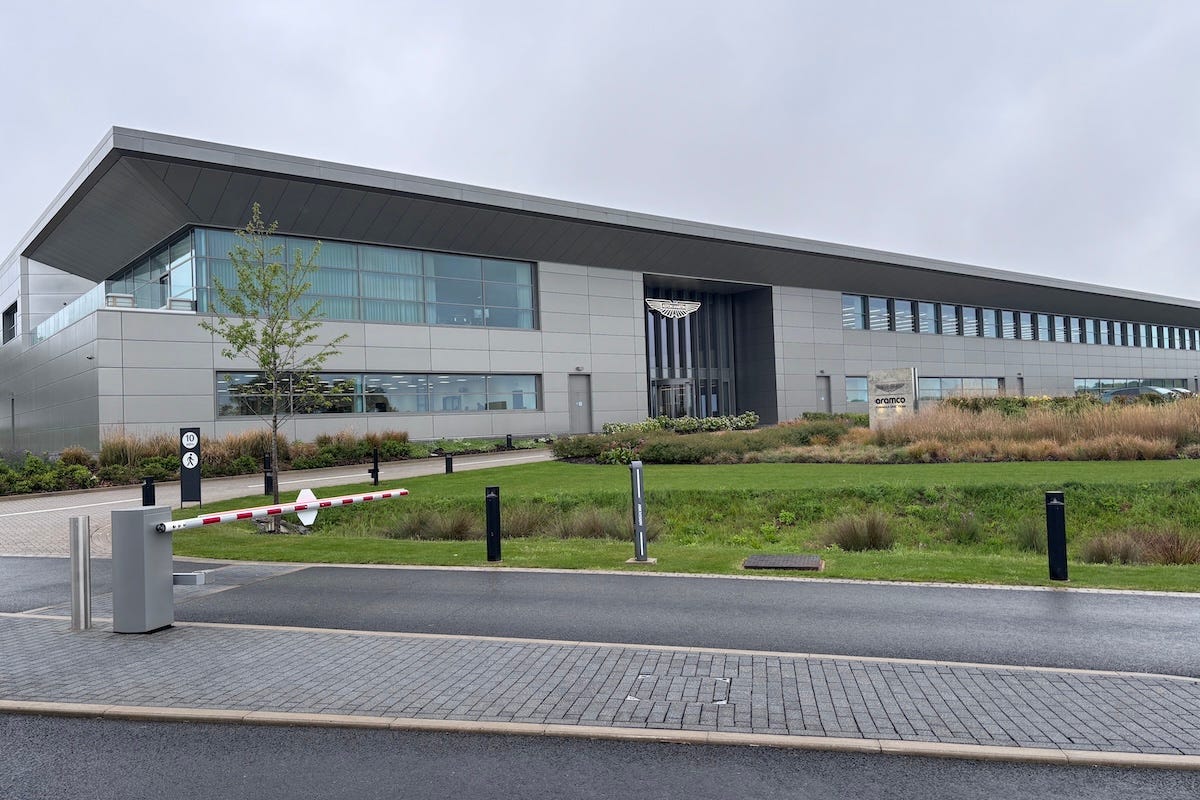
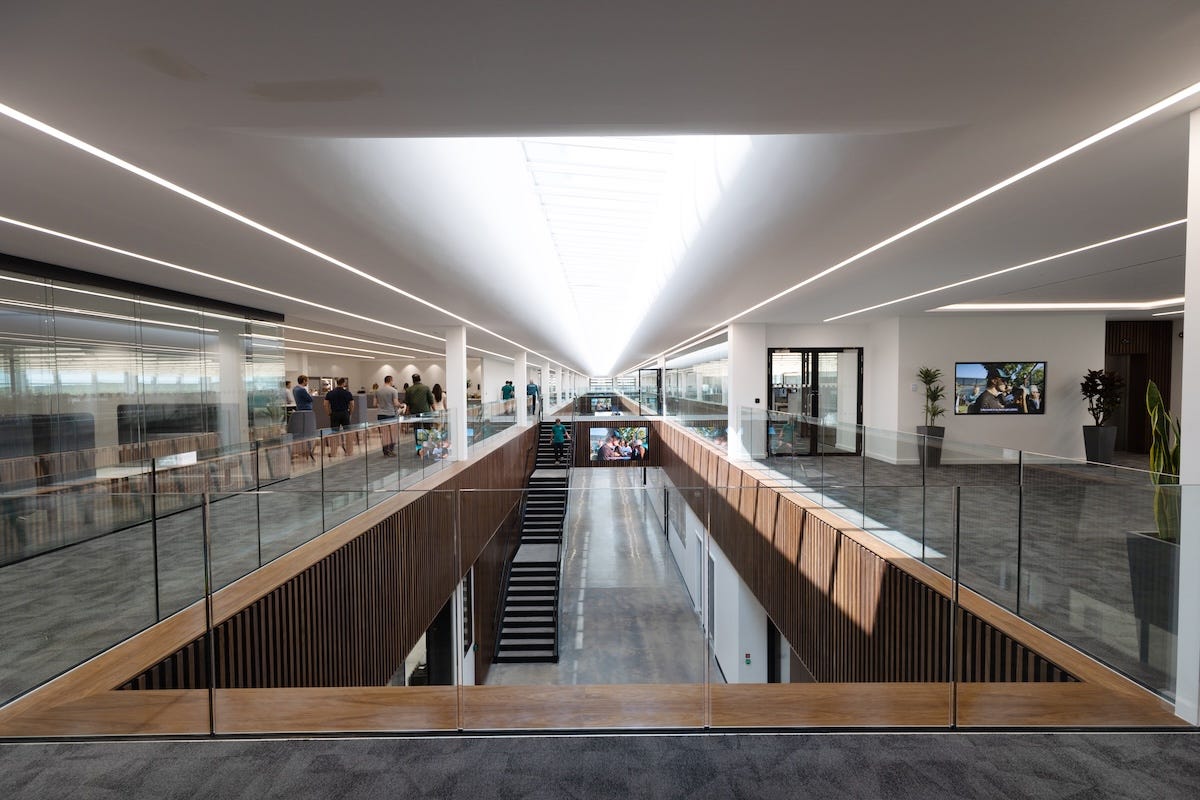
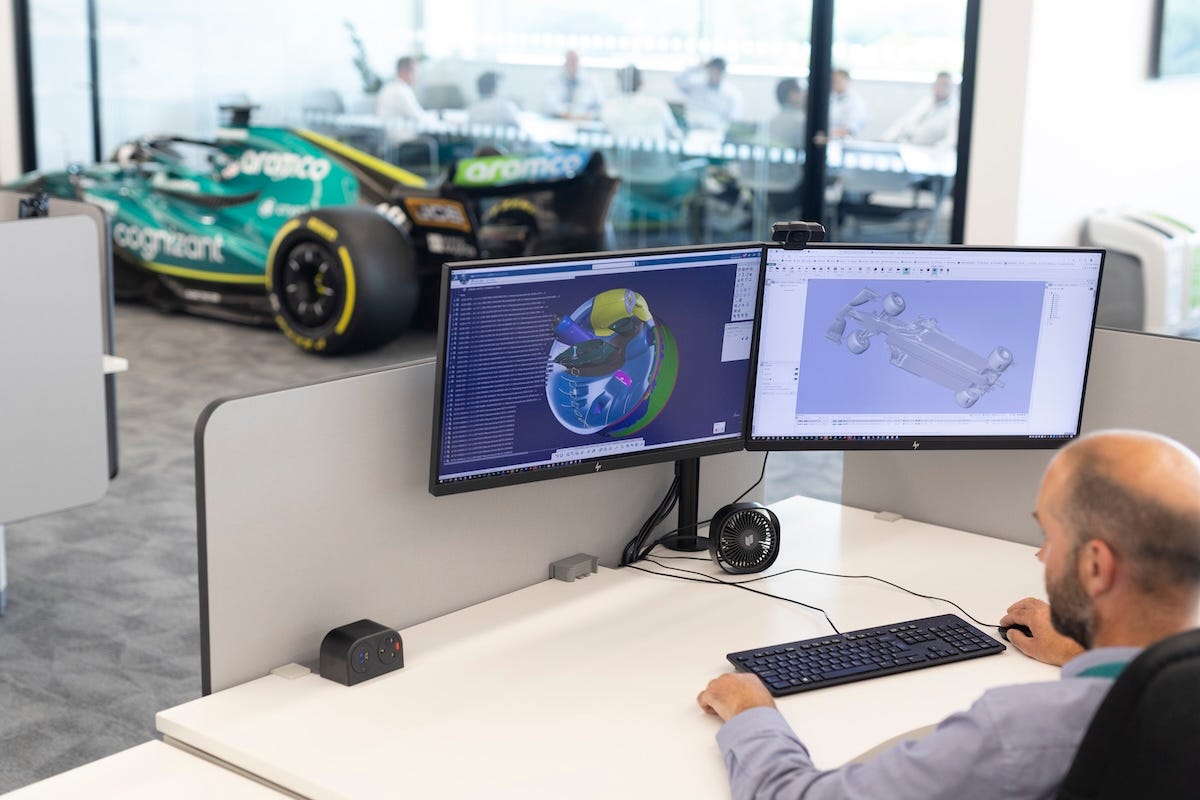
Every material decision inside a Formula One (F1) factory begins the same way: a three-way negotiation between weight, aerodynamic benefit and cost. At Aston Martin Aramco’s AMR Technology Campus in Silverstone, that tension is visible at every workstation and in every component waiting to be fitted to a race car.
The team operates under a $215 million annual cost cap imposed by the Fédération Internationale de l’Automobile (FIA). Before the cap, some teams reportedly spent over $800 million per year on development. Without the option of throwing money and manpower at a problem, teams are forced to find smarter solutions.
The tension plays out most vividly in materials selection. Aerogel would be ideal for certain parts of the car, but a cubic centimeter costs thousands of pounds and it does not appear on the car.
Rohacell, a high-performance foam, costs around £1,500 per square meter. It too is used only where the numbers justify it.
One side deflector panel on display during the tour had saved 250 grams by switching to Rohacell, a saving the team judged sufficient to justify the cost. That margin matters: the car must not fall below the FIA minimum weight of 768 kilograms.
A driver can lose up to four kilograms of body weight over a race distance, and that figure must be calculated accurately before every race.
The same logic governs what gets repaired rather than replaced. A titanium component costing around £300,000 is not discarded if a flaw is detected after manufacture. A non-destructive testing (NDT) department exists, in part, for this reason. Everything salvaged is money returned to the cost cap. Everything scrapped has to be made again.
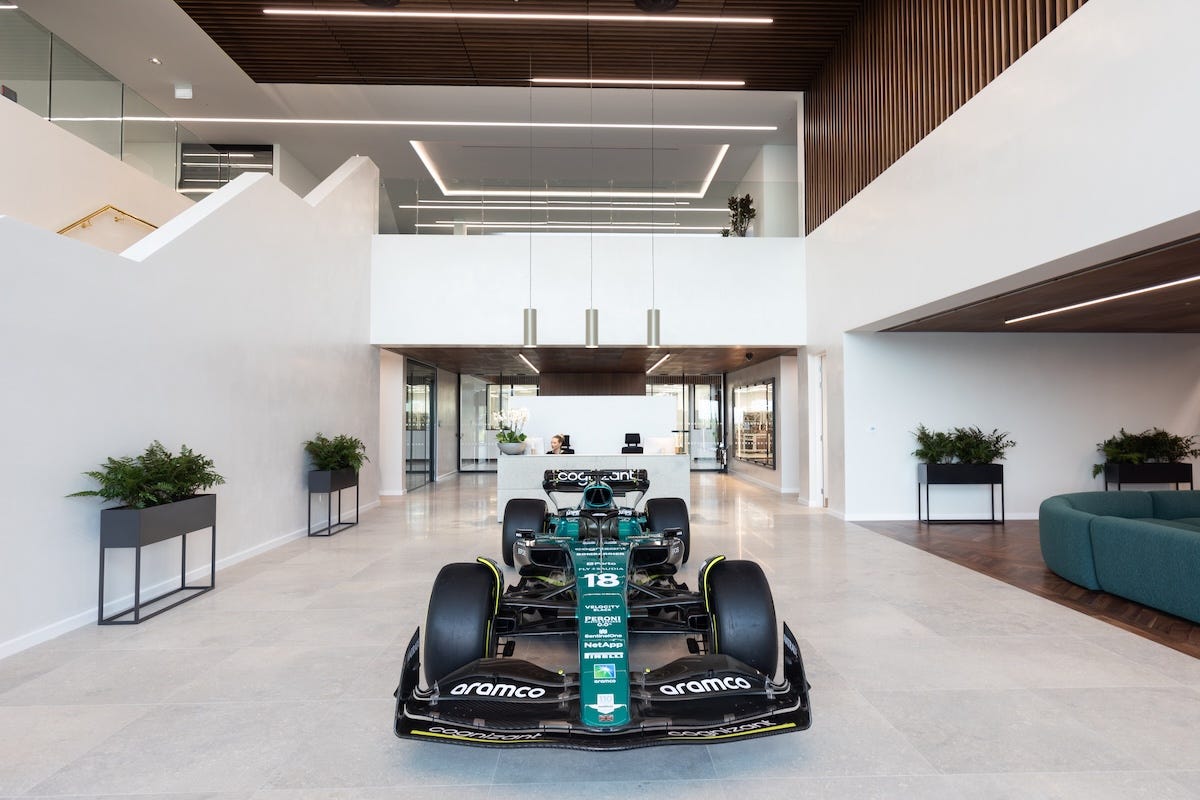
Aston Martin Aramco F1 Team, based in Silverstone, Northamptonshire, fields two cars in the FIA Formula One World Championship. Its drivers are Fernando Alonso and Lance Stroll.
NetApp serves as the team’s official data storage partner, covering infrastructure across the AMR Technology Campus and all 22 race locations on the Formula One calendar. The partnership began nearly four years ago.
Composites manufacturing
TechJournal.uk joined a group of international media invited by NetApp to tour the campus on May 19. The tour began in the composites manufacturing hall of Building One, where carbon fiber components are hand-laid, vacuum-bagged and autoclave-cured by specialist technicians.
Carbon fiber sheets arrive pre-impregnated with resin. Up to 40 layers are laid by hand, one at a time, with air trapped between each sheet.
That air must be extracted before the part enters the autoclave, a large industrial oven that applies heat and external pressure to cure the resin. Any air pocket left inside causes delamination, a structural failure that can also distort the aerodynamic profile of the finished part.
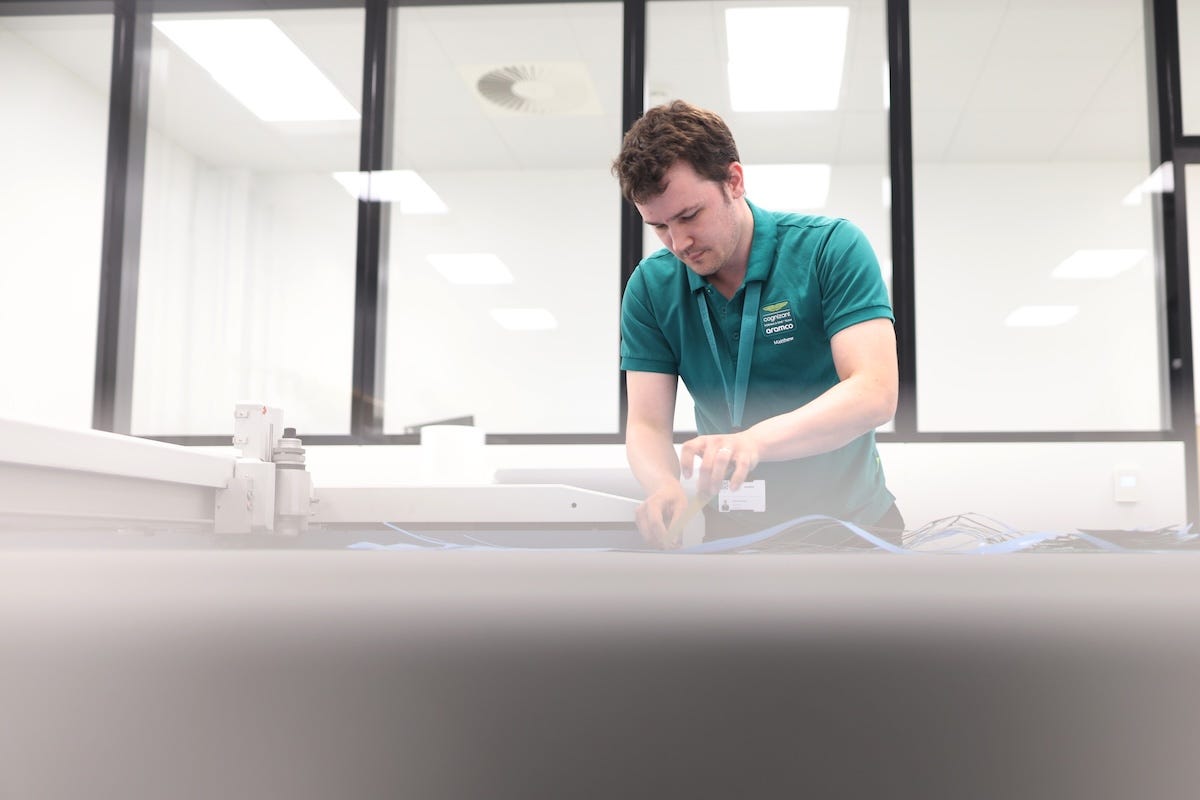
Once cured, every component is mapped against its original computer-aided design (CAD) drawing using a coordinate measuring arm, a laser-based caliper that scans each surface micron by micron. A color overlay is generated: green indicates within tolerance, red indicates excess material, and blue indicates insufficient material. Excess is sanded away using 3,000-grit abrasive paper.
This level of precision is not optional. Every hand-laid sheet of carbon fiber contributes directly to the structural integrity of a race car.
The chassis tub surrounding the driver combines carbon fiber with an aluminum sandwich core, channeling crash energy around the driver rather than through them.
Electronics and cockpit
The electronics department assembles and calibrates all wiring looms, sensor arrays and the steering wheel. The wheel costs around £35,000 and weighs 1.2 kilograms. A driver interacts with it roughly every second during a lap.
Over a race, a driver presses its buttons around 800 times and adjusts rotary dials approximately 160 times. The gear paddles are pulled about 3,000 times. The paddle shifters and clutch levers are individually molded to each driver’s gloved fingers.
The seat is cast from a foam bag shaped around the driver’s body, then reproduced in carbon fiber. The pedal box is adjustable for height. Every contact point between driver and car is personalized, because a driver who does not fully trust the car cannot push it to its limit.
Cockpit temperatures reach 65°C on a hot race day. Heart rate sits between 150 and 180 beats per minute for the entire race, the equivalent of sustained high-intensity interval training (HIIT). Driver vitals are monitored in real time, feeding into weight-loss models that inform pre-race car configuration.
Mission Control
A Mission Control viewing gallery upstairs extends the trackside team by 45 engineers, strategists and analysts during every race weekend. Car telemetry arrives with a delay of just 0.2 seconds from most circuits worldwide. The team works in shifts, unconstrained by travel fatigue or the FIA curfew rules that apply to trackside personnel.
Each car is packed with hundreds of sensors. The data they generate during a race is transmitted to Mission Control for analysis, helping engineers and strategists make decisions in real time. That volume of data requires robust storage infrastructure, which is where NetApp’s role becomes operationally critical.
The team uses artificial intelligence (AI) tools to process telemetry and simulation data during race weekends, helping strategists evaluate tire degradation and make real-time decisions faster. It has also partnered with the enterprise AI company Cohere, using its agentic AI platform, North, to manage proprietary data and accelerate research. Cohere is an AI startup backed by Nvidia, Salesforce Ventures, Oracle and Cisco, among others.
A row of volunteers monitors all rival team radio. FIA regulations require all driver-engineer communications to be broadcast publicly in English, making this entirely legal. It amounts to sanctioned corporate espionage. Every team listens to every other, building correlation models between what rivals say and what they do on track.
The result is an arms race of coded instructions and deliberate misdirection. Alonso is known to track competitor positions and on-track incidents via his dashboard display while racing, processing intelligence at 200 miles per hour and relaying it to his engineers.
Metallic machining
The machining floor runs 16 computer numerical control (CNC) machines around the clock, producing bespoke parts in titanium, tungsten, aluminum and steel. No standard fasteners are used. If the design office specifies a non-standard screw thread or an offset bolt head, the machine shop makes it.
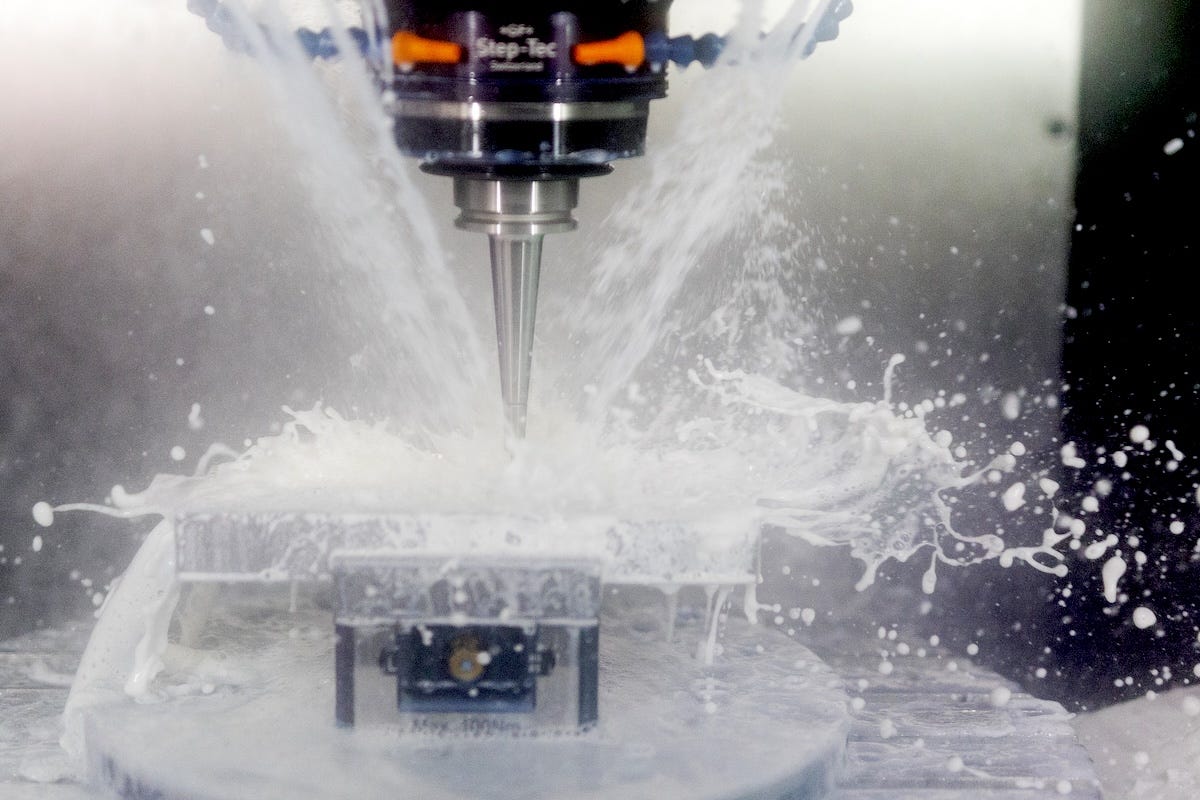
A push-on upright (POU) bracket, which connects the wheel assembly to the suspension, illustrates the precision involved. It is machined from a solid titanium block, with every cutting pass requiring precise x, y and z coordinates. Programming the machine to cut one bracket takes 60 hours. Cutting it takes 40 more.
Two additional machines are reserved exclusively for producing components of the wind tunnel model, a 60%-scale replica of the car that the FIA mandates for aerodynamic testing. The design process itself remains entirely human. Every drawing originates with an engineer, not an algorithm.
Wind tunnel
Building Three houses the team’s wind tunnel, the newest in F1. It was built from the ground up around current technologies, whereas rival facilities have had to retrofit advances over the years. The previous youngest tunnel in the sport is about 20 years old.
It uses particle image velocimetry (PIV), in which fine particles are seeded into the airflow and laser sheets are fired through them. Stereoscopic cameras reconstruct airflow over every surface of a 60%-scale model car in near real time.
Wind tunnel model components were once carved from wood or shaped in clay, at a rate of roughly one piece per week. The team’s 3D printing facility now produces around 600 pieces per week. A new aerodynamic concept can travel from the design office to the wind tunnel within seven days.
FIA rules prohibit testing outside two designated pre-season sessions, in Bahrain and Barcelona. Every aerodynamic update seen on an F1 car at a grand prix is running on track for the very first time, making each race weekend simultaneously a competition and a live engineering experiment.