


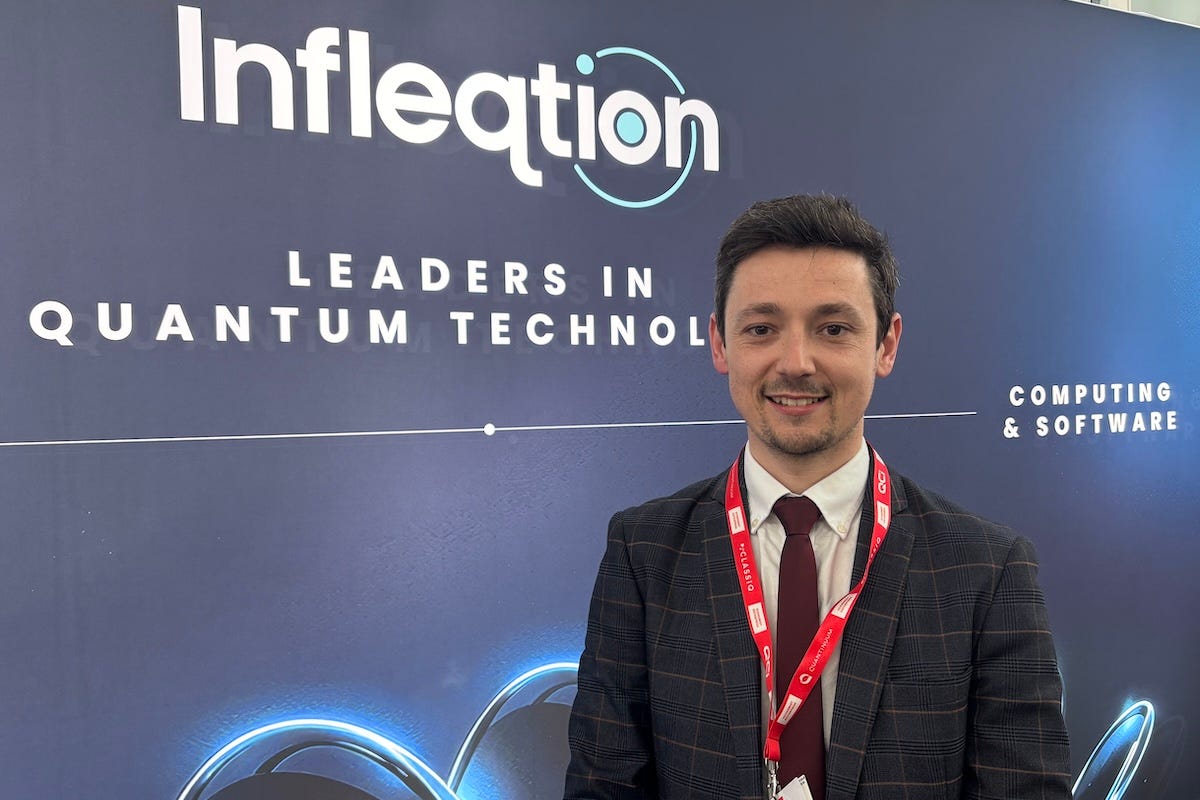
Infleqtion, a Colorado-based quantum technology company, is ramping up manufacturing and hiring engineers at pace following its New York Stock Exchange debut earlier this year.
The listing, completed in February 2026, made Infleqtion the first neutral-atom quantum company to go public and raised more than $550 million. The capital is being deployed not to fund more research, but to build, manufacture and ship.
“You start out with a team of a couple of physicists and engineers, spread across lots of things, a bit lumpy. But as you get through IPO, you start growing the team and filling those lumps with specialists,” said Ryan Hanley, UK chief technology officer of Infleqtion, who told TechJournal.uk on the sidelines of Commercialising Quantum Global 2026 in London.
The analogy comes from asteroid physics. In planetary science, the “potato radius” is the point at which a body becomes large enough for gravity to smooth its irregular surface into a sphere.
Hanley said Infleqtion has crossed that threshold, evolving from a generalist startup into a specialist organization with dedicated field-programmable gate array (FPGA) engineers, power electronics experts and photonics specialists.
Only around one-third of Infleqtion’s UK organization are physicists; the rest are engineers.
Hanley said a physicist is typically very good at making something work once, while an engineering discipline is what makes it work every time.
“For us, it’s really accelerating that productization, commercialization effort, and on the computing front, accelerating towards logical qubit utility scale. But also productionizing those systems as well,” he said.
The UK headcount stood at around 70 people and is expected to reach between 90 and 100 by the end of 2026, as Infleqtion moves to a larger Oxford facility nearby.
On May 28, Infleqtion announced the launch of a new Quantum Innovation Centre at Oxford Technology Park, tripling the size of its research, production and systems integration capabilities. The facility is scheduled to open later in 2026.
Hanley said around half of Infleqtion’s new Oxford facility is dedicated to manufacturing, validation and verification. Customers will ultimately want quantum computing systems on-premises, not just cloud access.
“A significant fraction of that facility is in production and manufacturing, because ultimately that’s how the UK succeeds as well. It’s selling products,” he said.
Hanley flagged skills in short supply across the sector: analog and FPGA engineers, control system specialists and photonics engineers capable of transitioning from fiber-based optical systems to photonic integrated circuits.
Infleqtion is headquartered in the United States with operations in Europe and Asia. Its product portfolio spans quantum computers, quantum optical clocks, radio-frequency (RF) receivers and inertial sensors, all integrated with its proprietary Superstaq software platform.
Its systems are in use by the US Department of War, NASA and the UK government, and form elements of multiple collaborations with Nvidia.
Washington signals quantum urgency
On June 22, US President Donald Trump signed an Executive Order on quantum technology, directing federal agencies to accelerate the development and deployment of quantum technologies across national security, commercial and scientific applications. Matthew Kinsella, chief executive of Infleqtion, attended the signing ceremony at the White House.
The order followed a significant funding announcement in May. The Department of Commerce confirmed that Infleqtion would receive $100 million in planned incentives under the CHIPS and Science Act, one of nine companies sharing $2.013 billion, to develop engineering systems for large-scale neutral-atom quantum computers.
The planned funding will support high-powered optical systems and novel readout and error correction systems. The Department of Commerce will take a minority, non-controlling equity stake in each recipient.
On the day of the signing, Infleqtion launched its America’s Quantum Space Initiative, focused on accelerating the development of quantum technologies for future space systems. The company had already secured a NASA collaboration, backed by more than $20 million in contracted mission funding, to fly the world’s first quantum gravity sensor to space.
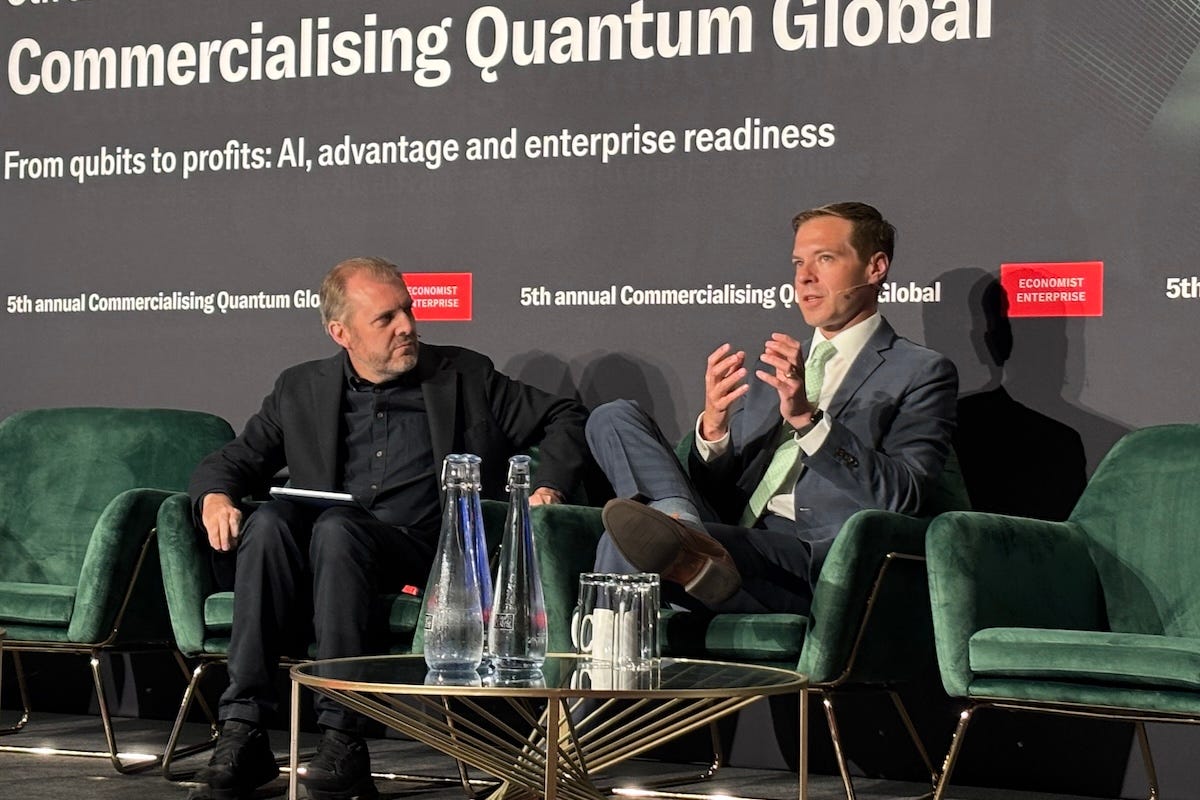
Kinsella had set out Infleqtion’s commercial vision six days earlier, on June 16, during a fireside chat at Commercialising Quantum Global 2026, organized by Economist Enterprise in London and moderated by Tom Standage, deputy editor of The Economist. The session focused on quantum technologies that are already generating commercial traction beyond computing.
“The critical infrastructure of the world, both for commercial purposes as well as military purposes, relies on precision timing, and that mostly comes from the GPS networks. The GPS network, unfortunately, is becoming increasingly prone to being denied or spoofed. What we can provide is better than GPS timing locally, in an unspoofable way, to continue to synchronize and have that critical infrastructure be able to do its job,” Kinsella said.
He said Infleqtion’s quantum clocks can be deployed across energy grids, radio-frequency (RF) networks and financial markets, providing timing more precise than GPS and continuing to function during outages or jamming events.
He said these near-term sensing and timing markets represent the first profitable wave of quantum deployment.
“On the maiden voyage of the Excalibur autonomous submarine, Tiqker was on board and performed wonderfully, all the way down to around 90 meters and back up. There’s no GPS underwater, so having precise local timing is absolutely critical. It’s one of the fundamental building blocks of navigating underwater in an entirely quantum way,” he said.
The Royal Navy launched Excalibur, its first autonomous submarine, last October. Tiqker locally disciplines the vessel’s classical inertial navigation sensors, eliminating the need to surface and synchronize with GPS.
The long-term goal is a fully quantum underwater navigation system requiring no GPS contact at all.
“We’re doing work with NASA to send gravity sensors up into space, residing inside a satellite, to sense changes in gravity on the earth’s surface, or importantly, below it. You can infer some very interesting things about what’s happening both on and below the earth’s surface based upon changes in gravity: the melting of polar ice caps, the depletion of aquifers, the building of underground facilities,” he said.
Kinsella said the sensing markets are large in their own right but serve a deeper strategic purpose: every advance in clock and sensor engineering compounds directly into progress on quantum computing.
Roadmap to quantum advantage
Infleqtion’s product portfolio reflects that dual focus. On the sensing side, it ships the Tiqker optical atomic clock, Quantum Spectrum RF receivers and inertial sensors.
On the computing side, it offers Sqale, its full-stack neutral-atom quantum computer, the Superstaq software platform and ready-to-use Quantum Cores for research applications.
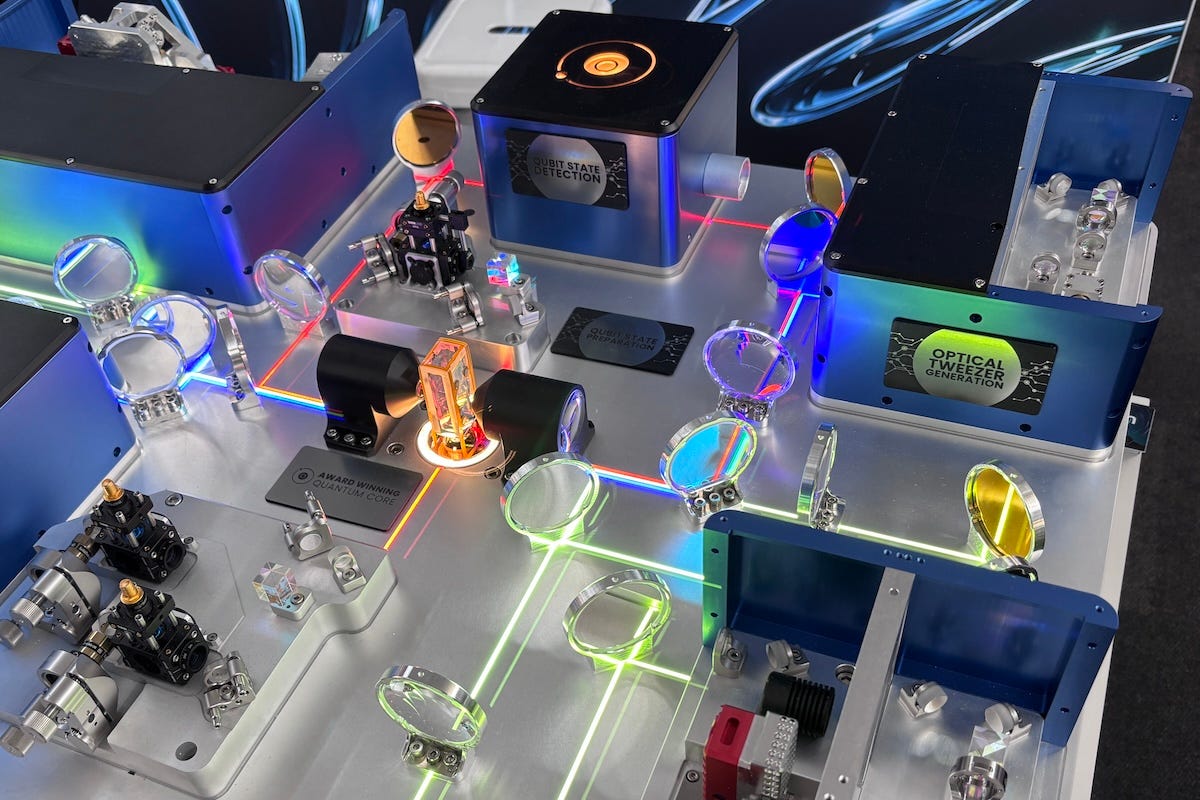
The computing roadmap has already delivered a landmark in the UK. At the end of 2025, Infleqtion supplied the country’s first 100-physical-qubit quantum computer to the National Quantum Computing Centre (NQC).
“We were really excited to be the company that was able to help the UK achieve its goal of having a 100-qubit computer in the UK,” Kinsella said.
Infleqtion has showcased 1,600 physical qubits in its own facilities. Academic partners at Caltech have demonstrated 6,100 physical qubits using Infleqtion’s foundational technology. Physical qubit counts, however, are not the measure of progress that matters most.
“We’ve publicly guided that we’ll be at 30 logical qubits by the end of this year, and 100 logical qubits by the end of 2028. We think at 100 logical qubits, that’s when you start to see real quantum advantage from a quantum computer,” he said.
Logical qubits incorporate error correction, making them far more reliable than raw physical qubits and the true measure of computing utility.
He said quantum computers will need to be designed for mass production, not assembled on lab benches, and that systems engineering discipline is the competitive differentiator the industry has yet to fully grasp.
“A lot of the work we’re doing on the sensing market is to compound in getting to useful quantum computing faster. The underlying technology is very similar: building a clock is much like building a quantum computer. These sensors are the building blocks of a quantum computer,” he said.
He left a career in finance and investment roughly two and a half years ago, drawn by what he described as distinct and accelerating changes in the quantum market. He said the question for large organizations is no longer whether quantum will matter, but when.
“I do really believe this has gone from a matter of if to a matter of when. Big shifts and acceleration in new technologies have given rise to new leaders across industries. Now is the time to capture that shift and take advantage of it for your businesses,” he said.
His advice to enterprise strategists is to start learning about quantum now, partner with companies focused on the technology, and consider deploying quantum sensors as a practical entry point before quantum computers reach utility scale. For Infleqtion, that moment is on a published roadmap.