


Artificial intelligence (AI) is helping make mining a national priority, as governments begin to treat metals and minerals as infrastructure rather than tradable commodities.
Without metals and minerals, AI would not be possible, the energy system would not work, defense industries could not rearm and supply chains could not be restocked. That dependence could bring state financing, subsidies and even public ownership to an industry long left to market cycles.
“Governments increasingly see metals and minerals as public goods. Historically, we’ve been privately traded commodities, driven by demand and supply. No longer,” said Rohitesh Dhawan, president and chief executive of the International Council on Mining and Metals (ICMM).
“The public benefit of metals and minerals means that we are now being seen much more like national infrastructure than a privately traded commodity. This isn’t just semantics. It’s a fundamental mindset shift.”
He said the change will open up policy tools so far reserved for ports, railways and bridges.
“I’m talking about things like financing support, help with land acquisition, subsidy and, in some cases, even public ownership of metals and minerals,” he said.
Washington has already moved in that direction. It announced a $400 million equity investment in rare earths producer MP Materials in July 2025, paired with a 10-year price floor, and has since agreed stakes in Lithium Americas, Trilogy Metals and USA Rare Earth. It has also backed a Korea Zinc smelter project in Tennessee.
“Overall this is positive for mining, but it’s uncharted territory. We need to prepare ourselves by changing how we see ourselves, not as a supplier of commodities, but as a part of critical national infrastructure,” he said.
Founded in 2001 and based in London, ICMM brings together the chief executives of 26 mining and metals companies. It estimates that its membership accounts for about a third of the global industry. Dhawan has led it since April 2021.
Tools of statecraft
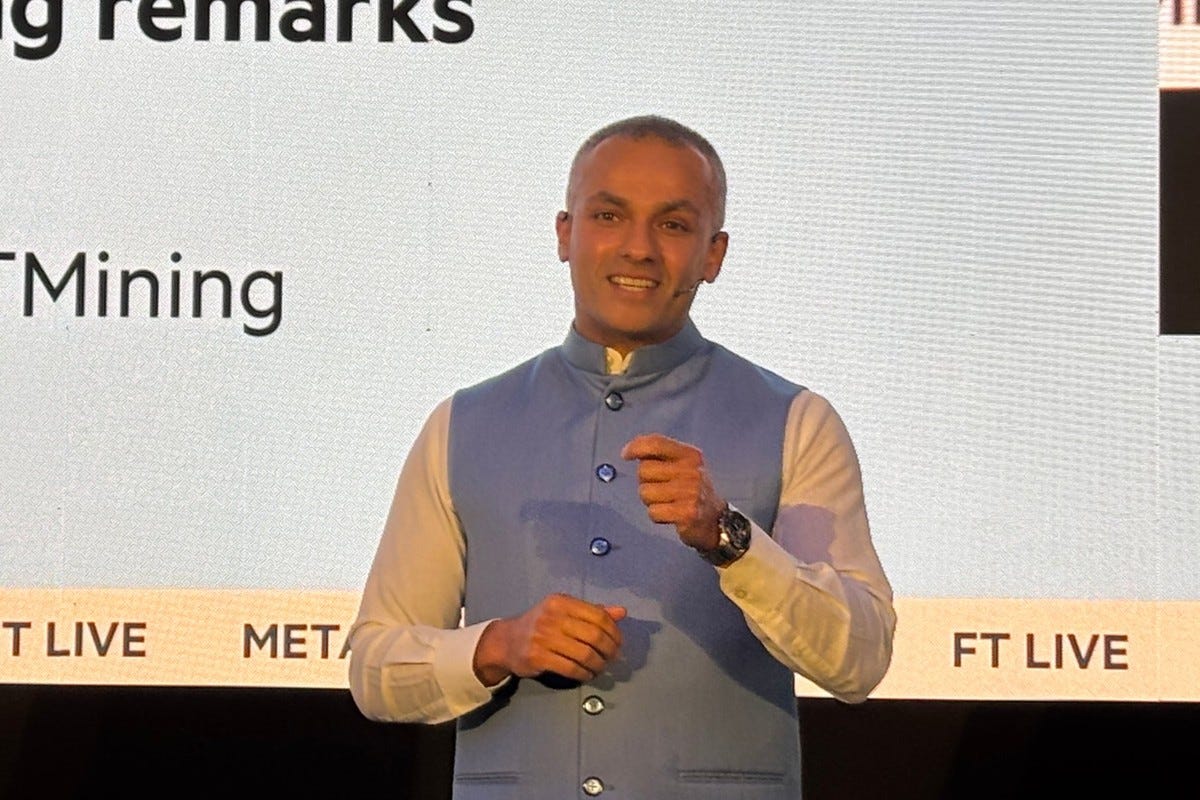
Dhawan gave opening remarks at the FT Metals & Mining Summit 2026, which the Financial Times organized in London on October 15. He outlined three fundamental shifts that he said have brought generations of change to mining in just five years: geopolitics, supply, and reputation.
He said these shifts set the agenda for the two-day summit.
“By understanding what has changed and why it’s changed, we can operate from a place of wisdom,” he said.
He opened by pointing to a week of headlines about missiles in Riyadh, protests in Delhi and treason in Germany. He said much has been said about geopolitics, but two aspects of how it intersects with mining remain underappreciated. The first is how closely governments now link minerals to their own security.
“Minerals are no longer just commodities. They are now tools of statecraft,” he said. “From price floors to trade wars, tariffs to investments, when you equate mineral security with national security, the game fundamentally changes.”
Dhawan said the other is the public-goods view of metals and minerals, which sits beneath the trade disputes.
“Behind the headlines, a deeper shift has occurred that we must recognize for what it is, name it and act accordingly,” he said.
The second of his three big shifts is on the supply side. For generations, the industry’s fortunes rose and fell with the economic cycle, with demand setting the pace. Dhawan said that holds less true today.
“If mining was a circus, then demand has been our ringmaster. Our fortunes have waxed and waned over generations to the tune of the economic cycle,” he said. “By no means are we immune to what changes on the demand side, but what happens on the supply side now has a much bigger impact on our fortunes than it ever has before.”
He said several pressures now compound one another to create a real tension point for supply:
Long permitting times for new mines
Environmental constraints
Social complexity
Deeper ores that are harder to reach
Copper stockout fears
Dhawan said nowhere is this truer than in copper.
On October 11, heavy rain triggered a landslide at Codelco’s El Teniente mine in the Andes, about 75 km southeast of Santiago, killing two contractor workers and forcing a partial suspension of operations.
The century-old mine, one of Chile’s largest, had already suffered a collapse that killed six workers in July 2025.
“Other operations are offline or curtailed because of strikes, extreme weather, mudslides or mud rushes, and combined they have created the almost unthinkable scenario of a physical stockout of copper,” he said.
“US tariffs haven’t helped by pulling metal into the US, which may not be exported back anytime soon. But this just shows you how important the supply side is. We need to rise to the challenge and meet this moment by investing in resilient and, most importantly, safe production.”
The third shift is the industry’s reputation. Dhawan said surveys show public understanding and perception of mining have kept improving over the past five years, citing other signs of progress:
Demand for mining jobs has soared
Countries are competing to bring mining onto their shores
Generalist investors now see the sector as investable
“This has been our Achilles’ heel for as long as I can remember, but we have turned a corner across the world. This has been very hard won. So we mustn’t avoid taking stock and celebrating the success we’ve had,” he said.
“But there is no time for complacency because this could be very short-lived unless we continue to tell our story, continue to be in open dialogue with people and, most importantly, continue to demonstrate safe and responsible production.”
Dhawan will step down at the end of the year and hand over to Froydis Cameron-Johansson, chosen by the 26 chief executives who make up ICMM. He said her 30-year career in natural resources makes her well placed to lead ICMM and the industry into its next era.
Cameron-Johansson has held executive roles at Rio Tinto, Anglo American and Shell, covering health, safety and security, sustainability and geopolitics. Her career spans three decades in both emerging and established markets.
“The job of the ICMM CEO (chief executive officer) is a genuine privilege. You get a ringside seat to the action and a bird’s-eye view of the industry,” he said.
He said the next era will be defined by the industry’s adoption of a common global mining framework, and he hoped people would remember mining not only for what it took from the earth but for what it gave back and the trust it built along the way.