



Copper used in data centers could hit 2.5 million to 3 million tons by 2028 if big tech companies build everything they have announced.
That would be roughly triple today’s 1 million tons and about twice the 1.4 million tons implied by market forecasts. Artificial intelligence (AI) may look like software, but its compute, power generation, grids and storage all need metals, and copper carries the electricity.
“AI is now the big new driver of copper, and this new demand is something where we do not know what the terminal value is. We don’t know what the maximum amount of AI and data centers worldwide will be,” said Henry Van, head of industrial metals analysis at Trafigura.
“In the installation of new data centers to fund and feed AI worldwide, there is fundamentally more copper than most other metals. You need a lot of energy to feed the semiconductors that run the AI models. What conducts electricity? It’s copper.”
Trafigura is an employee-owned commodity trader active in more than 150 countries. It also finances mining, infrastructure and logistics projects, and has deployed more than $7 billion to unlock mines worldwide in the past three years.
Van said copper is trading around $14,000 a ton, well above the roughly $10,000 many in the market treat as a long-term incentive price. It has outperformed the other major metals on the London Metal Exchange (LME) this year, reaching all-time highs against aluminum and nickel.
Trafigura sees three demand cycles over the past decade:
traditional sectors such as construction and white goods until 2020;
new energy, including solar, wind and electric vehicles, from 2021 to 2025; and
AI from this year.
“People view copper as a proxy for the physical build-out of AI within the global economy, and the amount of money being spent on this is growing at an incredible pace,” he said.
Trafigura estimates $1.2 trillion will flow into AI this year, 10 times what the entire metals and mining sector spends on capital expenditure (capex) annually. Van said copper has tracked AI stock indexes more closely than most other metals over the past two to three years.
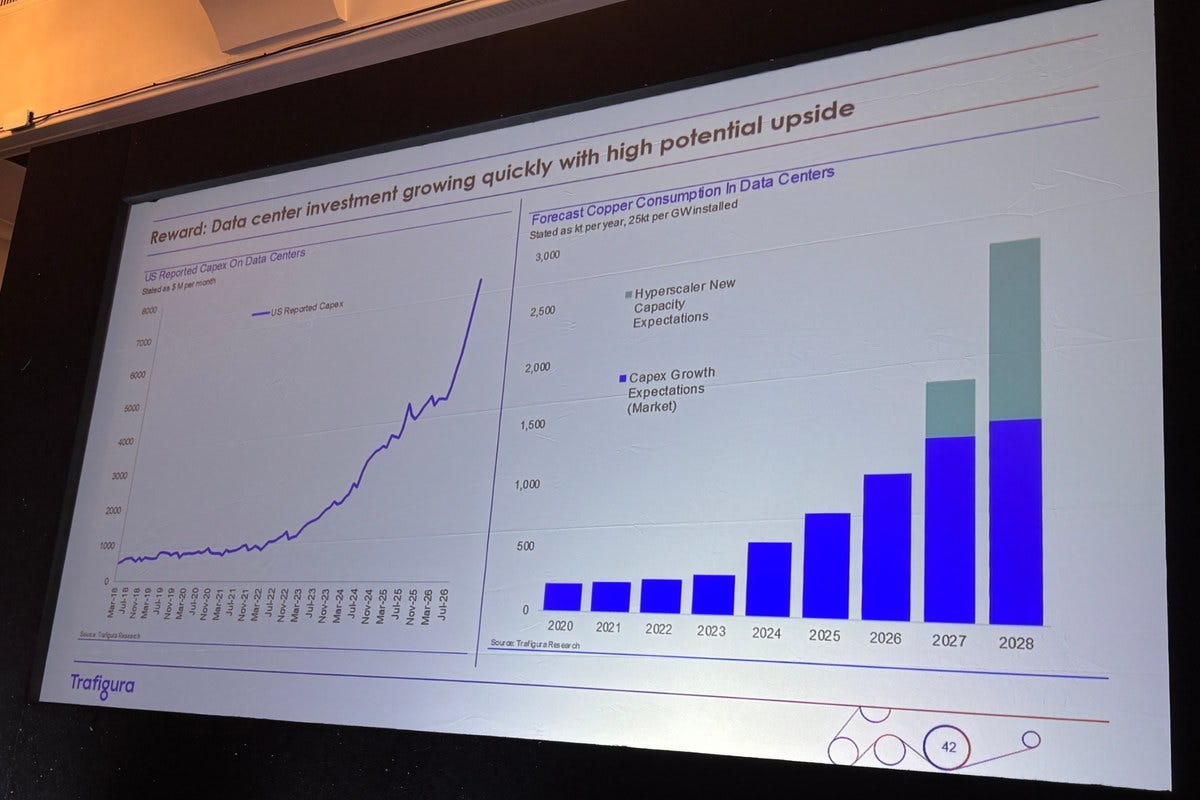
Copper is a market of more than 30 million tons a year, so data centers will still use less of it than construction or general infrastructure.
“It is the impulse in this demand from 1 million tons now to potentially 3 million tons in two years’ time, that is the real kicker, potentially, for a leg higher in prices,” Van said.
Borrowing to build
Van spoke at the Critical Materials Forum: London 2026, organized by research firm Project Blue and the Minor Metals Trade Association (MMTA) during LME Week in London on October 20. Jack Bedder, founder and director of Project Blue, hosted the session on the shifting order of critical materials.
Bedder said governments increasingly view critical materials through the lens of economic and national security. They are intervening through funding, procurement, tariffs, stockpiling and direct investment because markets alone cannot deliver the resilience they want.
“Supply is becoming less about simply finding the lowest-cost source. It increasingly matters where a material comes from, who controls it and how secure that supply really is,” he said.
Van said the flip side of the AI boom is that the global economy now leans heavily on a single sector.
Most equity valuation growth in recent years has come from tech stocks such as Nvidia, Microsoft and Google. By his calculation, AI capex contributed 80% of US gross domestic product (GDP) growth over the last couple of quarters.
“If this one sector that is such a driver of the global economy starts to crack, then there are consequences not only for copper prices but also for the global economy,” he said.
Van said tech giants such as Google and Microsoft can no longer fund the build-out from profits alone.
“Of all the money they make in profit, they are now spending more than 100% of it on data centers. What this means is that they are having to go out into the market and borrow money off balance sheet to fund these data centers.”
That borrowing now exceeds the mining sector’s total annual capex, and Van sees it as the main reason copper prices have climbed. Trafigura reckons global copper demand would be shrinking this year without AI. But oil prices, inflation and interest rates are all rising, making the debt more expensive.
“As interest rates and the cost of borrowing go up, it’s going to be harder and harder to continue building this pipeline of new demand. If the expectations are reduced, then you turn from having a very positive outlook on copper to potentially a challenging view on copper,” he said.
Nick Pickens, head of copper and by-products research at Project Blue, said policy has done more than AI to push prices to records.
“We’ve got excitement around AI, and there is a very strong demand picture there. But ultimately, it’s been about the dislocation of copper stocks. That’s why prices are high,” he said.
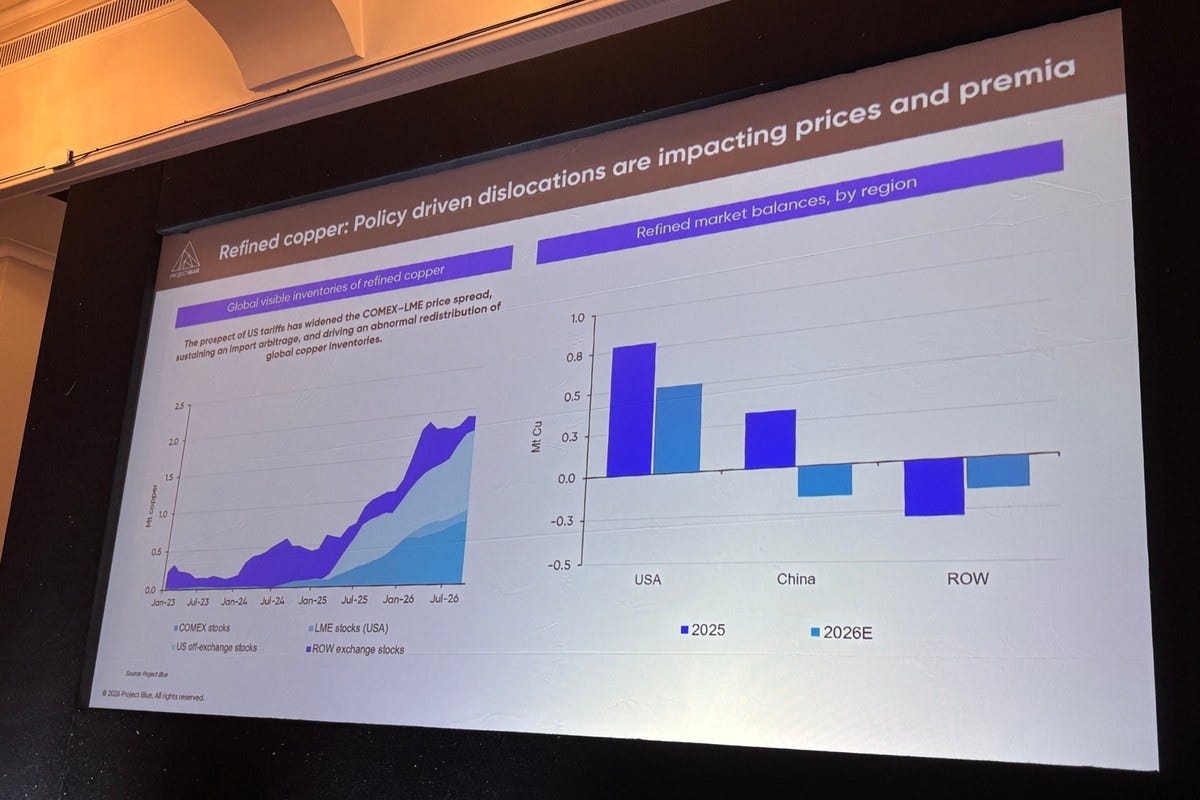
Pickens said the threatened US tariff on refined copper has driven prices for the past 18 months. Arbitrage between New York’s COMEX and the LME has pulled about 2 million tons into the US. The world market is in surplus overall, but all of it sits in the US, while China, the marginal buyer that sets prices, is moving into deficit.
“It’s incredibly distorting, and so we now have to look into the crystal ball and decide what the policy will be on US tariffs to really understand what’s going to happen with prices and stock levels next year,” he said.
Africa fills the gap
On supply, Van said new sources are beating expectations while traditional ones fall short. Africa delivered 2 million tons, or 63%, of global copper mine supply growth between 2020 and 2025, and Trafigura expects it to produce about 30% of the world’s mined copper by the 2030s.
African projects cost more to run than the global average. But they need about a third of the usual capital and take one to three years to build. Much of the new output comes from solvent extraction and electrowinning (SX-EW) projects.
“Yes, they’re more expensive when they’re online, but they’re still profitable. They can come online quickly. It doesn’t take much money to bring them on,” he said.
Traditional supply keeps disappointing. Trafigura has cut its 2025 and 2026 global concentrate output forecasts by 10% and 12%.
Pickens said copper trade is also splitting along geopolitical lines. Chile, which supplies about 40% of global copper concentrate exports, now ships close to 40% of them outside China, up from 25% two or three years ago.
Smelters in Japan, Korea, Europe and India are taking the extra tons. Across Chile, Peru, Mexico, Canada and the US, about 400,000 to 450,000 tons have been rerouted away from China, which has responded by lifting imports from Kazakhstan, Mongolia, Russia and Chinese-owned mines abroad.
“We are hearing and seeing that the rest of the world is rejecting the Chinese benchmark. We’re seeing a shift more towards bilateral negotiations and a market that is willing to take a different price other than the Chinese price,” he said of this year’s talks on treatment and refining charges (TC/RCs).
Pickens said TC/RCs are only one variable in smelter economics. Smelters outside China also earn from captive supply, scrap, multi-metal recovery, sulfuric acid and cathode premiums, and he expects concentrate pricing to shift toward regional prices and indices.
He also flagged a risk to copper scrap, which Project Blue expects to meet a record 38% of global copper consumption this year. China leans on it even more, with scrap’s share of its consumption rising from 26% in 2020 to an expected 37%.
From May 21, 2027, EU scrap can go only to approved countries outside the Organization for Economic Co-operation and Development (OECD), and China has not applied. Europe ships about 375,000 tons of copper scrap to China each year.
A US proclamation will require 25% of domestic copper scrap to be sold at home from 2027, though it already uses 65%. Pickens said Washington could go further, as it has with tungsten scrap, all of which must now be sold domestically. US copper scrap exports total about 600,000 tons a year.
“We’re talking about a million-ton risk to the market next year in copper scrap flows. I’m not convinced that the market is talking about this enough,” he said.
Pickens said record prices have pushed copper into demand-destruction territory but left producers with very healthy balance sheets and record free cash flow. Capex by major copper miners outside China has roughly doubled since 2020, to about $30 billion this year.
The US has backed about 725,000 tons of new copper projects a year, and the EU about 640,000 tons. He expects the extra investment to lift supply over the next five to 10 years.
The point about copper demand potentially shrinking without AI really caught my attention. I actually explored the financing side of this boom in my latest research. If borrowing costs continue to rise and hyperscalers start postponing projects, copper could become one of the earliest indicators of a slowdown in AI investment. I'll definitely be following this more closely. Great piece, Jeff!
Somebody tell the Bronze Age it was early.