


A British maker of expressive humanoid robots is building its first walking model, but it won't include its most sophisticated feature: the face.
The robot, due to be shown by the end of this year, will be smaller than a full-size humanoid and carry a simpler head than the expressive one on the company’s current machines. Very few legged humanoids are working in the real world yet, a point the summit’s previous panel also raised.
“We haven’t shown it off, and you guys are one of the first people to know that we’re doing that because I haven’t told anyone,” said Morgan Roe, chief operating officer of Engineered Arts.
“That’s not going to have the head with the facial features that we currently have because it’s going to fall on its face. That thing will fall down, and an expensive head with 32 motors in it is just going to get destroyed immediately,” he said.
Roe said the new robot will still be able to interact with people. It will stand 1.1 meters tall, and he has seen other humanoids that are shorter still.
When asked whether starting with the face made the route to a full humanoid harder, he said the company had approached the challenge differently. Very few markets exist for a robot with legs, while a desktop robot with just a head and neck can already serve front desks, care homes, and schools.
“We started with the face because that’s something that we can address right now. There are use cases for just a communication device,” he said.
Based in Falmouth, Cornwall, Engineered Arts has spent 20 years building humanoid robots that entertain, communicate and educate. Its customers include visitor attractions, science museums, university researchers and corporate labs that use its robots to test human-centric consumer devices such as virtual reality headsets and smart eyewear.
Small is safer
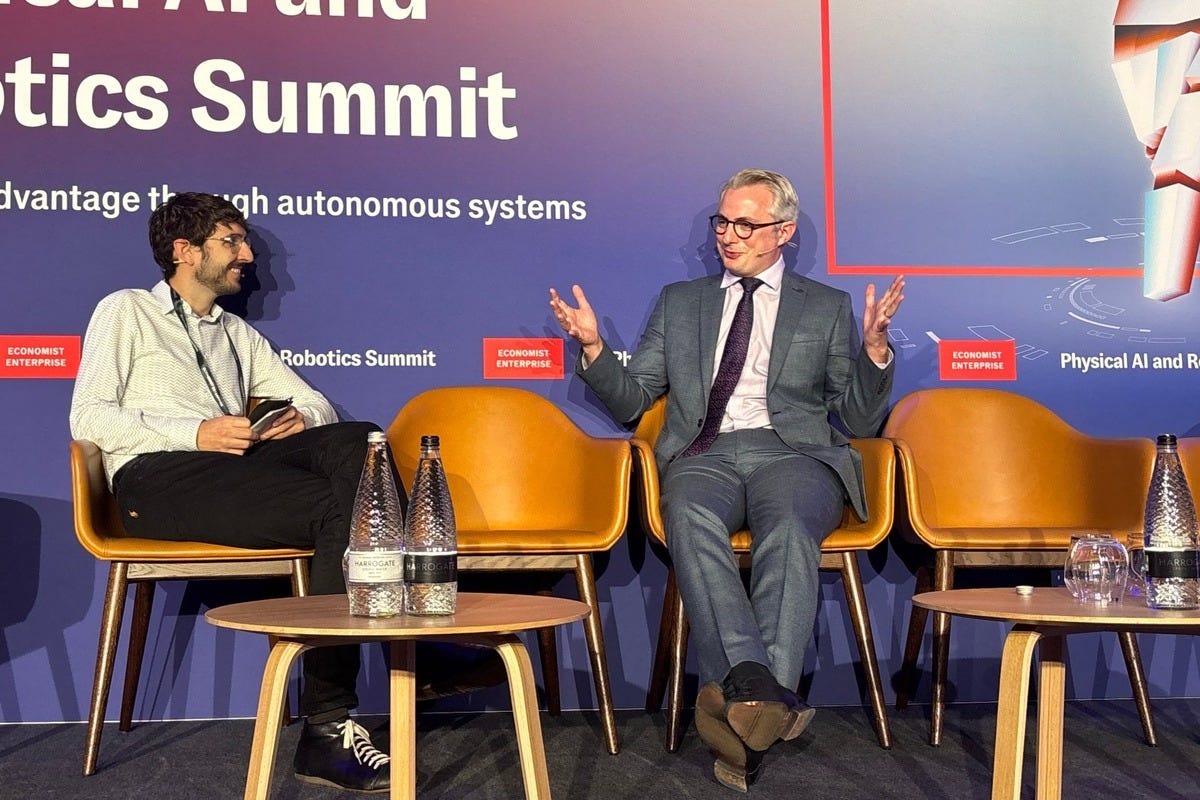
Roe spoke at the Physical AI and Robotics Summit, organized by Economist Enterprise in London on October 13. Alex Hern, an artificial intelligence (AI) writer at The Economist, moderated the fireside chat on why human-robot interaction matters.
Homes pose a problem because a robot maker cannot control what is inside them, from fine china to small children.
“It’s an unconstrained environment. That is why it’s our vision, because it’s one of the most, if not the most, difficult areas to operate a humanoid robot in,” Roe said.
A full-size humanoid stands about 1.8 meters tall and, however it is built, will never weigh less than 35 to 40 kilograms, and even that is lightweight. When something goes wrong, it falls, and the task is to mitigate that risk.
“Something falling from that distance is a risk. The smaller the robot, the less the risk,” he said.
He said the company is always looking at the next steps it can take toward working in the home, and one of them is making a robot that acts, reacts and interacts like a human. Yet looking too human carries its own risks.
In 2017, Engineered Arts began making ultra-lifelike robots with painted skin and hair, and that's when it entered the uncanny valley.
“The uncanny valley is when something is uncannily like a human, but not quite. If it gets quite like a human but doesn’t move, act or react like a human, that’s when you get that sort of ‘This is scary. I don’t want to be around this,’” Roe said.
Over 20 years, the company has seen people warm to its robots and recoil from them.
“For us, for the engineers, we were looking at that, and we preferred it when we took the skin off and the hair off and the clothes off. It looked like a robot again,” he said.
When the pandemic shut down the businesses that bought its robots, the company used the time to build the character it wanted. The new robot had no hair and gray skin, so people could see the machine underneath and how it worked.
The robot, Ameca, drew tens of millions of YouTube views within weeks of its December 2021 debut.
“Some of the comments were, ‘This is the most lifelike thing I’ve ever seen.’ But what we did is we made it less lifelike, and what that did was make it more of a blank canvas, so people could project their idea of what a human is upon the robot,” he said.
Built to look robotic
Roe said a robot will never be exactly like a human, so it should act and react like one without trying to look like one.
“I don’t think trying to make it ultra lifelike is what we should be gunning for. It’s great in movies. That’s absolutely fine. We know that what we’re building is a robot. As a human interacting with that thing, I want to see that it’s a robot,” he said.
The human form is a high-bandwidth communication device that works through gesture and facial expression as well as speech, and everyone already knows how to use it.
Roe’s grandfather, born in 1922, lived to 98 and through the digital age, but never owned a computer or smartphone or used the internet. Learning to use the technology meant learning to live and communicate in a different way, with risks such as emails that should never be answered.
Faced with all that, his grandfather decided he did not want to take part.
“A humanoid robot is an incredibly complex machine, but if it says hello and greets you, my grandfather would be able to use that piece of technology because he’s used that since the moment he was born. It’s about opening up these complex technologies to the world,” he said.
Roe said the same human-centered thinking is showing up in AI agents such as Meta’s Muse, launched last month.
The personal agent works in the background, comes with a cute character and can buy products for its user through partners such as Shopify and PayPal.
“We believe that humanoid robots are going to be in the home. They’ll be everywhere. That humanoid robot in my home, it’s going to know what I buy. It’s going to know when I’m running out of loo roll, so it will buy it for me,” he said.
He said people will end up with personal AIs in physical form, and those assistants will carry into the workplace, as ChatGPT did after starting as a consumer product.
He cited a survey this year that found 89% of people who use AI at work first used it at home.
“The trust and the acceptance of robots is going to come from reducing the risk of physical harm, but also what the agent does. If you give an agent money, you want it to buy your loo roll. You don’t want it to buy a Lamborghini,” he said.
Engineered Arts plans to unveil its 1.1-meter walking robot by the end of this year, its next step toward a humanoid that can work safely in the home.