


Robots built in the human image may impress audiences, but some robotics experts say a humanoid body is often the wrong design choice.
The debate goes beyond looks. Two legs require far more energy than four, and most factory floors are flat and stair-free. Yet older plants and many other workplaces were laid out around human workers, which keeps the humanoid form in contention.
“With robots, we don’t have those constraints, so it’s not obvious to me why we should say, ‘Well, we’re bipedal, so we have to make bipedal robots,’” said Jenny Read, programme director at the Advanced Research and Invention Agency (ARIA). “Clearly, there are constraints around robots needing to fit into human spaces, but we’re maybe overdoing the constraints that we have.”
Read said human bipedalism traces back to the tetrapod body plan. Humans’ ancestors needed more dexterity, so their forelimbs became hands, she said. Evolution could not add an extra pair of limbs, but robot designers face no such limit.
“There’s a psychological hack that when we see something that looks like a human, we attribute all kinds of human abilities to it,” she said. “So we’re intrinsically more impressed when we see a humanoid robot do something than we might be if it had a very different body plan doing the same thing.”
People then assume that a robot which looks human and does one human task can do everything else a human can, she said.
Read said wheels are fine in factories, while legs make sense only in less predictable places with more obstacles. She said ARIA is funding locomotion research, but today’s legged robots lack the robustness of biological bodies and their tolerance for contact.
Grzegorz Ombach, senior vice-president and group head of disruptive research, technology and innovation at Airbus, said the right form depends on the task. He said a two-legged robot serves as the interface between today’s world and the one to come.
“If you look at the facilities and the environment which we prepared, we haven’t prepared for a nine-legged human. We have prepared for a two-legged human,” he said. “We don’t use two legs because two legs require much more energy, so you would have to recharge them much more quickly in order to keep the balance.
Instead, Airbus uses four-legged robots in its factories for monitoring and safety, he said.
Plants built for humans
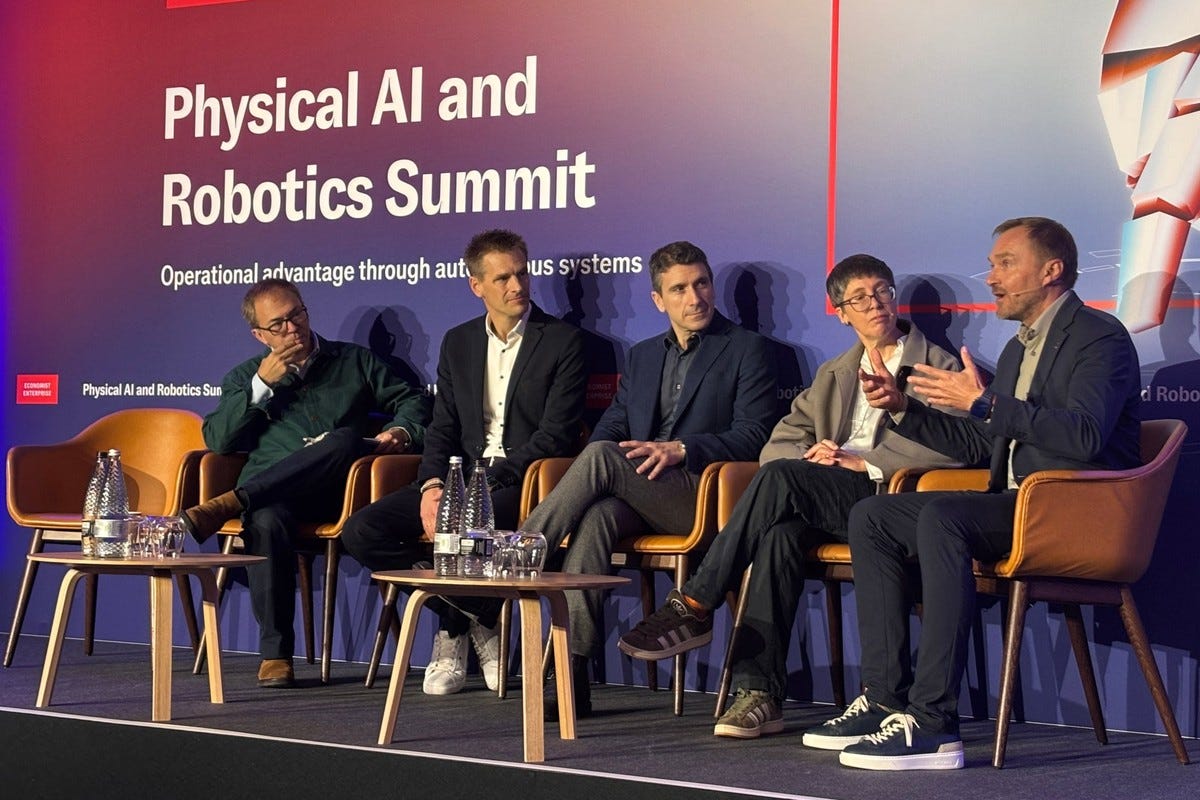
The panel took place at the Physical AI and Robotics Summit, organized by Economist Enterprise, in London on October 13. Kenneth Cukier, deputy executive editor of The Economist, moderated it and asked whether robots need to take a human form.
Sebastian Jonas, senior vice-president of advanced production technology at Schaeffler, said mobility decides whether robots pay off.
Schaeffler has more than 100 production plants worldwide. About 80% of its shop-floor staff move between jobs such as loading machines, quality checks, assembly and packaging inspection.
“If I put a robot there which has no mobility, it can work, but it brings no ROI (return on investment),” Jonas said. “So flexibility for us is a must in order to stay competitive, because there are no low-hanging fruits with industrial robots. They’re already automated.”
He said a new plant could rely on simple solutions such as automated guided vehicles (AGVs) and cobots. Factory floors are structured, so legs matter only in narrow spaces where AGVs cannot move. Standardized areas such as warehouses and electronics production are already automated, while assembling transmissions and bearings still demands human dexterity.
“If I have the possibility to plan a plant on greenfield, I’m not sure if I need humanoids. But we have a lot of brownfield, and the brownfield is designed by humans for humans,” Jonas said.
He said human dexterity is hard to match, since a worker can pick parts out of a box and assemble them with eyes closed.
Ombach said aerospace has an automation rate of only 20% to 25%, mostly in early stages such as screwing and joining parts. Later assembly stages still depend on people, and even in car plants humans route the cables because only they have the flexibility today.
Some factories that assemble mobile phones and tablets already run dark. Robots building whole aircraft will take longer because the industry’s product cycles last 30 to 40 years, he said.
“You have your process in manufacturing, and then you are introducing the robot, which is similar to the humans today. But you have to change your process in order to really capture the outcome. It’s not a 10% or 20% reduction, but a 10x reduction,” he said.
He compared the shift to adding artificial intelligence (AI) agents to digital workflows, saying process redesign is where dark factories and new forms of robots come in.
ARIA focuses on hardware, believing it will be the bottleneck, Read said.
“At the moment, robots are built with electric motors, and that’s very mature and effective technology. But it was never designed for robotics,” she said. “Despite the amazing achievements that you see in today’s robots, they’re often fighting the fundamental physics of their bodies, and in particular their actuation.”
Dexterous hands are not yet up to spec for factory work, she said. The UK government funding agency backs work on new actuation technologies, better tactile sensing and better materials. The aim is a hand with enough degrees of freedom, actuation and strength in a small volume.
The agency also funds electrostatic artificial muscles. She said a biological solution is unlikely to come first, since nobody yet knows how to supply nutrients to living muscle in a machine.
Fifteen minutes to learn
Ombach said the mechanical side of robotics is largely solved and the harder problem is the brain. The recent boom grew out of autonomous driving, which combines sensing, actuation and processing. Self-driving cars still need human operators, as do robots, for the same reason: they can't yet generalize.
“The goal is not to have millions of data points in order to train the robot. The goal is to have it like the human today. You come to me, I show you something for 15 minutes, and you can repeat it,” he said.
Until robots learn that quickly, he said, they will remain niche applications. He added that robotics is moving even faster in China than in the US.
Jonas said the biggest obstacle is the effort required to train robots before deployment.
“Teleoperation takes a lot of time. It’s high-quality data, but it takes a lot of time. We need to go more and more into simulation to close the sim-to-real gap, to train skills faster and then to deploy faster,” he said.
Read said generative AI, which increasingly learns robot control end to end, could also design the body. ARIA is funding early-stage work asking how many limbs a task needs, whether a tripod would be more stable, or whether three grippers would help. It starts with hands, asking what a given task needs.
“Potentially, AI can discover and explore that huge design space. That’s something AI is very good at,” she said. “Whereas at the moment, we’re just going, ‘Well, humans look like this. My robot’s going to look like that.’”
She said that approach would be more principled than simply copying the human form.
Ombach said it doesn't matter whether a robot has one leg or 25 if the goal is clearly defined. Future robots could even fly, though they would need new energy sources, he said.
Marco Iannone, group chief AI officer at Virgin Active, said the gym chain sees specialized robots cleaning pools and folding towels when members are not in the club. He said the software already lets robots learn new tasks, but Virgin Active wants robots dexterous enough for tasks it cannot yet predict.
“The real advantage in having humanoids, or let’s call them eclectic types of robots, is the fact that they can do a variety of different tasks and they can adapt to what’s needed in the club,” he said. “You need to put them in environments that are truly chaotic, and they need to be safe.”
He said interacting with staff and members is far more complex, much like autonomous driving. Virgin Active would phase deployment in four stages:
Robots working in isolation
Robots working alongside other robots
Robots working with staff
Robots working with members
Robot personal trainers are possible in principle, but nobody knows whether members want them, he said.
Ombach expects robots to take on entertainment and productive work within 10 years at most, with long-cycle industries such as aerospace transforming after that.