


A musician who lost his singing voice to a terminal illness performed live again this year, after an artificial intelligence (AI) company rebuilt his voice from old recordings.
The moment is being offered as proof that AI can restore, rather than replace, something people value most: their own voice. It is also framed as the clearest answer to a harder question: why a public wary of AI should trust it at all.
“AI is only useful if everybody actually has access to it,” said Mati Staniszewski, co-founder of ElevenLabs. “Probably one of my proudest works of all of it was working with people who lost their voice, unfortunately, to motor neuron disease (MND) or amyotrophic lateral sclerosis (ALS), and we could bring it back.”
He was describing Patrick Darling, a folk musician diagnosed with ALS at 29 who lost his ability to sing. Using pre-diagnosis recordings, ElevenLabs rebuilt his voice so he could perform live again.
“For the first time in years, I could hear myself sing again,” Darling has said. “That changes everything.”
The performance took place in February at the ElevenLabs Summit in London and is believed to be a world first. He was also billed to perform again at South by Southwest London.
He worked with Richard Cave, a speech therapist on ElevenLabs’ partnerships team, who used old recordings to help rebuild the voice he could no longer produce himself. He performed an original song, “Ghost of a Man I Never Met,” before an audience of nearly 1,000 people.
His case sits inside a wider effort. The ElevenLabs Impact Program, run with the nonprofits Bridging Voice and the Scott-Morgan Foundation, aims to give a million people affected by ALS and MND free access to voice cloning.
“When my family first heard my voice again, they cried,” said Tim Green, a former National Football League (NFL) player with ALS who used the program.
“Despite that unfortunate event, you can still inspire, do that work and bring everyone back,” Staniszewski said.
ElevenLabs is a London-based voice-AI company Staniszewski co-founded in 2022. It reached an $11 billion valuation in February, with backers including Sequoia Capital and Andreessen Horowitz.
Agents already on call
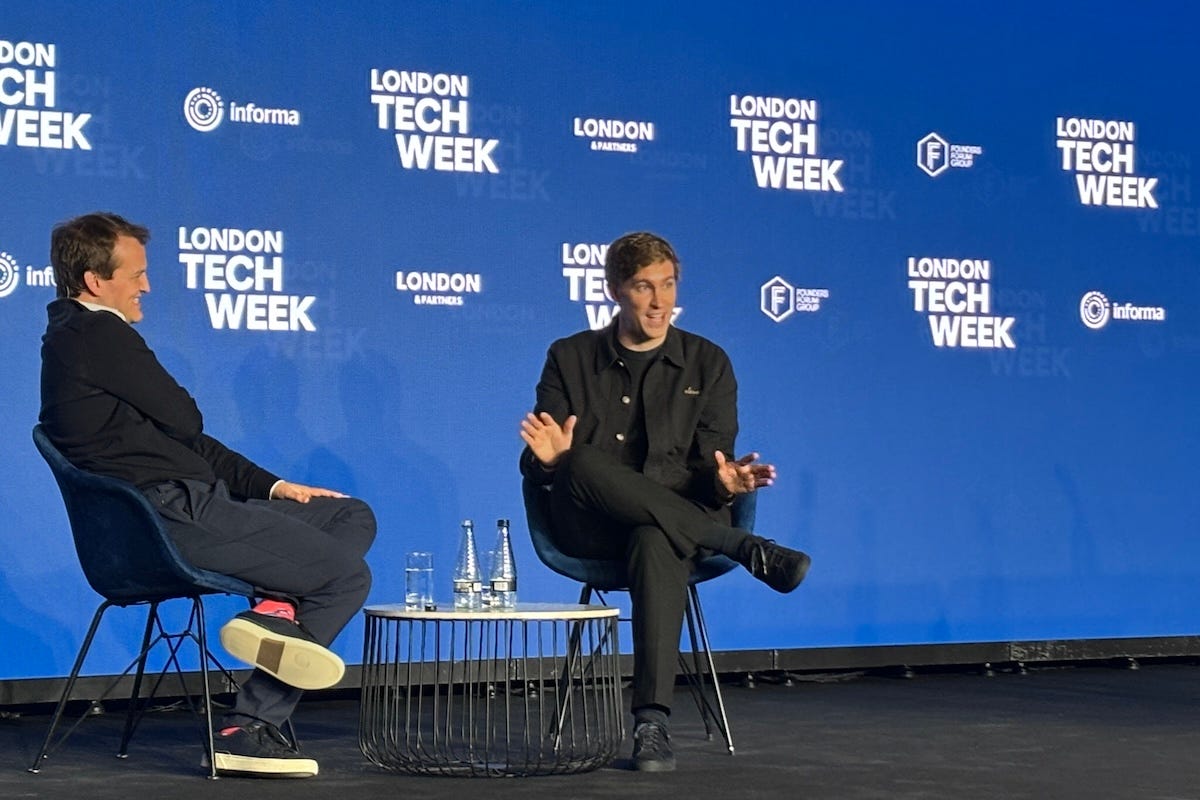
The comments came during a fireside chat at London Tech Week in London in June, moderated by Matt Clifford CBE, chair of the UK’s Advanced Research and Invention Agency (ARIA). The event, which explored the future of human-technology interaction, was organized by Founders Forum Group and Informa alongside London & Partners and Tech London Advocates.
Staniszewski, a Polish-born mathematician, co-founded ElevenLabs after working at Palantir Technologies and BlackRock. Clifford led the government review behind the UK’s AI Opportunities Action Plan and served as the Prime Minister’s AI adviser until stepping down last year.
“We have these incredible capabilities, and they are starting to get real pull, but there is also quite a lot of public suspicion of AI. It is not a very popular technology,” he said. “It is really incumbent on the industry to explain to people what the benefit actually is.”
Staniszewski described his answer as the start of a “golden era of consumer interactions,” in which callers get seamless, personalized help instead of working through a maze of automated menus.
He pointed to companies already using the technology in production: passengers on the rail-booking platform Trainline can call in when a ticket is disrupted and get an automatic refund or rebooking, and Revolut has rolled out voice agents so customers can get help with payments through its app.
“Call centers during the alerts, when the drones are coming over, need to be evacuated and moved to the shelter. In that time, that gets swapped over to voice agents that can still take those calls,” he said.
A common thread ran through both settings: a “builder” mentality inside organizations willing to experiment with the technology, whether or not the people driving it were technical themselves.
“The shift we see is from reactive to proactive. It is not only going to be, but I also have a problem, I am calling in. How incredible would it be if you could proactively reach out and get that help,“ he said.
He offered two more examples of that shift: a delivery platform proactively calling restaurants to confirm opening hours so that information stays current for customers, and agents moving from being one part of the customer journey to becoming central to it, greeting a visitor the moment they land on a company’s website.
Reading the caller’s mood
Staniszewski said the next big leap is emotional, not just acoustic. Within six to 12 months, he expects voice models to detect a caller’s mood and adjust their tone accordingly, rather than just sounding convincing.
“The huge thing we think will happen over the next six to 12 months is that the models you interact with won’t just sound good. They will be able to understand the emotion of the other side and adjust accordingly,” he said.
He said a stressed caller would get a reassuring response from the model, while an excited one would be met with matching energy.
Clifford, who led the government review behind the AI Opportunities Action Plan, used the conversation to take stock of its first year. He said the plan rests on three pillars: getting the policy framework right, driving public sector adoption and building AI sovereignty.
He pointed to early wins: scholarships to bring AI talent to Britain, and a new AI Growth Lab to help frontier companies navigate regulation. In April, the government also launched a £500 million Sovereign AI Unit to back domestic startups.
“That’s not the same as AI self-sufficiency. No country in the world will be self-sufficient in AI. But we need, as a country and as a continent, to have a seat at the table,” he said.
Compute is where progress has lagged furthest, he said, calling it the single biggest constraint on the plan’s ambitions.
He pointed to two recent deals as evidence Britain already carries real weight in the field. Isomorphic Labs, the Google DeepMind spinout working on AI-driven drug discovery, raised $2.1 billion in May, while Ineffable Intelligence, the AI startup founded by Yann LeCun, raised a $1.1 billion seed round, the largest seed round in European history.
“We only get a seat at the table if we have companies that are actually doing important things,” Clifford said. “The way you get to decide is to build it.”
He cited British computer scientist Demis Hassabis staying in London to lead Google DeepMind after its acquisition as evidence that domestic strength shapes AI’s global norms, not just its economics.
Staniszewski said the mood in the room had visibly shifted, with more companies now spinning out and scaling in Britain.
ElevenLabs’ own UK headcount illustrates that trend. It grew from 18 to 68 employees over the year ended September 2025, part of a wider expansion that took its European workforce past 90; the company now says it has around 200 staff in Britain, with more hires planned.
“The UK economy is highly geared on AI. If we adopt fast, we will benefit. If we don’t, we’ll probably lose out to international competitors,” Clifford said.
He named professional services, financial services, life sciences and creative industries as the sectors most exposed to that transformation.
The next test, in Clifford’s own account, is whether Britain’s push to be an AI maker keeps pace with the speed at which companies like ElevenLabs are scaling.