Artificial intelligence (AI) is reshaping not only industries, but family fortunes once built on bricks and mortar. For a new generation of Chinese family office leaders, the strategic question is no longer where to build, but where to compute.
The grandson of a developer behind some of China’s earliest landmark hotels and mixed-use projects has for several years been building exposure to AI infrastructure, venture funds, and emerging robotics plays as part of a broader technology diversification strategy. The transition marks a generational shift in capital allocation, from physical assets to digital systems.
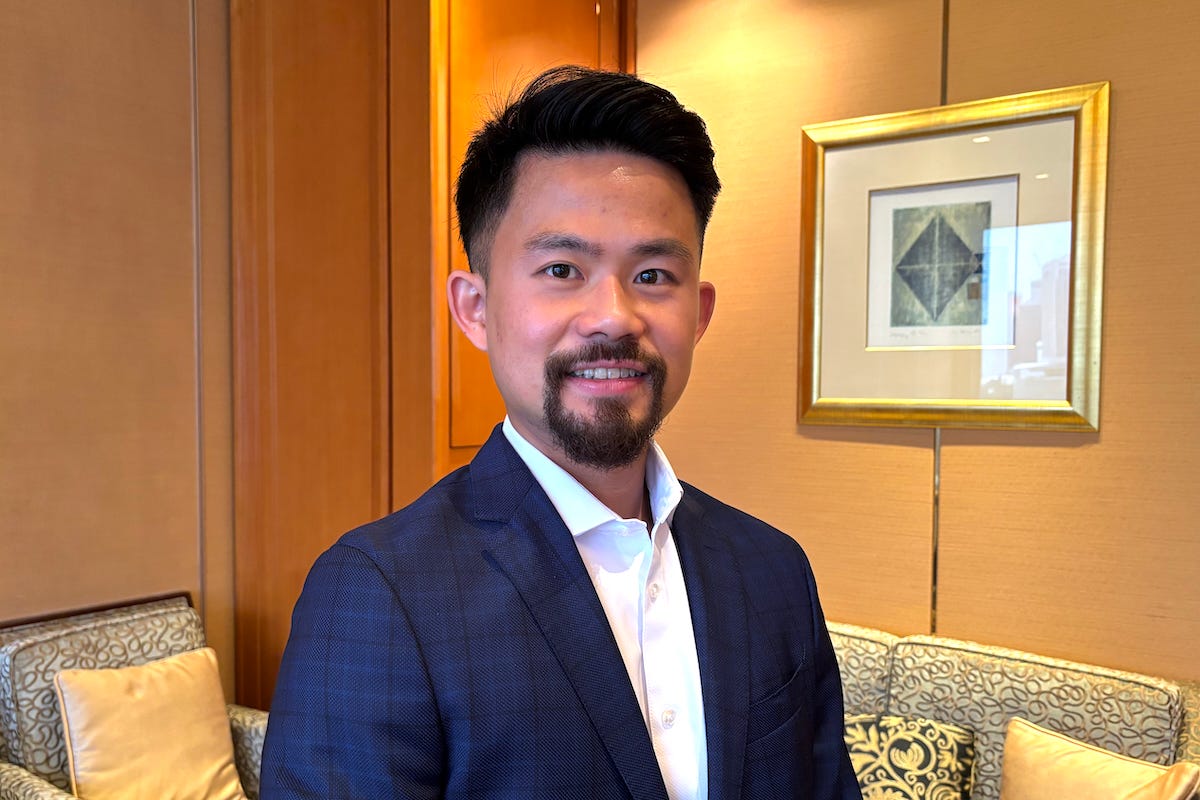
Hampton Tao, who studied manufacturing engineering at the University of Cambridge from 2014 to 2018, joined New Heritage Investments Limited, a Hong Kong-based single-family office, as an investment manager in 2020. In the same year, he also began helping manage the C.F. & Nancy Tao Foundation, the family’s philanthropic arm.
His father, Richard Tao, and his uncle, Paul Tao, are chairman and managing director, respectively, of New Heritage Investments.
“I’m really glad that my father and my uncle sold the real estate company before I came back. Otherwise, I wouldn’t come back. I’m not interested in real estate, but I’m interested in technology and the new economy,” Hampton Tao told TechJournal.uk in an interview in Hong Kong.
“It is a slower process to look at new opportunities as a family. We have different interests, and we gradually become more well-versed in different areas,” he said. “To get everyone on the same page about one particular compelling investment opportunity takes time.”
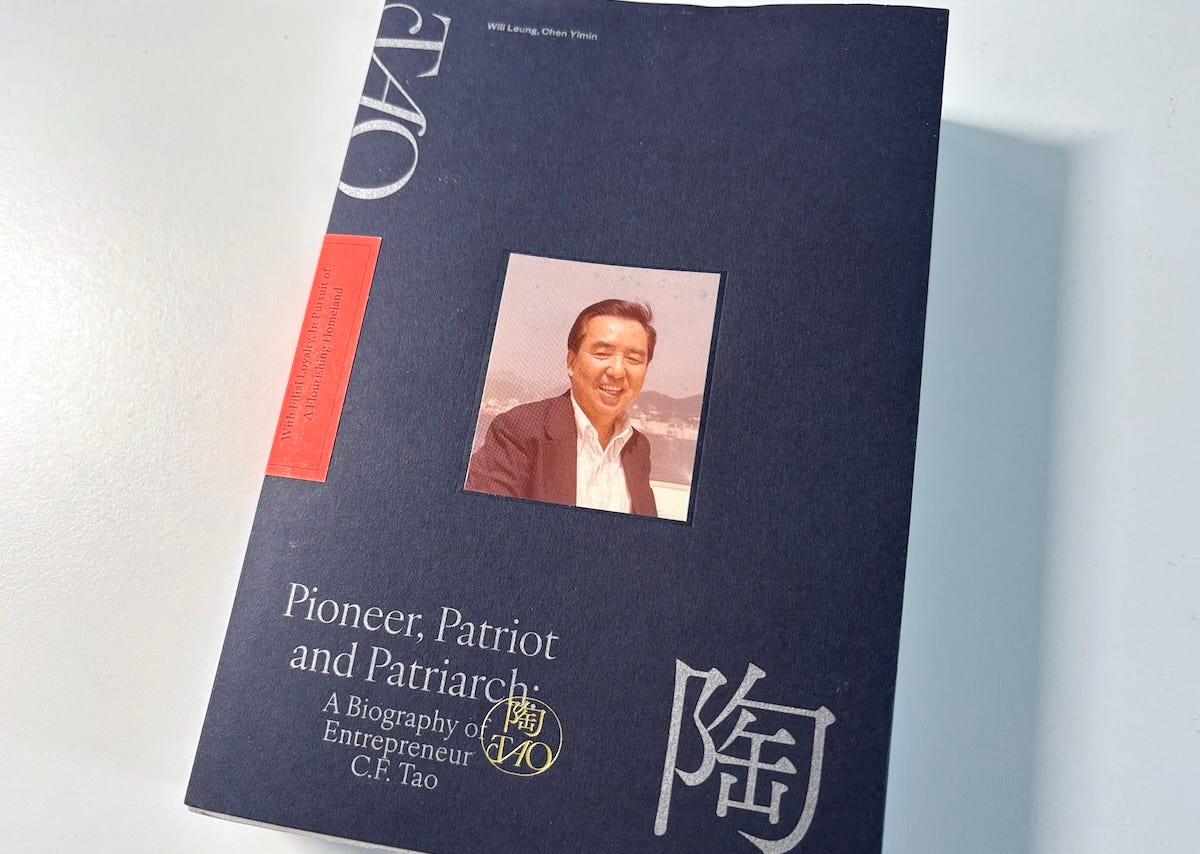
On January 29, Tao spoke on the sidelines of a press event introducing a new book about his grandfather, C.F. Tao — known in Thai as Choofuang Taochaifu — a Chinese entrepreneur who played a role in China’s reform-era development. The new book, titled “Pioneer, Patriot and Patriarch: A Biography of Entrepreneur C.F. Tao,” was published by Joint Publishing (H.K.) Co. Ltd.
C.F. Tao was born in Nanjing (Nanking), then capital of the Republic of China (ROC), in 1922. His career spanned trade, shipping, hotels, and real estate across Myanmar, Thailand, Singapore, Hong Kong, and mainland China. At its peak, his group owned 45 ships. He was instrumental in the planning and construction of Jinling Hotel in Nanjing in 1983, once China’s tallest building and one of the country’s earliest five-star hotels after reform and opening up.
He later developed Beijing’s Landmark Towers, among the capital’s earliest mixed-use commercial complexes, integrating offices, serviced apartments, retail, and a business hotel. In Suzhou, he spearheaded residential projects and helped revitalize the historic Pingjiang district, combining commercial ambition with urban renewal. He died in 2015.
His two sons chose to sell the family’s mainland property businesses in 2014. The timing proved prescient. China’s property market peaked around 2016, entered a downturn in 2018, and culminated in the high-profile collapse of property giant Evergrande in 2020. Liquidity generated from those disposals gave the next generation flexibility to redeploy capital into new technologies.
Fund-first approach
Rather than building an in-house AI research team, Hampton Tao’s strategy centers on selecting venture capital managers with domain expertise.
“For our situation, we focus on investing in funds rather than directly in AI companies. We don’t have enough domain expertise, and we don’t have enough time to spend understanding the space inside and out,” he said. “We work with venture capital managers to help us keep up, and they send us a lot of deal flow and help us stay up to date with what’s happening.”
That process, he said, has matured over time, and the family is now comfortable with a roster of general partners (GPs) tracking frontier themes such as embodied AI, AI agents, and enterprise integration tools.
The approach reflects risk management and structural humility. Tao said AI’s pace of change makes it difficult for family offices to compete directly with specialist funds in sourcing and technical diligence.
To structure exposure, Tao draws on a framework shared by one of his AI-focused partners, mapping the AI ecosystem from infrastructure to applications.
“There are four layers. If I start from the bottom, there’s the energy layer. The second layer is the chip layer. On top of the chips, you have the large language model layer. And on top of that, you’ve got the applications,” he said.
In other words, at the base sits power generation and data center infrastructure, followed by semiconductor manufacturers and emerging chip challengers. Above them are large language model developers and, finally, application companies building AI agents and enterprise tools.
“We think it’s too early to tell which layer will create the most compelling investment opportunities,” Tao said. “We’re taking the easy way out. We’re investing in all of them.”
Execution differs across segments of the AI value chain. On the energy and semiconductor side, Tao said public markets offer efficient access.
“A lot of the AI companies listed in public markets have done really well, and they have disproportionately made up the market cap of a lot of ETFs,” he said. “On the energy and chip side, it’s very easy to express that through public equity.”
By contrast, exposure to model developers and early application companies is expressed through private funds.
“On the large language model side and the application side, because it’s still a bit early, we express that through private investments,” he said.
The portfolio lens cuts across asset classes. Tao noted that in Hong Kong, allocating 20% to private equity and venture capital is already considered high. The family is gradually exiting some illiquid positions and rebalancing to maintain long-term health.
China and robotics
Beyond financial structure, geography also shapes Tao’s AI thesis. He works closely with a venture partner who regularly meets entrepreneurs in Shenzhen and maintains ties to Tsinghua University.
“We think China has a commanding lead, especially in terms of AI hardware,” Tao said. “China has incredible talent density, as well as the national will to help these companies grow into unicorns.”
Robotics, particularly embodied AI, is an area of interest, though he remains cautious about commercialization timelines.
“A lot of the AI robotics you see are demos or prototypes. They are not production-ready, and they’re not ready to be broadly commercialized yet,” he said. “Based on what I hear from our GPs, we’re many years away from that.”
Still, China’s manufacturing depth and government-backed research spending may offer structural advantages over time.
Disciplined Growth Plan
The Tao family’s trajectory mirrors a broader capital rotation across Asia, as legacy property fortunes seek exposure to digital infrastructure and AI platforms.
For Tao, the next phase centers on execution. The family office plans to deepen relationships with core venture partners, increase allocations to high-conviction technology funds, and selectively pursue co-investments alongside trusted GPs.
Portfolio construction will remain disciplined. Public-market exposure to AI infrastructure and semiconductors will provide liquidity, while private investments in model developers and application startups will be scaled in line with valuation discipline and exit visibility.
The roadmap is gradual: build technological depth, maintain liquidity buffers, and rebalance as cycles mature. The shift from property to AI is framed as a long-term allocation strategy grounded in risk management rather than momentum.