


A proposed United States missile defense system known as the Golden Dome is emerging as more than a shield against future threats. It is increasingly being understood by policymakers, strategists, and industry as a catalyst for a fundamental shift in how space is used in conflict, raising questions about deterrence, escalation, and the role of allies.
Rather than reinforcing space as a supporting layer for terrestrial operations, Golden Dome points toward a future in which space becomes an active war‑fighting domain. That shift carries profound implications for global security, from strategic stability to the structure of defense industries and alliances.
“The Golden Dome opens the possibility for space‑based interceptors and, ultimately, space fires from orbit,” said Gabriel Elefteriu, senior fellow for space power at the Council on Geostrategy.
He said the concept represents a broader transformation in how space power is conceived, rather than a narrow technological upgrade. He said the proposal reflects a bigger doctrinal change already underway in US military thinking, with space no longer viewed primarily as an enabler for operations on land, sea, or air, but as a domain in which combat power is generated and applied directly.
The implications extend well beyond missile defense. Space‑based interception would require persistent sensing, targeting, and command‑and‑control architectures in orbit, creating a foundation that could support a far wider range of military missions.
Doctrinal shift
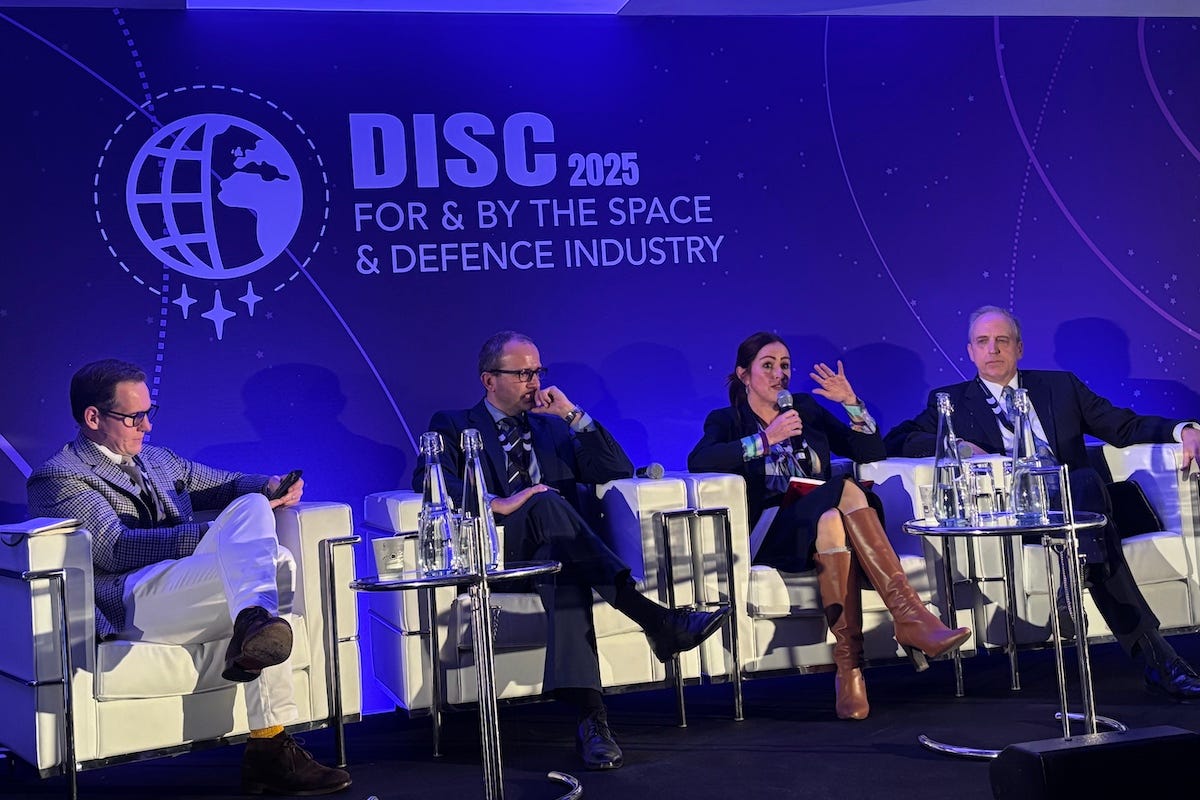
At a panel discussion during the Defence in Space Conference 2025 in London, moderated by Nik Smith, regional director for the UK and Europe at Lockheed Martin Space, speakers examined what Golden Dome could mean for future space conflict.
The event brought together policymakers, strategists, and industry leaders to assess how missile defense, space doctrine, and allied cooperation are evolving in response to emerging threats.
The debate around the Golden Dome comes as the US space doctrine undergoes its most significant evolution in decades. Recent doctrinal publications emphasize space superiority and combat operations, marking a departure from the long-standing view of space as a largely defensive or supportive environment.
Elefteriu said this change should be understood as strategic rather than incremental. He warned that placing interceptors in orbit would inevitably alter how adversaries perceive incentives and risks in a future conflict.
“Once you introduce an architecture that enables interception and strike from orbit, space becomes the ultimate high ground,” Elefteriu said.
He said such an advantage would inevitably become a priority target for adversaries in any future conflict.
Golden Dome is central to that shift because it is designed to operate across multiple phases of a missile’s flight. While existing systems focus heavily on terminal defense, Golden Dome is intended to extend interception into earlier stages, including midcourse and potentially boost phase, where missiles are most vulnerable.
Achieving that ambition would require a dense constellation of space-based sensors, persistent tracking, and near-real-time command-and-control links capable of cueing interceptors across domains. In practical terms, this would bind together satellites, ground-based radars, airborne assets, and terrestrial interceptors into a single integrated architecture.
Such integration blurs traditional boundaries between offense and defense. Even if the stated purpose is interception, the same infrastructure could support space-to-space engagement and, in extremis, terrestrial strike from orbit, reinforcing concerns that Golden Dome accelerates the weaponization of space.
At the same time, proponents argue that the ability to deny an adversary confidence in long-range strike capabilities could strengthen deterrence, particularly as hypersonic weapons proliferate.
Deterrence dilemma
The question of whether the Golden Dome stabilizes or destabilizes the strategic balance remains contested. Critics argue that even limited missile defense can undermine mutual deterrence by creating incentives for pre‑emptive action or arms racing.
Michelle Howard, strategic policy adviser at D Group, said the effectiveness of such systems must be assessed realistically, particularly when nuclear weapons are involved.
“If you’re talking about nuclear‑tipped warheads, what does this do about turning the logic for mutual assured destruction on its head?” Howard said.
She said she still did not understand how effective Golden Dome would be at changing deterrence dynamics, even if the system performed well against conventional missile threats.
She added that history offers little comfort in predicting outcomes. She cautioned against assuming that new defensive technologies automatically make conflict less likely.
“History is made by people who do not know what is going to happen next,” she said. “We tend to idealize war as confined, brief, and decisive, and that assumption has repeatedly proven wrong.”
From a policy perspective, uncertainty is compounded by questions about long‑term political commitment, funding continuity, and how adversaries might respond asymmetrically rather than directly.
Golden Dome also carries implications for nuclear stability that go beyond conventional missile defense. By seeking to intercept long-range threats earlier in their trajectory, the system could be perceived as eroding second-strike credibility, particularly by peer competitors with smaller or less survivable arsenals.
Elefteriu warned that this dynamic could drive adversaries to pursue countermeasures rather than restraint.
“Adversaries will not stand still,” he said. “They will look for asymmetric ways to bypass or overwhelm any defensive architecture, which is why the risk of an arms race in space is very real.”
Those countermeasures could include saturation attacks, novel delivery systems, cyber operations against command-and-control networks, or direct attacks on orbital infrastructure. Each response would further entangle space assets in the opening stages of any major conflict.
Allies and industry
Beyond strategy, Golden Dome poses practical questions for allies and industry.
Justin Keller, chief architect at DGS Space, said the scale implied by a continental or hemispheric missile defense architecture suggests a program that would unfold over decades and span multiple domains.
He said many of the capabilities required for boost‑phase interception, advanced sensing, and directed energy do not yet exist at the necessary scale, creating both risk and opportunity for industry.
“Allies are going to be key contributors, particularly where geography and early detection matter,” Keller said, adding that cooperation could eventually extend beyond North America.
In a related geopolitical move, United States President Donald Trump has recently revived calls for the US to secure control of Greenland, with Washington now engaged in detailed framework discussions that frame the island’s Arctic position as strategically relevant to future Golden Dome architectures.
The discussion around the Golden Dome is also sharpening debates in Europe about defense priorities. Several European governments are investing heavily in air and missile defense, drone countermeasures, and space‑related capabilities, but coherence remains a concern.
Elefteriu said Europe risks conflating industrial policy with defense strategy.
“Europe needs to decide whether it is trying to solve a defense problem or an industrial problem, because those are not the same thing,” he said.
He warned that spreading resources too thinly across multiple initiatives could dilute effectiveness at a time when strategic clarity is most needed.
What comes next
Even in its earliest phases, Golden Dome is already influencing how governments and companies think about space security. Whether or not it is realized in its most ambitious form, the concept is accelerating a broader shift toward treating space as a contested and operational domain.
For allies, the challenge will be to balance participation with sovereignty, deterrence with escalation control, and industrial opportunity with strategic discipline. For the industry, the program underscores a long‑term demand for resilient architectures, advanced sensing, and secure networking.
What is clear is that Golden Dome has moved the debate beyond missile defense alone, forcing a reassessment of how power is projected, defended, and contested in space.