


The US government’s Golden Dome initiative is emerging as a turning point in how military space capabilities are funded, tested and deployed.
The program’s cash‑prize contracting model — where companies compete for staged funding awards instead of a single large contract — is designed to accelerate innovation and attract new entrants into a domain long dominated by traditional defense contractors.
The shift reflects growing urgency to counter hypersonic and ballistic threats while moving faster than legacy procurement cycles. By combining staged funding, rapid prototyping, and public‑private partnerships, the approach signals a structural transformation in how governments acquire space‑based defense capabilities.
David Broadbent, President and Chief Executive of SES Space & Defense, said the US government has completely changed the game in how it plans to acquire the space‑based interceptor. He said the industry is now expected to fund prototypes before any down‑select decision is made.
“It’s a totally different mindset, and it encouraged a lot of private equity and private investment into the space,” he said.
Broadbent said the government will evaluate prototypes through a lab process and award cash prizes at stages of the competition before making a down‑select decision.
The Golden Dome initiative is a US government effort to build a multi‑layer, space‑based missile defense system designed to counter hypersonic and ballistic threats through rapid acquisition and public‑private partnerships.
The program is built around the SHIELD (Scalable Homeland Innovative Enterprise Layered Defense) contract vehicle, a 10‑year, $151 billion Missile Defense Agency multiple‑award Indefinite Delivery/Indefinite Quantity framework (IDIQ) intended to fund thousands of participants across staged development rounds.
Rather than relying on a single prime contractor, the model encourages broad participation, rapid experimentation and early elimination of underperforming technologies.
The result is a competitive environment that blends commercial speed with national security priorities. It also opens the defense space market to a wider range of technology companies and investors.
Acquisition overhaul
SES Space & Defense provides end‑to‑end satellite network solutions to government customers worldwide using a multi‑orbit fleet and global terrestrial infrastructure. It operates as a wholly owned subsidiary of SES, a global content and connectivity provider with decades of experience in government satellite communications.
Broadbent said the new procurement approach of the Golden Dome program reflects a broader shift in how governments and industry collaborate. Increased competition and the emergence of new space companies are changing the traditional relationship between governments and contractors.
“The desire to move at the speed of the threat has been taken a lot more seriously now than at any time in my 27 years in the industry. The level of competition and new space investment is changing the relationship with the government,” he said.
He said the shift has encouraged private investment into missions previously considered too risky or too dependent on government demand. By defining mission priorities and signaling long‑term demand, governments are enabling companies to invest earlier in technology development.
“Industry could see the missions that were going to be available to them, and that became part of their addressable market,” he said.
This alignment between government priorities and commercial opportunity is encouraging companies to adopt new investment strategies and accept greater levels of technical risk.
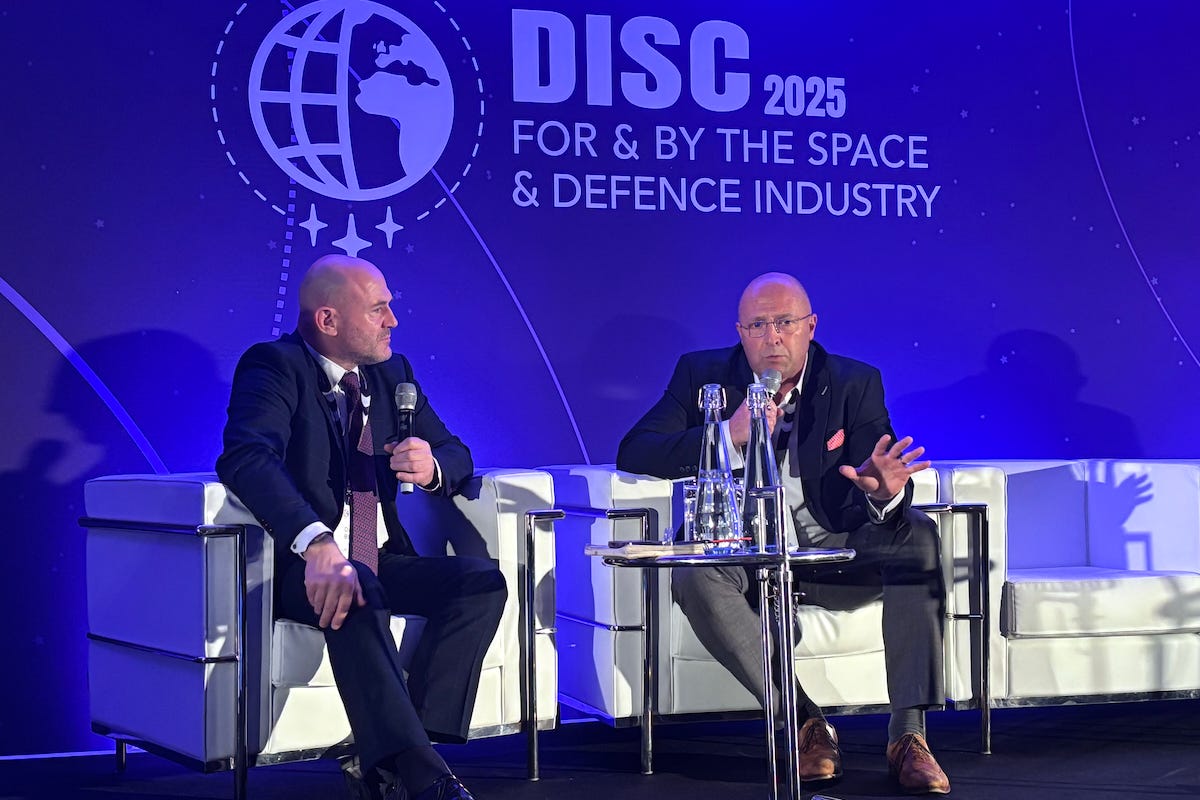
Broadbent made the comments during a fireside chat at the Defence In Space Conference (DISC) 2025 in London. He was interviewed on stage by David Black, Head of Satellite Coordination at UK Space Command.
Hybrid architectures
A central element of the transformation is the acceptance of hybrid space architectures that combine commercial and government capabilities. These architectures allow governments to leverage private investment while maintaining access to critical services.
Broadbent said the industry has moved away from a model dominated by sole‑source, cost‑plus contracts toward one in which new entrants are investing their own capital as governments become more comfortable with using commercial dual‑use technologies for space missions.
“The whole investment equation has changed now. We can afford to take a different appetite in terms of the investment because we’re not just investing for defense and intelligence — we’re also investing for commercial markets.”
The acceptance of dual‑use technologies is changing how space systems are funded and deployed. Commercial markets can help support large infrastructure investments while reducing the financial burden on defense budgets.
Broadbent said governments are increasingly willing to accept faster and more affordable systems that can be upgraded regularly rather than waiting years for highly complex solutions.
SDA momentum
The transformation in procurement is not limited to Golden Dome. The US Space Development Agency (SDA) has demonstrated how streamlined processes can accelerate satellite deployment and reduce bureaucracy.
“What the SDA has done is remarkable. They essentially threw away the DoD 5000 manual — all the things that drive the bureaucracy,” Broadbent said.
The DoD 5000 series is the primary set of policies and procedures governing the Defense Acquisition System (DAS) in the US Department of Defense (DoD). It has traditionally been associated with lengthy and complex procurement processes.
Broadbent said the SDA created small, empowered teams focused on outcomes rather than compliance and managed to place 22 satellites in orbit within about 2.5 years, with around 40 satellites now in the first operational tranche.
The agency’s approach highlights the benefits of smaller teams, outcome‑based incentives and rapid prototyping.
“When you remove the bureaucracy and incentivize teams the right way, it’s amazing what you can do,” he said.
Commercial investment surge
The changing procurement landscape is also changing the business strategies of satellite operators and service providers. Companies are expanding beyond traditional communications services to support defense and intelligence missions.
“We’ve got to pivot away from pure-play satellite communications to more sophisticated missions in the space realm. Missile warning, missile tracking, space situational awareness and Earth observation are where we want to go with the business,” Broadbent said.
“With our MEO (Medium Earth Orbit) investment, we’re going to be at about 100 satellites in five years. That’s roughly $5 billion of investment.”
The satellite figure refers to the combined fleet resulting from the SES–Intelsat merger rather than a plan to launch 100 new satellites within five years. SES officially completed its acquisition of Intelsat in July 2025.
He said commercial revenue streams play a critical role in supporting these large infrastructure investments.
“That investment case doesn’t close with just DoD or intelligence customers. A large portion of the revenue comes from commercial sources,” he said.
He meant that large satellite constellations cannot be funded by government demand alone and must also generate revenue from commercial customers such as telecom, aviation and maritime users.
The integration of defense and commercial demand is creating new business models that rely on shared infrastructure and dual‑use capabilities.
Living architecture
Looking ahead, Broadbent said the industry is moving toward a single architecture capable of orchestrating complex assets across all orbits and domains, describing it as a self‑healing mesh network designed to provide high levels of redundancy.
He was referring to the ability of space networks to maintain communications and data services even if individual satellites, ground stations or links are disrupted or destroyed, by automatically rerouting traffic across multiple alternative paths.
He said adopting spiral development will enable continuous upgrades and faster adaptation to evolving threats.
Spiral development in satellite networks refers to a risk‑driven, iterative and incremental approach pioneered by the SDA, in which new capabilities are deployed in regular tranches and improved continuously rather than waiting for a single, fully finished system.
“Everybody’s going to be using spiral development and upgrading capabilities every six months. You can consistently evolve your mission set to address the evolving threat.”
The convergence of procurement reform, commercial investment and hybrid architectures suggests the defense space sector is entering a new phase of rapid innovation. Programs such as Golden Dome are likely to shape how governments and industry collaborate for years to come.