


Fusion is moving from theory to engineering reality, with measurable milestones now defining progress rather than long-term promises. The shift is increasingly being judged by whether systems can replicate power plant conditions, not just produce experimental results.
That transition is being driven by machines designed to operate at a meaningful scale, with clear timelines tied to performance targets. The focus is no longer only on achieving fusion, but on proving it can be delivered reliably, repeatedly and economically under conditions that resemble real-world energy systems.
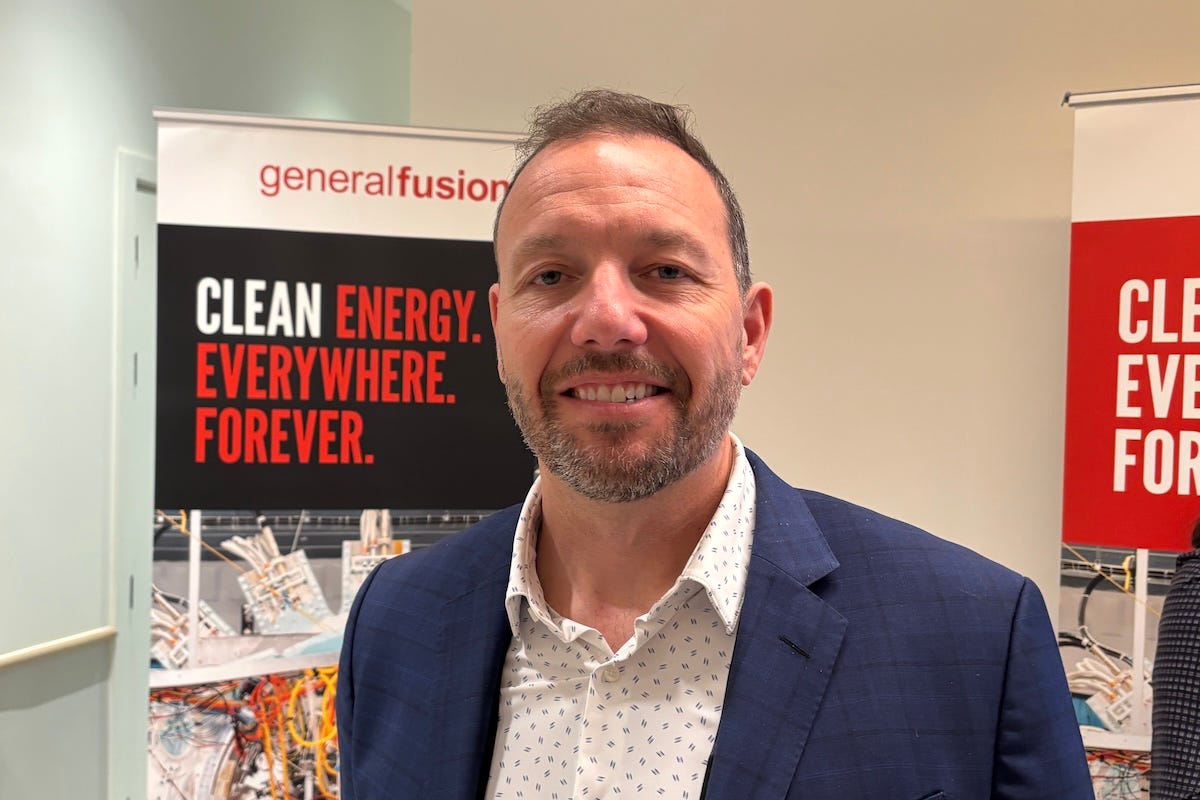
“Fusion is having a moment of inflection. Decades of research and demonstration have now led to very meaningful results in the last few years,” said Greg Twinney, chief executive of General Fusion.
“For us, the machine you see here is designed to demonstrate our technology at 50% power plant scale. We expect to reach early milestones this year,” he said.
General Fusion is operating Lawson Machine 26 (LM26), a magnetized target fusion demonstration system built at half the scale of a commercial power plant. The system was designed, built and brought into operation in under two years, compressing plasma mechanically using a lithium liner as part of its core architecture.
The machine forms the foundation of what the company describes as a structured engineering program, aimed at validating both the physics of fusion and the systems required to support continuous operation. Unlike smaller experimental setups, LM26 is intended to operate at a scale that can directly inform commercial plant design.
Twinney outlined a sequence of defined technical milestones. These include heating plasma to 1 keV, or about 10 million degrees Celsius, followed by 10 keV, or roughly 100 million degrees.
“Our milestones are achieving 1 keV and 10 keV. These are the conditions that move us toward break-even inside the machine,” he said.
The ultimate objective is to reach the Lawson criterion, which defines the combination of temperature, density and energy confinement time required to produce net fusion energy. Meeting this threshold would demonstrate that a system can generate more energy than it consumes.
This criterion connects laboratory-scale experimentation with the requirements of real energy production. Achieving it would mark a transition from proof of concept (POC) to practical deployment.
He said the company is working toward achieving these milestones between now and 2028 as part of a defined technical trajectory, with early demonstration targets expected within the next two years as the machine progresses toward higher temperature thresholds and break-even conditions.
General Fusion plans to complete its Lawson Program by mid-2028 before transitioning into a commercialization phase. This next stage will focus on designing and validating key systems such as seals, valves, liquid-metal systems and heat-exchange components.
These systems are essential to translating fusion reactions into usable electricity. They form part of the broader balance-of-plant infrastructure required to integrate a fusion reactor into existing energy networks. The longer-term objective is to complete the design of a first-of-a-kind fusion power plant and begin operations around 2035, marking a transition from demonstration to commercial deployment.
General Fusion, headquartered in Vancouver, was established in 2002 and focuses on magnetized target fusion as a pathway to cost-effective, carbon-free energy. The company has raised more than US$400 million from institutional investors, industry partners and government programs, and works with organizations including the UK Atomic Energy Authority (UKAEA) and the US Department of Energy on research and development, alongside commercial partners supporting power-plant engineering and fuel-cycle systems.
Industry momentum and IPO push
Twinney was speaking to TechJournal.uk on the sidelines of Fusion Fest, held in London on April 14 and organized by Economist Impact. The event brought together industry leaders, investors and policymakers to discuss the commercialization of fusion energy and its role in future power systems.
He said the current wave of technical progress reflects a broader shift across the industry.
“Many dozens of companies are now coming to market. That was not the case even a few years ago,” he said.
He said decades of research are now translating into tangible results, marking a transition from experimental science to applied engineering.
This shift is unfolding alongside a push to access larger pools of capital. In January, General Fusion announced plans to go public through a business combination with Spring Valley Acquisition Corp. III, with the transaction expected to be completed in mid-2026.
“We’ve announced that we are merging with a SPAC to list on Nasdaq. That would make us one of the first publicly traded pure-play fusion companies in the world,” he said. SPAC refers to a Special Purpose Acquisition Company, a type of shell company.
The move reflects an effort to align long-term technology development with public market funding structures. Access to capital at scale is necessary to support the extended timelines and infrastructure requirements associated with fusion.
The deal is expected to result in a Nasdaq listing under the ticker “GFUZ,” providing the company with access to public capital markets.
The transaction implies a pro-forma equity valuation of approximately US$1 billion. It includes around US$105 million in committed private investment in public equity (PIPE) financing and US$230 million in trust capital, assuming no redemptions.
Twinney said the proceeds will be used to advance the LM26 program and demonstrate the technology in a commercially relevant way.
This includes further testing, system validation and preparation for the next phase of engineering development, which will bridge the gap between demonstration and full-scale deployment.
Prior to the planned listing, the company has raised more than US$400 million from institutional investors, industry partners and government funding programs.
Funding, technology race
Twinney said improving technical results are influencing investor behavior, with capital flowing into the sector.
“It seems the industry is picking up momentum. The results happening in labs and companies are now turning into capital,” he said. “Events like Fusion Fest are bringing together investors in ways that would have been much harder a few years ago.”
The presence of investors at industry gatherings reflects alignment between scientific progress and financial backing. As milestones become more tangible, capital is tied more closely to measurable outcomes rather than long-term projections.
General Fusion’s approach to fusion is based on magnetized target fusion, which differs from other methods such as tokamak systems or laser-driven fusion. The system avoids superconducting magnets and high-powered lasers, instead relying on mechanical compression and a liquid-metal wall as part of its core design.
This approach is designed to use existing materials and simpler engineering systems, positioning it as a more practical pathway to commercial power plants. General Fusion’s system uses a liquid metal wall that performs multiple functions, including shielding the reactor vessel from neutron activation, producing tritium fuel through interactions with lithium, and capturing energy for conversion into electricity.
The liquid metal circulates through the system, transferring heat to a heat exchanger, which can then be used to generate steam and drive a turbine. This process mirrors conventional power generation methods, allowing fusion systems to integrate more easily with existing infrastructure.
He said the company has taken an engineering-led approach to developing fusion systems, focusing on designing technology that can translate into power plants rather than remaining in experimental configurations.
“Everyone is chasing fusion conditions, whether that is tokamak, laser fusion, or our magnetized target fusion. The race is really about who can demonstrate those conditions first,” he said.
He said the industry is currently in a phase of demonstration, with multiple approaches working toward achieving fusion conditions within their respective systems.
As companies move through these milestones, the ability to demonstrate performance at scale will determine which technologies advance toward commercial deployment. The next phase of development will depend on whether these systems can move beyond isolated experiments and operate as integrated energy solutions.