


Fusion’s future may no longer belong solely to tokamaks. A growing group of startups is betting that alternative reactor architectures — once considered fringe concepts — could ultimately deliver cheaper, simpler and more scalable fusion power systems.
Rather than competing directly on plasma physics alone, these companies are increasingly framing fusion as an engineering, manufacturing and commercialization challenge. The companies argue that the eventual winners may not be the first to achieve fusion, but the first to deploy economically viable systems at industrial scale.
“Tokamaks look really hard. What if we did the exact opposite of what a tokamak does? Instead of plasmas inside magnets, you end up with magnets inside plasmas,” said Ratu Mataira, chief executive of OpenStar Technologies. “Why would you do this? Your magnet is now pulling inward to attract the plasma. Whenever you have a central attractive force, you end up with a stable distribution.”
Mataira said OpenStar’s levitated dipole (LDR) concept uses a superconducting magnet floating inside a vacuum chamber to confine plasma, mimicking the natural magnetic fields of planets such as Earth and Jupiter. He said the architecture naturally stabilizes plasma behavior while simplifying maintenance and hardware iteration, as the compact central magnet can be replaced more easily than the large external magnetic structures used in tokamaks.
“The levitated dipole was the only concept I ever came across in fusion that stopped [being] physics challenges and was engineering challenges,” he said. “That simplicity then drives cost reduction, which makes us bullish.”
Koichi Masuda, founder and chief executive of Liberty Fusion, said future fusion systems must also be manufacturable and rapidly deployable rather than excessively capital-intensive.
“We’re looking at it essentially a very different way to a fusion power plant,” he said. “Instead of a massive capex-heavy infrastructure, [it is] almost like software-as-a-service (SaaS) or almost like your iPhones. Every two or three years, you’re buying new ones. We’ll upgrade and update the plasma guns every two years.”
He described Liberty Fusion’s plasma guns as factory-manufacturable components roughly the size of computer monitors. The company expects commercial systems to use hundreds of plasma guns that can be periodically replaced and upgraded as hardware improves.
“If we all love to talk about supply chain, workforce training and scaling fusion technology, then we have to look at the end result 20 years down the road,” he said. “How do you actually go build power plants very quickly, affordably and at scale?”
Meanwhile, Renaissance Fusion is attempting to simplify stellarator design, historically one of fusion’s most technically complex reactor concepts.
“What we do is we start from a 2D tape,” said Sam Guilaumé, chief executive of Renaissance Fusion. “You engrave it with shapes that will be the current path, and then you roll it up. You end up with this cylinder in which you have the 3D magnetic field that you need to build the stellarator.”
Scaling beyond physics
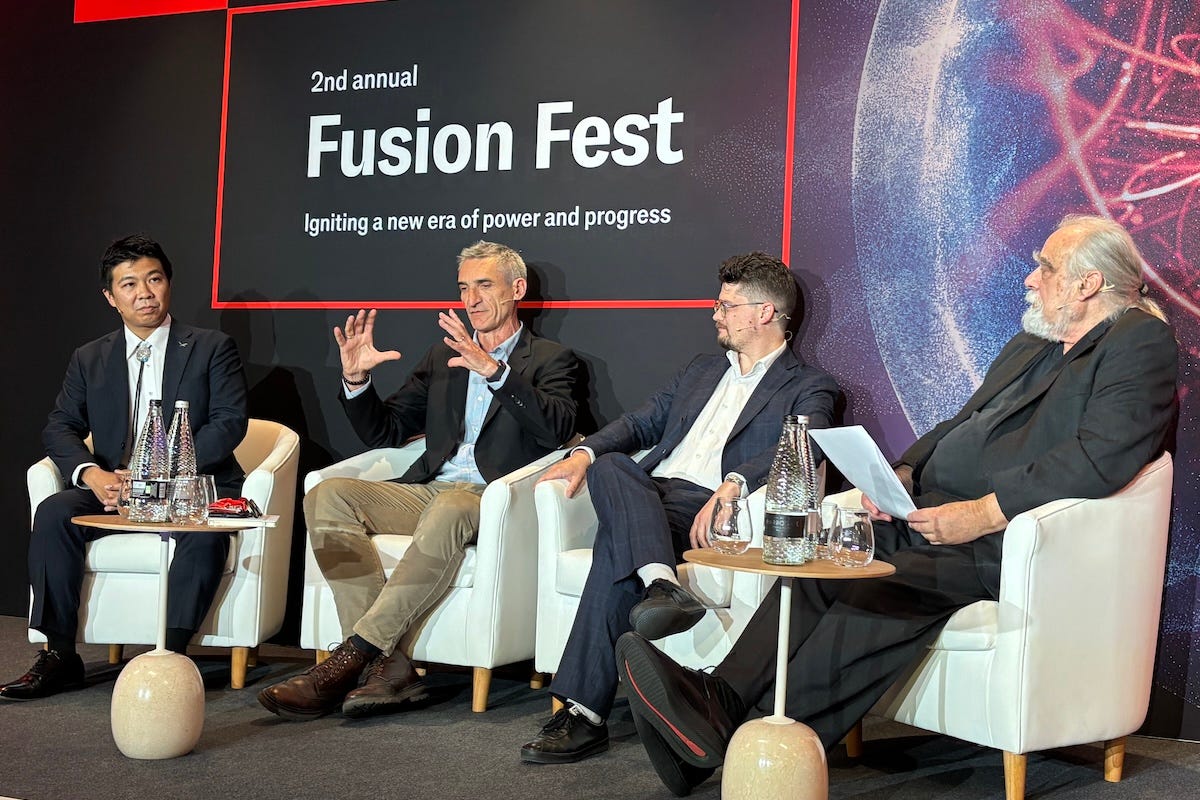
The discussion took place during Fusion Fest, organized by Economist Impact, in London. The session was moderated by Geoffrey Carr, senior editor for science and technology at The Economist. It examined whether fusion remains dominated by tokamaks or is evolving into a broader field of competing technologies.
Beyond reactor physics, the panelists repeatedly returned to engineering execution, manufacturing and industrial scalability as the industry’s defining challenges.
“It’s not that much a question about science, per se, but more about engineering excellence of execution,” Guilaumé said. “You have to understand the whole equation, from sourcing critical materials all the way to building your machine and thinking about maintenance and operation.”
Renaissance Fusion’s development model relies heavily on rapid iteration. The company continuously builds, tests and improves systems while using engineering milestones to strengthen credibility with investors and industrial partners.
“We keep on improving. Six months from now, we will have done this and this and this, and a year from now this is where we will be,” Guilaumé said. “We gain credibility as we execute, we build, we test, we learn and we improve.”
The panel also discussed how artificial intelligence (AI) and growing computing power are accelerating development across multiple fusion architectures.
“Less conventional designs are made feasible and realistic today because of advances in science and processing power,” he said. “The path to having a realistic concept is shorter nowadays because of all these tools.”
However, the speakers cautioned against overstating AI’s role in solving plasma physics itself.
“AI, for us, is not helping us figure out the plasma,” Mataira said. “But fusion is such a dramatic undertaking. The ability to bring people up to speed and embed institutional knowledge into AI could dramatically help us scale organizations.”
Fusion startups face major operational challenges as they rapidly expand engineering teams. Embedding technical workflows and institutional knowledge into AI systems could reduce onboarding time and help firms scale more efficiently.
The speakers also suggested that some of fusion’s remaining bottlenecks are shifting away from superconductors and toward mechanical engineering and industrial manufacturing.
The remaining bottlenecks increasingly involve structural materials, machine simplicity and maintainability rather than magnetic performance alone. Mataira said high-temperature superconductors (HTS) have matured significantly in recent years.
Revenue before ignition
The panelists said many fusion startups are now pursuing dual-use commercial strategies designed to generate revenue before grid-scale fusion systems become operational.
“There’s a strategic avenue for revenue generation in a meaningful way at such an early-stage company,” Masuda said. “Our plasma-gun technology has an immediate aerospace and defense use case for testing materials.”
Liberty Fusion does not intend to become a defense company, but sees adjacent industrial applications as a way to finance long-term fusion development.
Renaissance Fusion is also building a parallel business around HTS tape production. HTS materials are increasingly viewed as strategically important for magnetic-confinement fusion systems and advanced-energy infrastructure more broadly.
“We provide a tremendous return on investment for investors and also very short-term revenue,” Guilaumé said. “We are becoming a critical supplier for high-temperature superconductors in the fusion industry.”
The panel also explored changing public attitudes toward nuclear technologies as geopolitical tensions and energy-security concerns intensify.
Mataira said the public primarily wants transparent engagement and respectful discussions around fusion technologies. He said concerns about nuclear energy often become more manageable when companies openly explain safety issues and the differences between fusion and fission.
Public acceptance of nuclear technologies has improved in Europe amid rising electricity costs and energy-security concerns. Guilaumé said tensions around the Strait of Hormuz could have a lasting impact on energy and electricity markets.
“Fusion is dramatically different from fission when it comes to waste and risks,” Guilaumé said. “The acceptance of nuclear is improving.”
Despite the growing number of fusion startups, the speakers said no single technological winner has yet emerged.
“There’s no clear winner per se,” Masuda said. “There are clearly better-funded companies that have advanced their science and technology milestones, but that does not mean they are the definitive winner.”
The panelists said collaboration across supply chains, enabling technologies and industrial manufacturing will likely become increasingly important as fusion companies move from laboratory systems toward commercial deployment.