


Fusion energy has long been sold on its promise: clean, limitless and too important to fail. But as artificial intelligence (AI) reshapes the global power market and data center operators hunt for cheap, reliable electrons, the fusion industry faces a harder question: can it compete on price?
The answer, according to one of the sector’s leading figures, is that it must. Fusion cannot afford to trade on its novelty or its environmental credentials alone. It will have to earn its place in the energy mix the same way every other technology does, by matching the prevailing benchmark.
“We can’t expect to get a premium for fusion because it’s special. A data center provider wants green, firm, cheap electrons — end of the day,” said Warrick Matthews, chief executive of Tokamak Energy. “The industry can’t expect to pay a premium cost just because it’s special.”
Matthews said fusion should aspire to power data centers directly behind the meter via DC transmission, which he described as highly efficient. Near-term commercial opportunities also include industrial heat and other settings suited to dispatchable baseload power, but AI data centers represent the “gold medal, aspirational” end use for the technology.
The pricing challenge is stark. Lazard, a global financial advisory firm known for its annual analysis of energy costs, and the International Energy Agency (IEA) both identify solar-plus-batteries as the cheapest power source in most markets today. Combined-cycle gas plants offer another clean and firm alternative. Any fusion plant seeking broad commercial contracts will have to meet that benchmark.
Keith Strier, senior vice president of global AI markets at AMD, said the picture is more nuanced than a single price point.
“If you’re building an AI data center campus and trying to land the biggest buyers in the world — from ByteDance in China to Google in the US — the cost of electricity matters,” he said. “But if you’re building a bunker data center for national security purposes, the cost of energy doesn’t really matter.”
There are roughly only 10 major companies globally that serve as anchor buyers for large AI data center campuses. Government and national security facilities represent an early, price-insensitive market where fusion could gain a commercial foothold before competing at scale.
But industry experts’ broader consensus was clear: fusion must ultimately reach price parity with the levelized cost of energy (LCOE) benchmark, the standard metric used by Lazard and the IEA to compare power sources, to achieve wider relevance.
Tokamak Energy, backed by private investors, has been developing compact fusion reactors and high-temperature superconducting magnet systems for over a decade and is among the leading private fusion ventures in the UK.
Superconductors in the rack
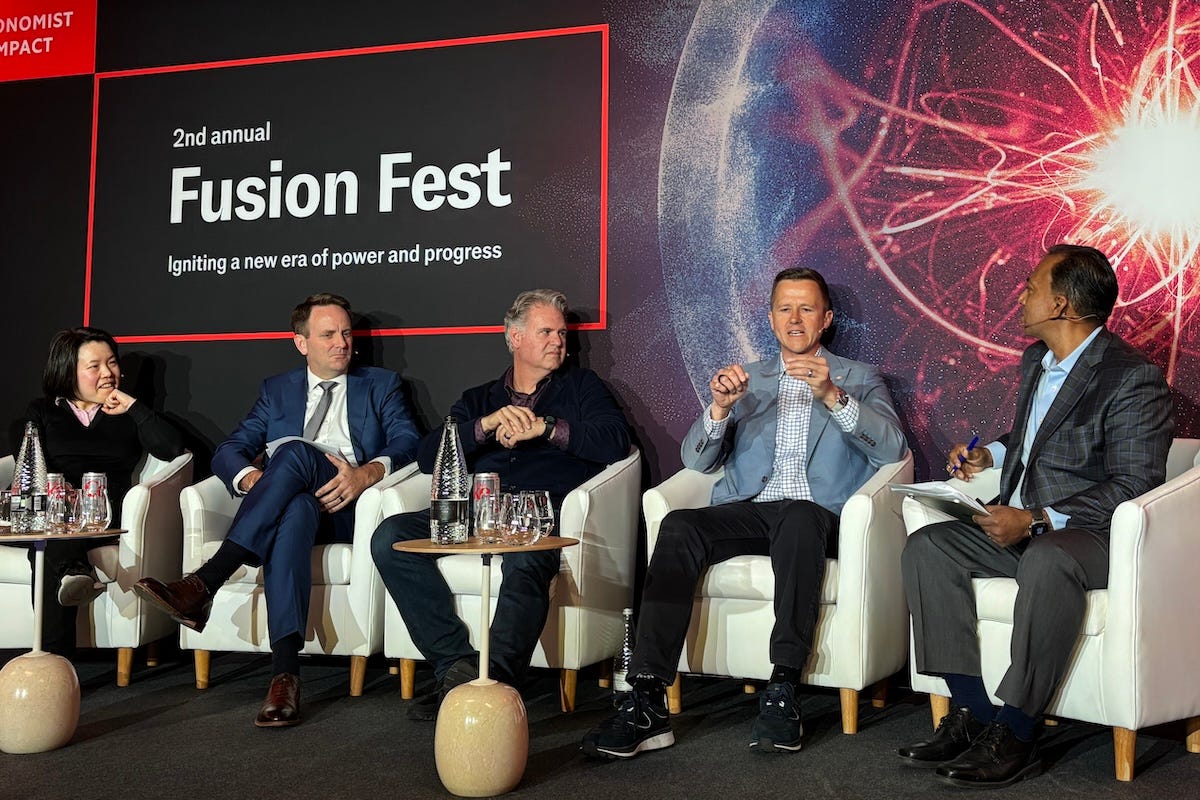
The discussion took place at Fusion Fest in London, an event organized by Economist Impact. The panel, titled “Plasma, predictions and power: how might fusion help ease AI’s energy crunch?”, was moderated by Vijay Vaitheeswaran, global energy and climate innovation editor at The Economist.
The other panelists were Strier, Luke Murry, head of government affairs at Marvell Technology, and Wendy Ng, an AI futurist.
Matthews used the session to announce that Tokamak Energy has been selected as the magnet system provider for the UK’s STEP (Spherical Tokamak for Energy Production) program, the government-backed initiative to build the country’s first fusion power plant. The selection marks the company’s transition from a research-and-development outfit to a commercial supplier.
“We’ve gone from identifying 30 challenges of why this was perceived to be unworkable, solved those, and become experts in high-field magnet systems,” he said. “Tokamak Energy has been selected as the magnet system provider for the UK STEP program — that is huge for us, commercializing an R&D endeavor into an actual commercial business.”
The technology at the heart of both the fusion program and a growing data center opportunity is high-temperature superconductor (HTS) tape, which Matthews held up during the panel. Embedded within it is a layer of rare earth barium copper oxide just two microns thick, roughly 2% of the width of a human hair, capable of carrying thousands of amps of current with near-zero resistance.
“When you have to deliver one megawatt of energy into a rack in 2028, you have to move away from copper,” Matthews said. “You have multiple power density challenges, copper availability challenges, heat challenges — and superconductors will solve that.”
HTS materials could allow data centers to use up to 99% less copper while delivering 10% more compute per watt. Microsoft and other major technology companies are already calling on the industry to develop superconducting infrastructure for data centers.
Tokamak Energy has developed prototypes of busbars, transformers and switchgear using HTS materials and last September acquired Leicester-based Ridgway Machines, which Matthews described as the world’s best manufacturer of superconducting cable-winding machines.
Strier underlined the significance of the megawatt-per-rack milestone.
“Twenty years ago, one megawatt was a data center — you spent years getting permits and raising money to build one,” he said. “Now we’re working towards a megawatt in a single rack. A single rack is a supercomputer today.”
Ng said the convergence of fusion, quantum computing and AI could prove more transformative than any previous technology wave.
“In 10 years’ time, we will not recognize society if those three work well together,” she said. “It’s bigger than the internet in terms of productivity gains.”
Strier agreed, noting that AI is already being applied to fusion research, a point reinforced by a Google DeepMind presentation earlier in the day, and that grid-level fusion energy may arrive sooner than widely expected as a result.
Timelines and trillions
Murry provided some of the starkest figures on the demand side. In 2017, data centers accounted for roughly 2% of US energy consumption.
“That had doubled by 2023 — and in just two more years, it’s expected to maybe even triple, to 12% of US energy consumption,” he said.
Marvell sends 75% of its chips to AI data centers and is producing at three-nanometer, with plans to move to two-nanometer fabrication. The politics of AI energy use is becoming an increasingly prominent issue in the US alongside concerns about safety and jobs, he added.
Strier said AI demand should not be viewed as a single, monolithic force.
“From Guyana to Vietnam, there isn’t a country in the world — whether a wealthy OECD nation or not — that isn’t planning, permitting or already breaking ground on multi-gigawatt data centers,” he said, adding that models are also getting smaller as well as larger, and that hardware efficiency is advancing rapidly.
Ten years ago, the most powerful computer in the world had 80,000 processors, comparable to what a single server with a few GPUs can deliver today.
Vaitheeswaran drew a parallel with the early internet, recalling predictions that it would require burning “infinite quantities of coal” to power, a forecast undone by efficiency gains and market dynamics.
The IEA projects that the rate of electrification growth over the next five years will be roughly twice the overall rate of energy consumption growth globally, driven primarily by air conditioning, economic growth and transport electrification in the developing world.
An informal audience vote at the event asked when fusion would be commercially competitive with solar-plus-batteries: most attendees chose either 10 or 20 years; only one person voted “never.”
Murry said the $10–12 billion invested globally in fusion to date is insufficient and could cripple the sector if delivery timelines slip. He called for more government funding for basic research, particularly to sustain high-burning plasma and to develop components that can withstand extreme radiation and heat. He said the US could easily commit $10 billion to such work and still find more that needs to be spent.
Ng said a global unified strategy for energy technology is unrealistic but not necessarily undesirable.
“A global unified strategy — I can’t see that happening. But that’s not necessarily a bad thing, because it allows regions the freedom to do what is most beneficial to them and the technologies they can develop,” she said.
Regional specialization may ultimately prove a faster path to the clean, firm power that both the AI economy and the climate will demand. Fusion, if it meets the price, could yet play a central role.