


The fusion industry’s biggest financing obstacle is not a shortage of capital but a shortage of proof. Insurers and lenders will not back a first-of-a-kind power plant until someone has shown, in hardware rather than theory, that the technology behaves as promised.
That distinction between science risk and engineering risk is reshaping how developers court financiers. Banks are drawing a sharp line between backing the companies building fusion technology and backing the projects that will eventually generate power, and only one of those two categories is ready for debt.
Chris Mowry, chief executive officer of Type One Energy, said that bar is different from the demonstrations fusion has already delivered.
A test that proves fusion happens, such as the laser-driven ignition achieved at the US National Ignition Facility (NIF), is not the same as proving a specific reactor design can run reliably inside a power plant.
“What insurance and finance need to see is technology demonstration, something close enough to what you’re actually going to do in a power plant that you can say the technology risk is bounded and therefore you can price it,” he said. “If you can’t do that, you can’t get insurance, and without insurance, you’re not going to get it financed.”
Financiers apply a similar distinction from the banking side. Iain Smedley, global chairman of banking at Barclays, said equity investors already back early-stage fusion developers, but debt financing, the kind needed to build an actual plant, will not arrive until a technology has moved past a single successful attempt.
“You have to differentiate between equity finance and the debt finance we need for projects,” he said. “You need to have got beyond first-of-a-kind for it to be structured in a way that finance will be there, without explicit backstops from government, because until you’ve got there, you’re not going to get the insurance market behind a true first-of-a-kind.”
Financing challenges are seen as largely a product of the underlying technical, engineering and business hurdles the industry still faces, rather than a shortcoming in the finance industry itself.
He said the market’s next signal to watch would be another major funding round for a fusion developer.
“I’d like to see another landmark capital raise in the equity markets for a fusion player, and I suppose the most likely place for that is in the US. But I wouldn’t mind seeing an equivalent investment here,” he said.
Both bankers and developers agreed that closing that gap means shifting risk away from untested parts of a project and toward participants with a track record.
A financeable blueprint
The comments came at the UK Fusion Forum 2026 in London on September 15, organized by the Fusion Industry Association.
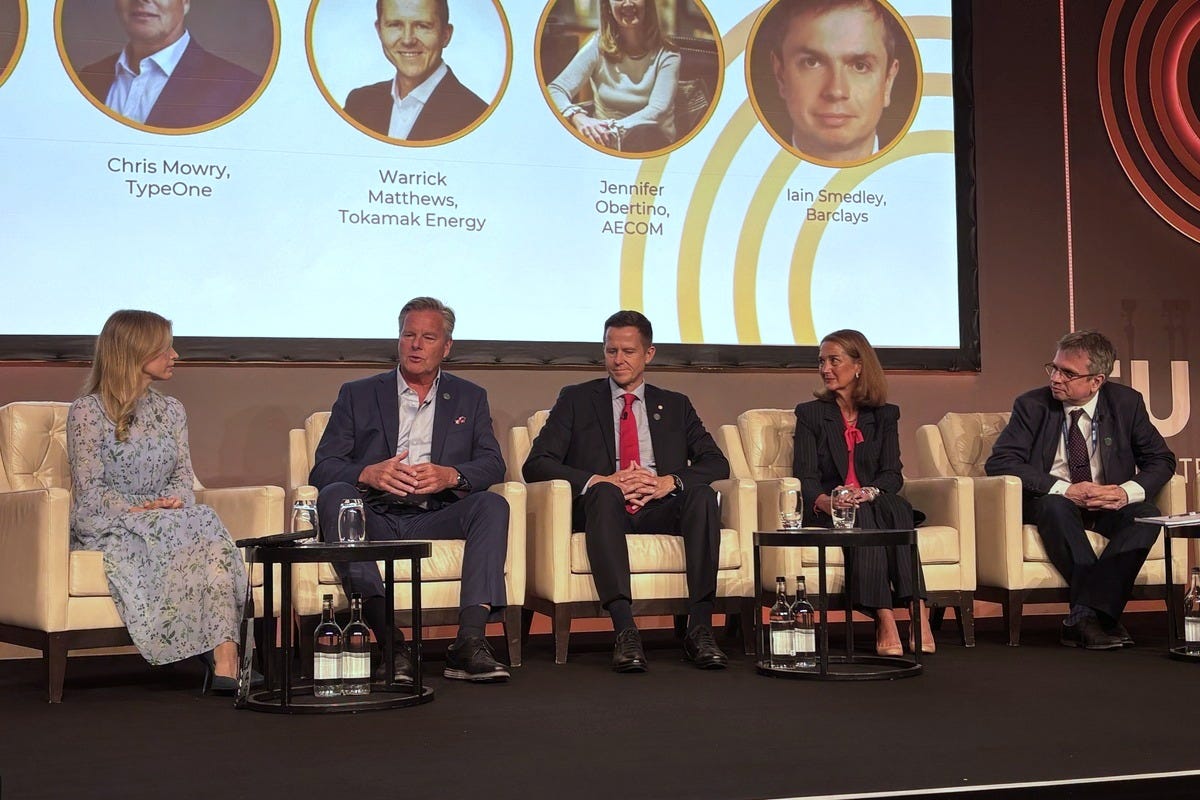
The panel, moderated by Jennifer Jordan-Saifi, chief executive officer of the Sustainable Markets Initiative, examined how the UK Infinity Fusion Consortium plans to fund and build a commercial fusion power plant.
The consortium was formed by Type One Energy, Tokamak Energy and AECOM to combine an American reactor design with British and American engineering and manufacturing capacity. It centers on Project Infinity, a planned commercial plant in Tennessee that the Tennessee Valley Authority (TVA) will operate.
Mowry said the consortium is designed to remove risk layer by layer rather than ask investors to underwrite an unproven project outright.
“Having TVA as an operator effectively takes operating risk off the table, and having confidence that you have an operator with the experience, the capabilities and the track record adds comfort to anybody thinking about putting equity into a project,” he said.
Warrick Matthews, chief executive officer of Tokamak Energy, said the company has shifted its own strategy to fit that model. Rather than building its own plants, Tokamak Energy now focuses on high-temperature superconducting magnet technology and supplies magnet systems to programs including the UK government’s STEP (Spherical Tokamak for Energy Production) program.
“Ridgway makes machines that wind the cables and wind the magnets, and if you are anchoring that order book, there are different financing routes open to you,” he said. “When you have that certainty of demand, you can move into debt financing and project financing.”
Jennifer Obertino, global energy practice leader at AECOM, said the firm’s role is to make the design scalable rather than bespoke to one site.
“Type One is advancing the technology, and with the agreement they have with TVA, they are a fantastic partner,” she said. “We’re able to bring the engineering and the power plant design, the civil site, to make this a scalable technology we can take from the US to the UK.”
Panelists said interest from artificial intelligence (AI) data center operators is beginning to change how that financing case gets made.
“We saw it just last week, the Finnish utility announced a deal with Google for a large-scale power purchase agreement, and the share price went up 10% on the day,” Smedley said.
Mowry said hyperscale companies are almost uniquely positioned to pay first-of-a-kind electricity prices because their profit margins are large enough to absorb the premium, though they have historically planned only 18 to 24 months ahead.
“It’s easy to get an offtake agreement that’s just a piece of paper, but something with real teeth requires a belief that you have a pathway to deployment, partly from the technology side and partly from the supply chain,” he said.
Educating the market
Smedley said much of the caution around fission is misplaced when applied to fusion. He said the risks investors actually worry about in fission projects are civil engineering and construction risk, plus the risk of policy reversal, rather than anything specific to nuclear technology itself.
“A lot of the risk people worry about with fission isn’t really nuclear technology risk. The risks we spend a lot of time on are fundamentally civil engineering and construction risk, along with risk from government policy change and discontinuation,” he said.
Mowry drew the same line from the developer side.
“If this were nuclear fission, we’d be having a very different conversation. You’re probably not able to finance a first-of-a-kind fission project without a significant government backstop, because of nuclear liability and a track record of construction delays driven by regulation,” he said.
Both said closing that understanding gap, for insurers, investors and the public alike, would happen faster once fusion has a small number of working projects to point to rather than more explanation.
Matthews framed the stakes more broadly.
“When you look at what’s going on around the world, most of the common denominators of conflict are energy,” he said. “The biggest prize is not just that we need more baseload dispatchable power, but the role this plays in a more peaceful world by democratizing power-dense systems for electrification.”
Mowry pushed back on comparing fusion’s moment to the rise of SpaceX, a parallel raised earlier in the discussion.
“SpaceX isn’t necessarily a good analogy. They didn’t invent the product, and there was zero science risk in getting into space. They put together a system as an integrator, but in the way fusion is first-of-a-kind, that’s not a good reference case for what we’re trying to do,” he said.
Matthews said the industry is moving away from developers trying to build every component themselves.
“Type One is leading in that system-level thinking as a private company, on the public-private partnerships,” he said. “You can’t be vertically integrated to do something this hard perfectly across all the technologies, so you want the best system provider for magnets, diagnostics, and a big engineering company to help put it together.”
Obertino said the model also depends on identifying an operator and an end customer early in the process, rather than treating those roles as afterthoughts once the technology itself is settled.
“It’s bringing in who is going to operate and who is going to be the end client, making sure what we’re designing is able to be utilized and will, at some point, be one of the cheapest options,” she said.
The next test comes as the Tennessee project moves toward construction, with the UK consortium aiming to repeat the model at home.