


Carbon data is no longer just a compliance exercise. It is increasingly being positioned as a real-time decision tool that can influence procurement, pricing and risk management across global supply chains.
That shift is forcing companies to rethink how they collect and use emissions data. Instead of relying on backward-looking reports, executives are under pressure to integrate carbon metrics directly into operational workflows, where decisions are made daily.
“We use artificial intelligence (AI) to make the output in real time. Instead of just having a report after the fact, our platform enables decisions in real time,” said Mattias Brodendal, co-founder and chief executive of Simple, an AI-powered carbon data platform. “We don’t use AI for the reporting. We use it for the data, to save time and raise the quality, and by doing it in real time, enable decision-making.”
The shift reflects a broader move away from treating emissions data as a static reporting requirement.
“We move beyond reporting and actually offer data you can base decisions on. We always connect the carbon data with the financial data, so you can see both the financial impact and the carbon impact,” Brodendal said.
Traditional sustainability workflows are largely retrospective. Companies typically receive emissions insights only after reporting cycles are complete, limiting their ability to act on the data. In contrast, integrating emissions into procurement decisions allows firms to compare suppliers based on both cost and environmental impact at the point of purchase.
Brodendal said high carbon intensity should increasingly be viewed as a financial risk indicator. Companies with energy-heavy supply chains may face rising costs and regulatory pressure, making carbon data a forward-looking metric rather than a historical one.
Simple, founded in 2025 and headquartered in Sweden and Austria, positions itself as a data intelligence platform that structures emissions data from existing enterprise systems. The company focuses on transforming raw transactional data into actionable insights that can be used across finance, procurement and sustainability functions.
Data bottlenecks
Brodendal told TechJournal.uk in an interview that artificial intelligence (AI) is being applied to address structural inefficiencies in sustainability data. The discussion focused on enterprise adoption, regulatory pressures and the technical challenges of emissions tracking, particularly in Europe.
“There are three major blockings in this climate world. One is time, another is data quality, and the third is the output. A lot of time goes to data collection, and we use AI to use data already existing, so we really speed up the time,” Brodendal said.
Sustainability teams often rely on fragmented processes, including spreadsheets, supplier questionnaires and manual data aggregation. Around 70% of effort is spent collecting data rather than analyzing it, creating bottlenecks that slow down reporting and reduce efficiency.

“Today it’s heavily based on estimates. If you use AI correctly, you can raise the quality,” Brodendal said. The reliance on estimated data, often derived from industry averages, can lead to inconsistent results that do not reflect actual operational activity.
He added that the output of traditional systems is typically static. Reports are generated periodically and offer limited value for real-time decision-making. By contrast, AI-driven systems can generate continuous insights, allowing companies to respond more quickly to changes in supply chains and market conditions.
The Greenhouse Gas Protocol (GHG Protocol), created by the World Resources Institute and the World Business Council for Sustainable Development, is the leading global standard for measuring and reporting emissions. It gives companies and governments a clear framework to track emissions across operations and supply chains.
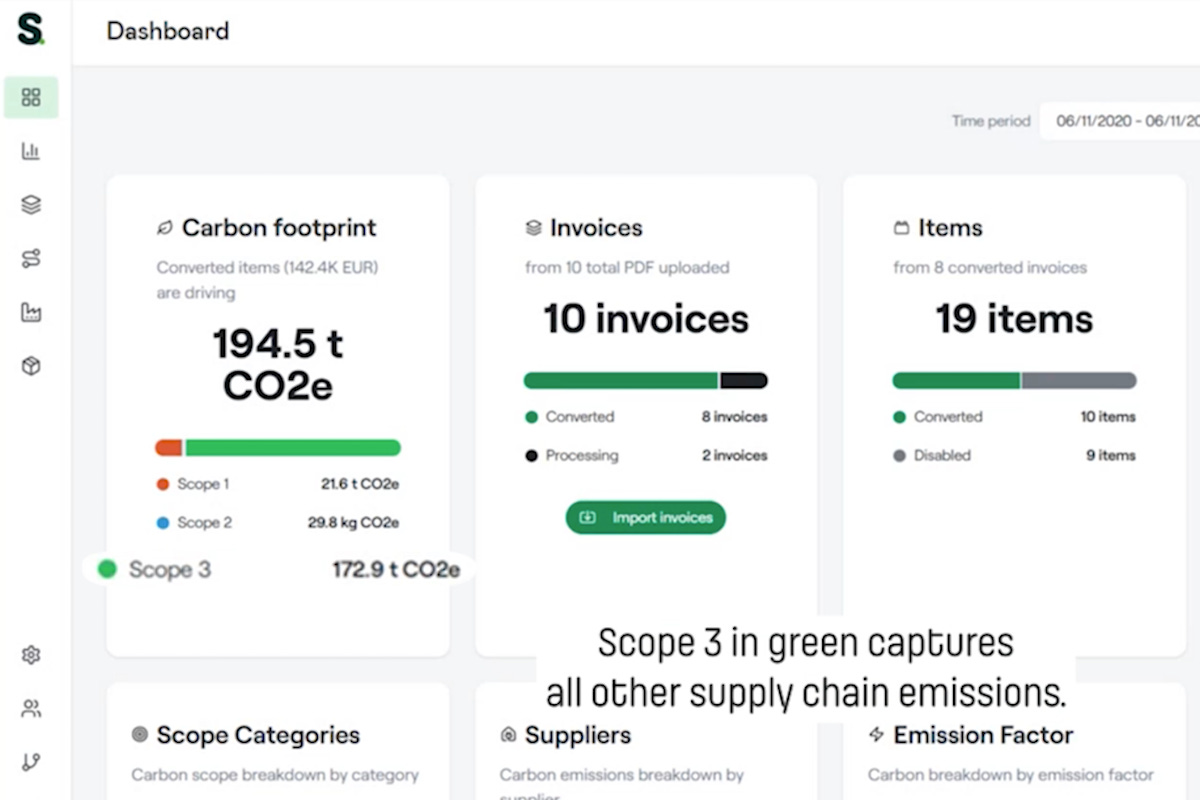
Scope emissions are typically divided into three categories:
Scope 1: Direct emissions from owned operations, such as fuel use
Scope 2: Indirect emissions from purchased energy, including electricity, heating and cooling
Scope 3: All other indirect emissions across the value chain, including suppliers, logistics and product usage
“Scope three is everything else in your value chain, and for most companies it is about 90% of their emissions,” Brodendal said. “The traditional way is that you ask suppliers for a lot of data, and the quality is sometimes good, sometimes bad, and it takes a lot of time.”
Companies have traditionally relied on supplier disclosures to estimate Scope 3 emissions. This approach is time-consuming and often produces inconsistent data, as suppliers may use different methodologies or provide incomplete information.
Brodendal said an alternative approach is to bypass supplier questionnaires and instead extract insights from existing internal data. Regulatory frameworks such as the Corporate Sustainability Reporting Directive (CSRD) are increasing pressure on companies to improve the accuracy and transparency of their emissions reporting.
Accounting shift
Spend-based carbon accounting is under scrutiny and breaking down. Tying emissions to financial outlay creates volatility that has little to do with physical reality.
“Even though companies spend a lot of time collecting data, the output is heavily estimated. If you’re a good negotiator or inflation goes up, your emissions in that system actually go up and down,” Brodendal said.
In practice, this distorts decision-making. Price changes, discounts or currency swings can move reported emissions without any change in materials, logistics or energy use. The result is a metric that is difficult to operationalize and harder to trust.
Activity-based accounting addresses this gap by linking emissions to what is actually purchased—quantities, materials and transport—rather than what is paid. That shift turns carbon from a proxy into a measurable operating variable.
At the core is invoice-level processing. Invoices provide the most reliable record of economic activity and, when structured correctly, the most scalable entry point for emissions analysis.
“We extract and break down invoice data, then interpret it and fill data gaps with AI. We take the financial data and the carbon data, and we match them, line by line, per article, per supplier,” Brodendal said.
The workflow is straightforward but demanding at scale:
Extract and normalize line-item data from invoices and ERP systems
Infer missing attributes such as weight or composition
Match each line item to validated emissions datasets
Output combined financial and carbon metrics at the transaction level
He said this produces a decision-grade dataset that can be used across procurement, finance and sustainability teams. Buyers can compare suppliers on cost and carbon intensity at the point of purchase, rather than after the fact.
Commercially, the company is prioritizing adoption over rapid expansion. The immediate objective is to embed the data layer within existing enterprise workflows and demonstrate repeatable value across use cases.
“Right now, the focus is to get more clients and let them know we exist and that we can be the data layer they are looking for,” Brodendal said. “We think this is a global problem that should be tackled globally, but we focus more on regions where we have a physical presence.”
Initial traction is concentrated in Europe, particularly in the Nordics and German-speaking markets, with a parallel push into Asia from a base in Thailand. Engagement spans large enterprises and smaller firms, reflecting the broad applicability of supply-chain emissions data.
As regulatory pressure intensifies and energy costs remain volatile, carbon data is moving from disclosure to control. The organizations that operationalize it earliest are likely to set the pace on both cost efficiency and compliance.