A Taiwanese manufacturing giant best known for assembling iPhones is closing in on its first working quantum computer.
A prototype is expected within the year, capping a five-year effort that began with theoretical study before hardware work started three years ago, when researchers chose ion traps over the more common superconducting qubit approach.
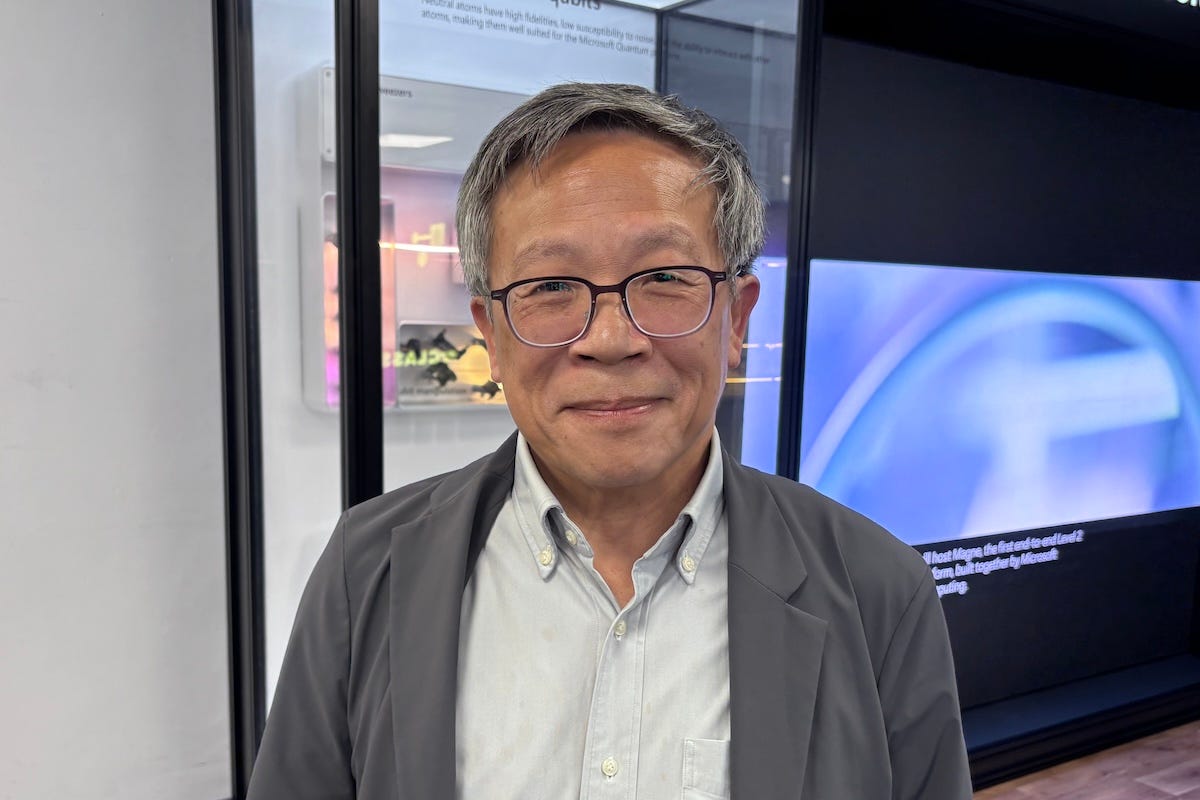
“Foxconn started this about five years ago. In the initial two years, they only did theoretical study and recruited people from around the world, but three years ago, they started building hardware,” Ching-Ray Chang, board director of Hon Hai Technology Group (Foxconn) and a professor at the Chung Yuan Christian University, told TechJournal.uk in an interview in London.
“Probably next year they will try to at least deliver the prototype,” he said. “Foxconn still needs to catch up. They are at a very initial stage, but this can operate.”
Foxconn’s Hon Hai Research Institute set up an Ion Trap Quantum Computing Laboratory, or IonLab, in late 2023, which lab director Guin-Dar Lin has called Taiwan’s first fully corporate-funded quantum research and development base.
The lab has laid out the program in three phases.
Short term, by 2027: build a universal ion-trap prototype with 5 to 10 qubits, meaning general-purpose hardware like a classical computer, programmable for many tasks. Too few qubits to solve practical problems.
Medium term: develop the technologies needed to scale up, moving from today’s 3D ion traps to 2D semiconductor-fabricated chips, plus ion-shuttling and integrated optical and electronic controls.
Long term: build stable, modular architectures supporting hundreds, thousands or even tens of thousands of qubits. Once mature, the lab will pursue fault-tolerant algorithms aimed at powering advances in AI, energy storage and pharmaceuticals.
Asked whether tightening US export controls could slow Taiwan’s quantum ambitions, Chang drew a direct comparison with the island’s semiconductor history.
“Fifty years ago, when Taiwan started building its own semiconductor industry, nothing was classified. Everyone shared knowledge with each other, though of course you had to pay for it,” he said. “Right now, even if you want to pay, sometimes you still cannot get the transfer. It’s a different situation.”
He said the shift is pushing countries toward self-sufficiency rather than collaboration.
“Every country is trying to build its own, because this is some kind of sovereignty issue,” Chang said. “They have probably learned a lot from the semiconductor industry. You need to control things yourself. You cannot rely on others.”
“Not only the patents, but also the production,” he said, when asked whether the concern extended beyond patents.
From years to days
Chang set out the case for quantum-assisted materials design in a keynote at the Commercialising Quantum Global 2026, an event organized by Economist Enterprise in London.
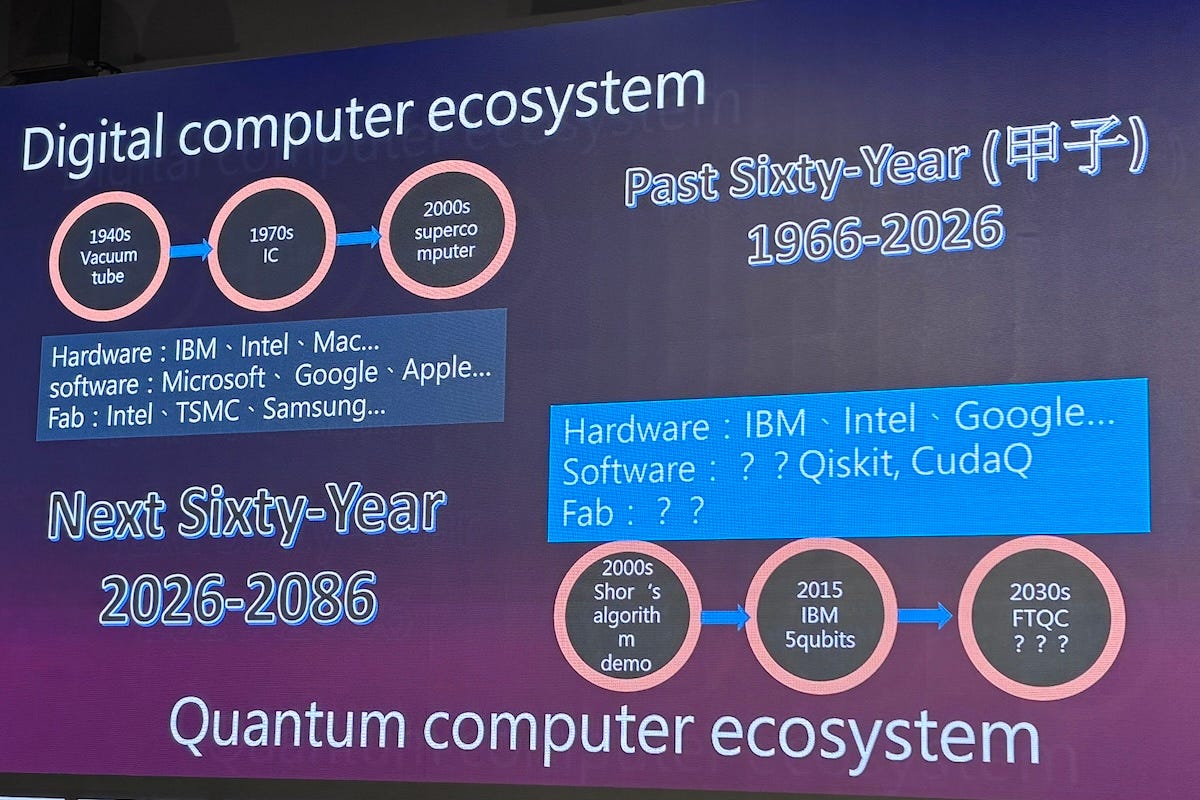
He framed the shift as a generational handover, pointing to a 60-year cycle that took computing from the 1940s vacuum tube through the 1970s integrated circuit to 2000s supercomputers, and predicting an equivalent buildout for quantum computing through 2086 and beyond.
“Materials shape the world,” Chang told the conference. “Before the 20th century we used trial and error, over years, to identify compounds. In the next 30 years we will probably use quantum and artificial intelligence (AI) combined to identify new materials.”
He said the limits of that trial-and-error approach still apply today, even with AI involved.
“Right now we use trial-and-error, whether by humans or by AI, and it takes far longer than we would like,” he said. “That’s why we have never been able to design good materials in time.”
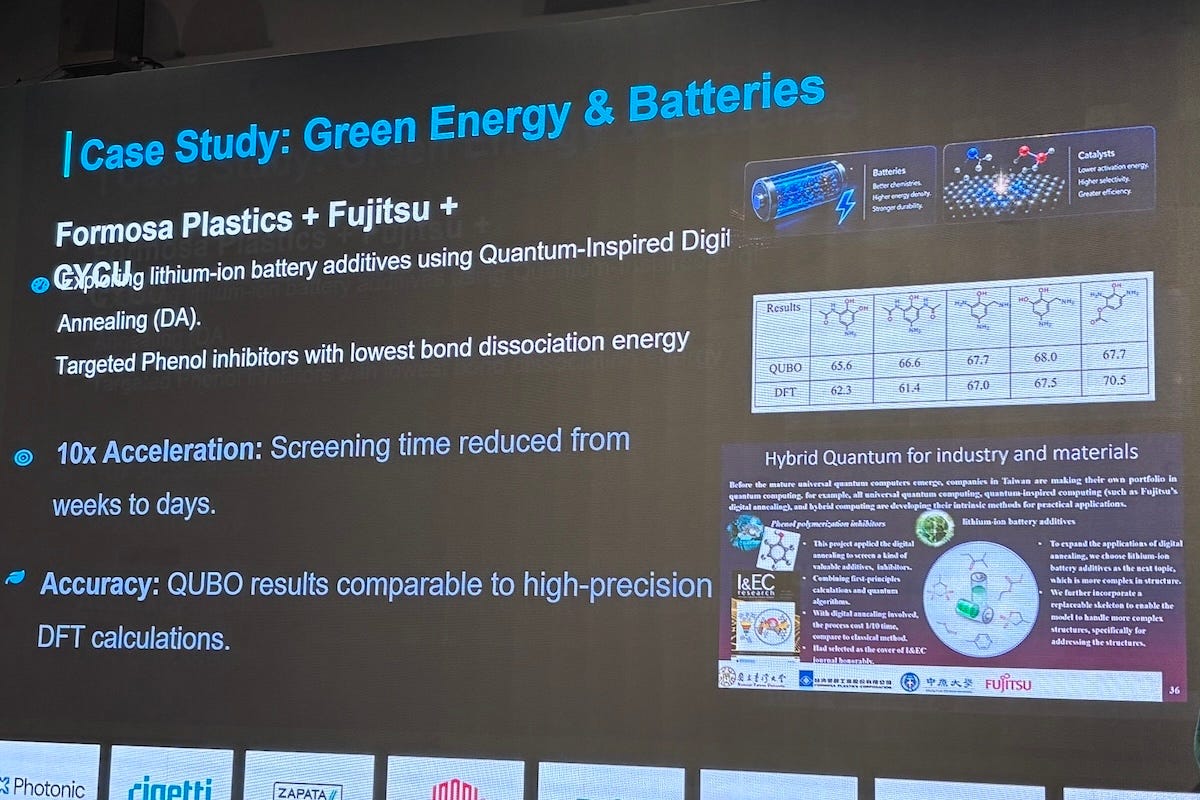
Chang pointed to a project with Formosa Plastics Corporation, Fujitsu and his own university.
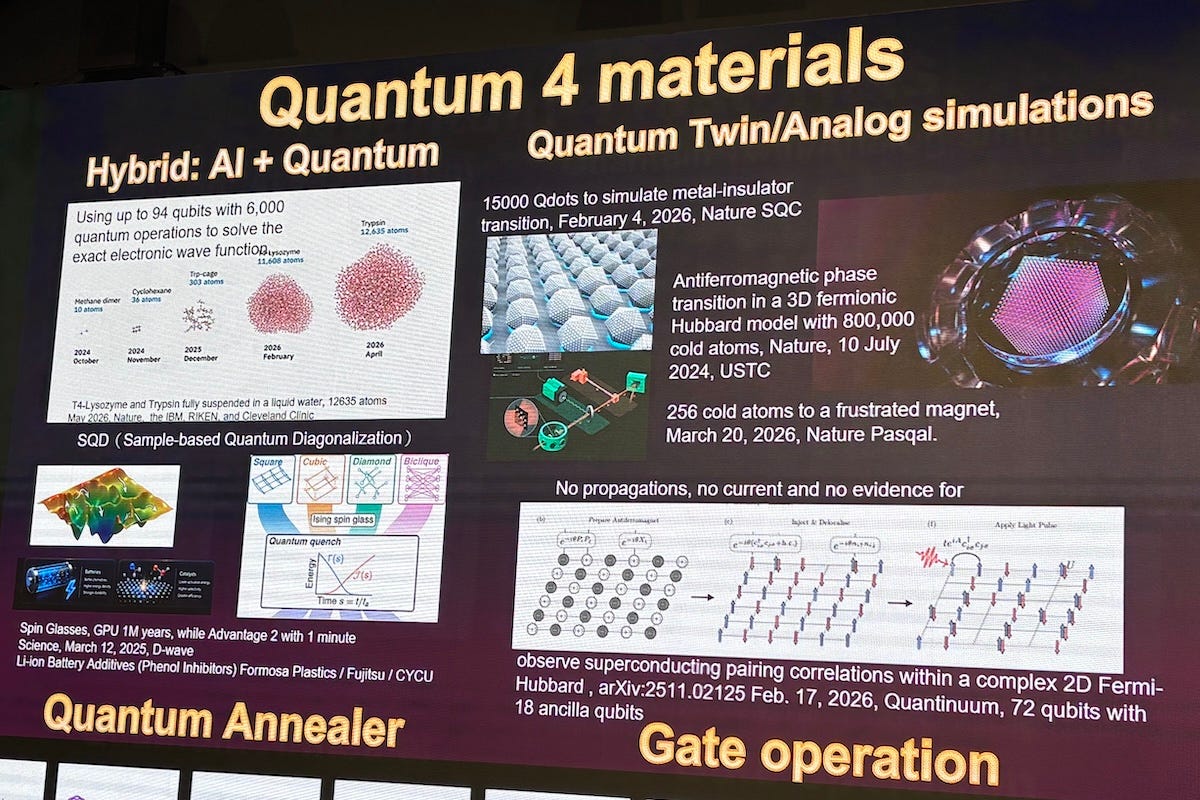
The team screened phenol-based inhibitors for lithium-ion battery additives, targeting compounds with the lowest bond dissociation energy, using quantum-inspired digital annealing rather than a full quantum computer.
Defining the problem took up to two years before the algorithm could be applied to the roughly 50 candidate compounds.
“If you calculate this the conventional, classical way, each combination takes about two or three hours, and finishing all the combinations could take six years,” Chang said. “After we used the algorithm to write the energy formula, we could gather the five lowest combinations almost instantly.”
Published results from the project put the acceleration at a more modest tenfold, cutting screening time from weeks to days, with accuracy comparable to high-precision quantum-chemistry calculations.
He pointed to examples from beyond his own team.
A collaboration involving IBM, RIKEN and the Cleveland Clinic used classical AI for protein analysis, a high-performance computer to fragment large molecules, and up to 94 qubits to calculate exact electronic wave functions, handling more than 6,000 quantum operations in the process.
The molecules simulated grew from a 10-atom methane dimer to a 12,635-atom protein in less than two years.
Separate groups have used similar analog approaches:
Silicon Quantum Computing (SQC) simulated a metal-insulator transition with more than 15,000 silicon quantum dots in February.
The University of Science and Technology of China (USTC) modeled an antiferromagnetic phase transition with 800,000 cold atoms.
The French firm Pasqal simulated a similar frustrated-magnet system with 256 cold atoms in March.
Quantinuum used 72 qubits and 18 additional ancilla qubits in a gate-based experiment published in February to observe pairing correlations linked to superconductivity, though without yet demonstrating a working current.
Chang said a more robust quantum computer would be needed to take the next step, potentially identifying a room-temperature superconductor.
Chang said rivals are moving faster on raw qubit counts than Foxconn.
“IonQ says that by 2030 they can have more than 80,000 logical qubits,” he said. “If that is true, I think the whole world will change.”
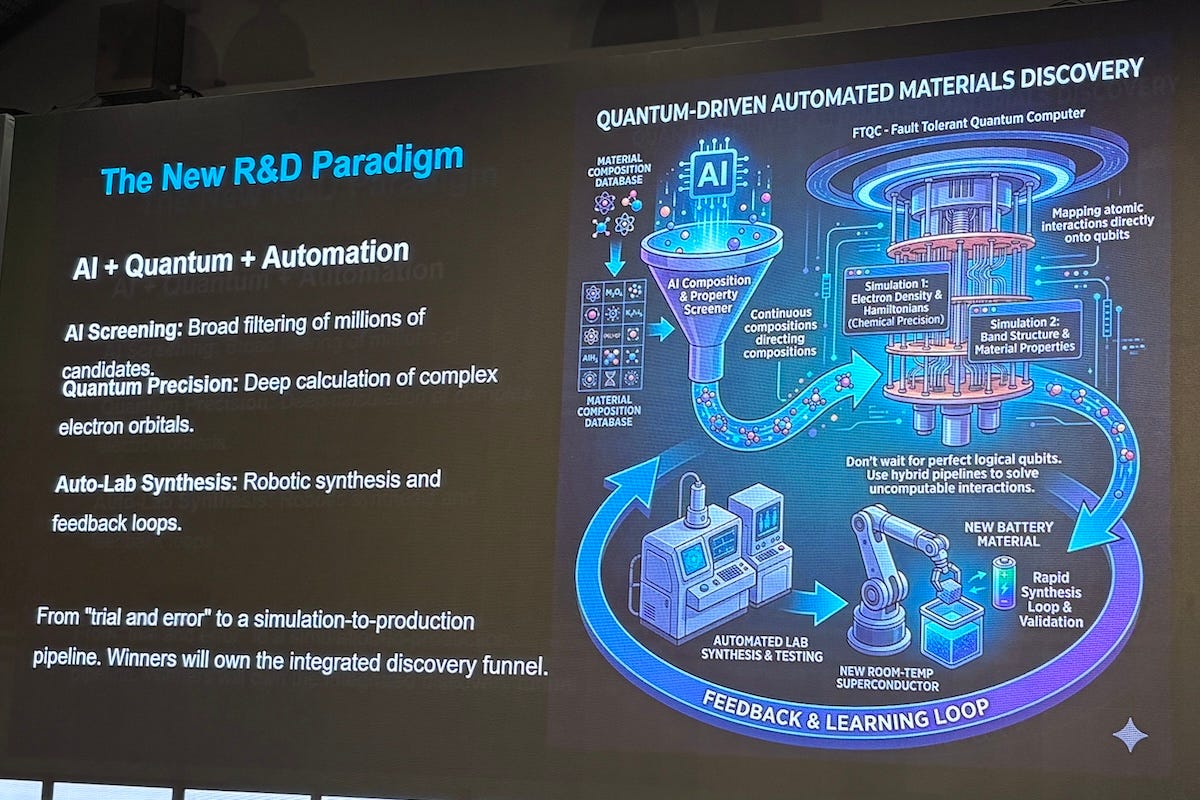
“In the future, this will definitely be the best way to design materials,” he said. “Use AI to screen down a large sample to a smaller set, use the quantum way to solve it exactly, then transfer the result to AI and robotics to run the automatic synthesis pipeline.”
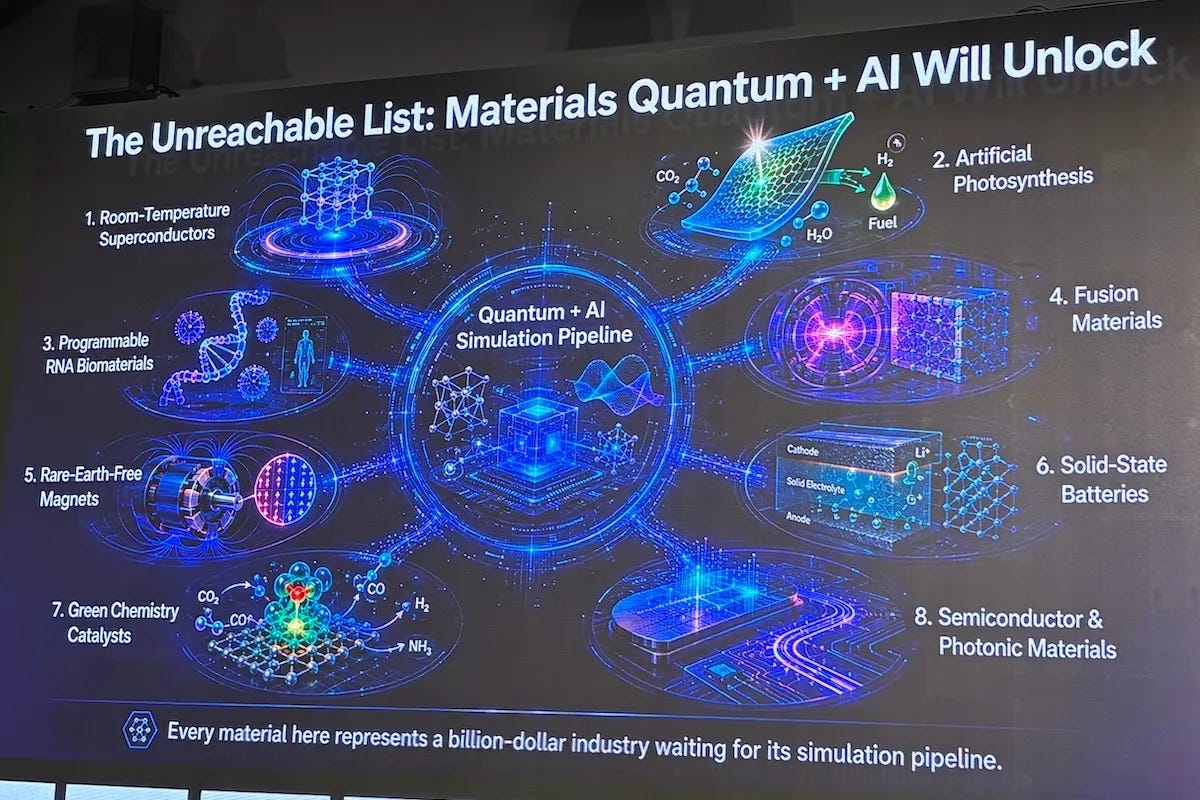
Chang listed the payoff on offer: room-temperature superconductors, programmable RNA biomaterials, rare-earth-free magnets, solid-state batteries, fusion reactor materials, and catalysts for green chemistry, artificial photosynthesis and next-generation semiconductors.
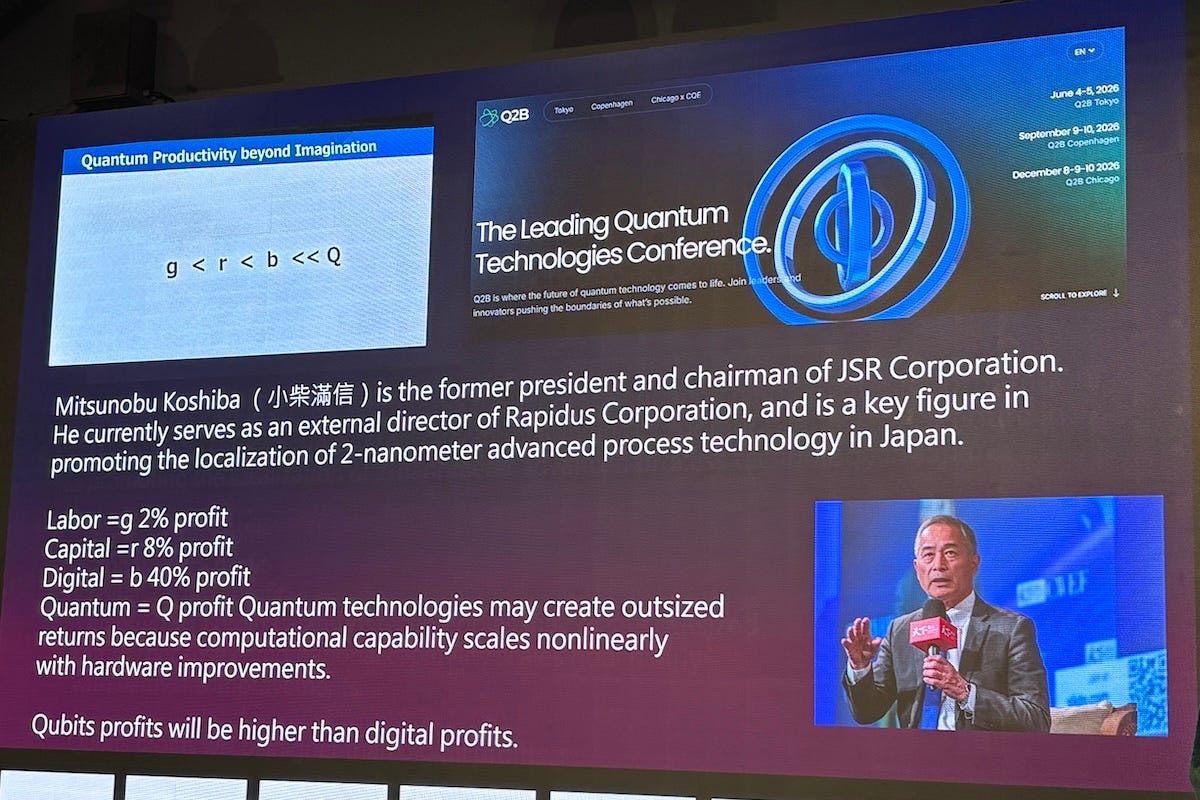
Chang illustrated the stakes with a comment from Mitsunobu Koshiba, former president and chairman of JSR Corporation and now an external director of Rapidus Corporation, who was speaking at the Q2B quantum technology conference in Tokyo on June 4.
Koshiba estimated that labor generates about 2% profit, capital about 8%, and digital technology as much as 40%. He said quantum computing could produce outsized returns, since computational power scales nonlinearly with hardware gains.
Racing on three fronts
Taiwan’s quantum push is running alongside its semiconductor strength, though the island’s small population is starting to show.
“Taiwan’s semiconductor industry is quite strong and we benefit a lot from that. Recently, AI has made Taiwan’s GDP grow very fast, but Taiwan doesn’t have a large population, so human resources are not enough right now,” Chang said.
“We developed quantum technology late, but in the last three years the research and development side really caught up quite fast,” Chang said. “In Taiwan, we are focusing on three tracks: superconducting qubits, trapped ions, which Foxconn is focused on, and photonic.”
He said Foxconn’s own interest in ion traps is tied to a specific commercial goal beyond research prestige. The company is trying to build an EV battery that is as safe and long-lasting as possible. Trial-and-error is not easy for finding the best material, so in-silico design is much better with the help of a quantum computer.
Foxconn has already published two projects toward that goal.
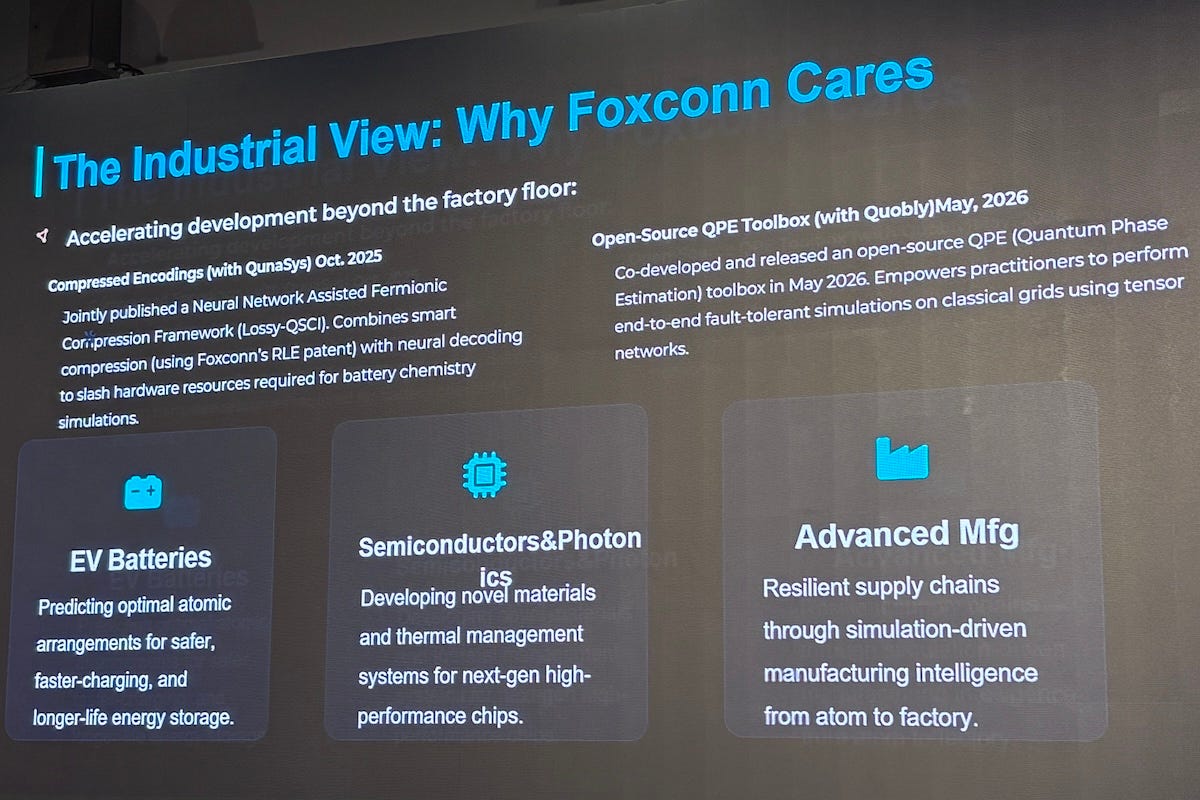
With QunaSys, it released a neural-network-assisted compression framework in October 2025 that uses one of Foxconn’s own patents to cut the hardware resources needed for battery chemistry simulations.
With Quobly, it released an open-source toolbox in May 2026 for quantum phase estimation.
The technique is aimed at running fault-tolerant simulations on classical computing grids using tensor networks, giving Foxconn a head start before its own ion-trap machine is ready.
Chang’s own standing in the field was recognized in December 2025, when he was named an honoree in the UN-backed Quantum 100 initiative. He has authored more than 280 academic papers and holds more than 28 patents.
He previously served as executive vice president and acting president of National Taiwan University, where he founded the NTU-IBM Quantum Hub and introduced quantum computing into its formal curriculum. He also set up the Quantum Information Center at Chung Yuan Christian University.